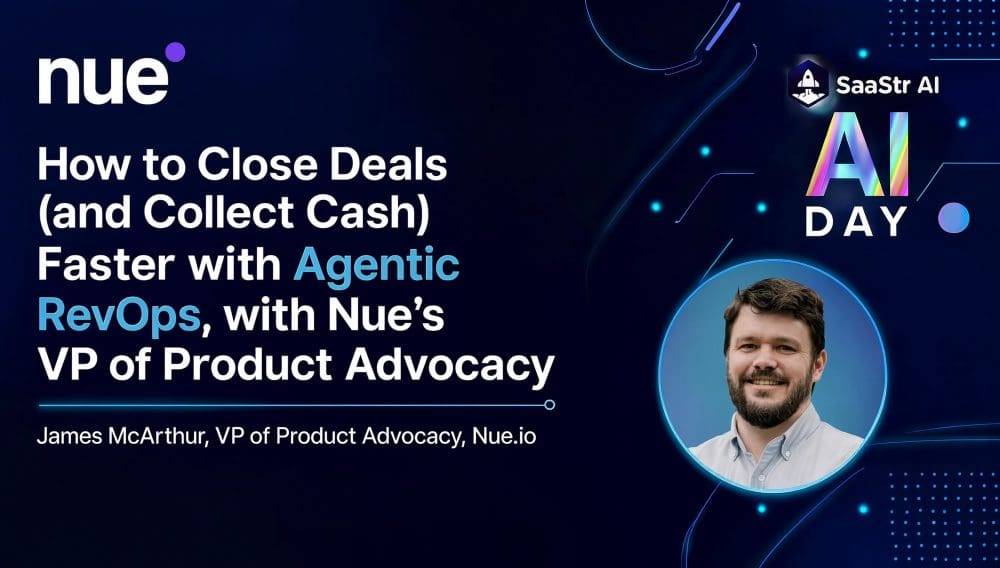
James McArthur, VP of Product Advocacy at Nue.io, ran a live demo at SaaStr AI Day this week and let the agent hit its limits on screen, on conference Wi-Fi, in front of everyone. That made it more useful than most vendor sessions.
The setup was familiar to any B2B revenue team. Reps spending days going back and forth on a single quote. Deal desk and RevOps rebuilding every closed deal by hand because finance won't accept what came out the other end. One of Nue's customers described the process to him as "a spreadsheet and a prayer."
Anyone who has been through a CPQ implementation has spent quarters encoding guided selling rules. McArthur built one live in about two minutes by describing it in plain English: show subscriptions up for renewal, check active subscriptions first, lock the price book to standard, set discount caps by tier, generate the quote PDF.
The system wrote those instructions into a markdown file and then went and validated them. It looked up the actual SKUs. It confirmed which tiers could be sold at what quantities. It set minimums and maximums, and tied the discount caps into the approvals engine.
The agent isn't producing a spec that a human then goes and implements. It's writing rules against the live product catalog and checking whether those rules are sellable.
When the playbook finished validating, it came back and said it could check auto-renewal status but could not directly access usage and consumption data. Nobody prompted that. Support ticketing was reachable, but only because MCP servers were connected, and the system distinguished between the two.
Most AI failures in revenue ops right now aren't models being dumb. They're models acting confidently on data they don't actually have. An agent that surfaces its own gap in a validation step is worth considerably more than one that drafts slightly better copy, because you can audit it.
McArthur played rep and asked for 150 units of a tier capped at 75. The system refused and made him make the call.
That's the argument for putting AI inside CPQ rather than beside it. A chat interface with no constraints just generates quotes finance will reject, faster than before. Same story on pricing: he asked for a 35% discount on a one-year deal, and the approval requirement surfaced inside the flow rather than after the quote had gone out. Those route through Approvals Pro, the approvals product Nue acquired last year, with routing to email or Slack and a full audit trail.
His argument: when an invoice has to be corrected, the quote was wrong or the order was wrong. Invoice failures are upstream process failures showing up weeks later in front of the customer.
Nue's answer is previewing every invoice across the full contract lifecycle at the moment of quoting, so you see what will be billed before anything gets signed. Worth running that test on your own stack regardless of vendor: count how many billing corrections you issued last quarter, and how many of them traced back to a quoting error.
Amelia Lerutte asked the question that came up repeatedly across the day: how much of this is human-reviewed at the start, and how much stays that way?
Her answer from running SaaStr's own agents was that everything went through a human at first because it's finance and you can't get it wrong, and the automation now runs with the agent flagging questions before it acts.
McArthur was blunter. If your finance team isn't involved, you're setting yourself up for failure. Nue pulls the CFO into initial discovery on every build, including CPQ-only builds where billing isn't in scope, on the theory that a disconnected quoting and billing system will send you the wrong direction no matter how good either half is. The catches are structural: approval rules on the back end that stop the AI when it heads somewhere it shouldn't.
Mid-flow, the agent created an opportunity with the wrong stage, caught the error itself, edited it, and kept going. Later a Stripe payment went through but the allocation didn't show up on refresh. McArthur's response: "Well, demos are demos. Live demos are even better."
An agent that detects and corrects its own bad write is doing something different from one that only executes, and seeing that happen live is better evidence than a slide claiming it. The second failure is a reminder that none of this is finished yet. Vendors who only demo the happy path are telling you less.
Asked how long setup takes, McArthur said the average is about 90 days, then immediately said it depends on the complexity of your product catalog and how good your data is, and that a year is easy to end up with. Their policy is good in, good out. Broken data produces a broken CPQ.
His advice to anyone starting a CPQ project: don't assume you're taking what you do today and migrating it. No system can do that, and AI doesn't change it.
This is what most AI revenue-ops buyers are underweighting in 2026. The agent layer got much cheaper and faster. The catalog and the data underneath it didn't. A two-minute playbook build on top of a product catalog nobody has cleaned since 2019 will produce wrong quotes in two minutes.
Reps never leave Salesforce, and finance never has to enter it. McArthur said he has never met a finance person who wanted to log into Salesforce, so Nue gives finance its own invoice management surface, with credit memos, write-offs, payment processing and Stripe links, while reps stay in the CRM they already use.
Amelia's addition was the economic one: it isn't only that finance doesn't want a Salesforce seat, it's that spending a license on them is hard to justify.
Adoption problems in revenue tooling are rarely about capability. Most of the time you're asking someone to learn a fourth interface for a job they already do across the first three.
James McArthur is at james@nue.io, and he'll be back on the SaaStr AI Annual stage in 2027.