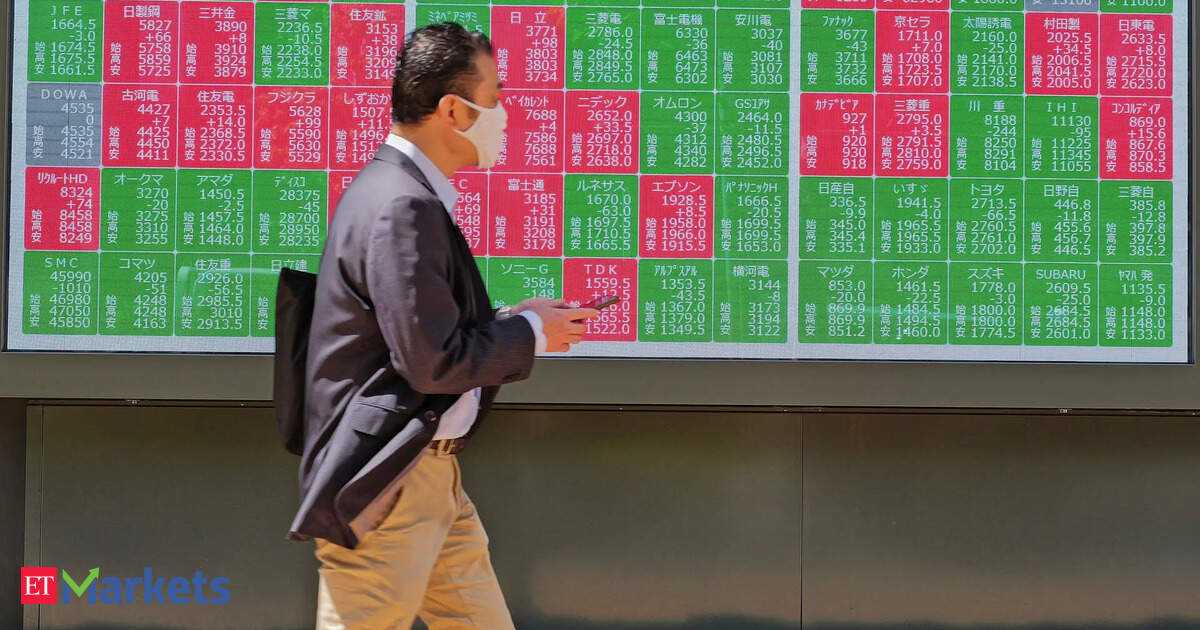
The Nikkei 225 index has surged past the 62,000 level, marking a significant milestone that is forcing a re-evaluation of capital allocation across Asian equity markets. This move is not merely a domestic Japanese phenomenon. It represents a broader rotation where liquidity is increasingly favoring established technology hubs that benefit from global supply chain shifts and high-end manufacturing demand.
For investors tracking the broader stock market analysis, the Japanese rally serves as a bellwether for how regional indices react when local tech heavyweights decouple from broader macroeconomic stagnation. The mechanism here is clear. As the Nikkei breaks into new territory, institutional capital is being pulled away from emerging market proxies that have struggled to maintain momentum, effectively tightening liquidity for secondary markets in India and Southeast Asia.
This shift creates a specific friction for technology-heavy portfolios in India. Companies like Infosys Ltd and Wipro Ltd are currently navigating a complex environment where global demand for IT services remains lukewarm. While these firms are not direct competitors to the hardware-centric giants driving the Nikkei, they are competing for the same pool of international institutional investment. When the Nikkei offers a high-beta, high-liquidity play on the tech sector, the relative valuation of Indian IT services firms faces downward pressure as fund managers rebalance their regional weightings.
Financial institutions are also caught in this cross-current. HDFC Bank Ltd remains a primary indicator for domestic Indian sentiment, yet its performance is increasingly sensitive to foreign institutional investor (FII) outflows. When regional indices like the Nikkei hit record highs, the immediate reaction is often a sell-off in Indian financial stocks to fund the reallocation toward the Japanese market. This creates a liquidity trap where domestic fundamentals are overshadowed by the sheer velocity of capital moving toward the Tokyo exchange.
Regarding current positioning, our proprietary data reflects these pressures. HDB holds an Alpha Score of 40/100, signaling a mixed outlook as it struggles to decouple from broader FII sentiment. Meanwhile, INFY carries an Alpha Score of 57/100, and WIT sits at 46/100, both reflecting the ongoing volatility in the technology services sector as they compete for attention against the hardware-led rally in Japan.
The next decision point for traders is the upcoming flow data from major global custodians. If the Nikkei maintains its position above the 62,000 threshold, expect further pressure on Indian financial and IT stocks as passive funds adjust their regional mandates. Watch for any divergence in local currency strength, as a weakening yen could eventually trigger a profit-taking event in Japan, potentially reversing the current capital flight back into emerging markets.