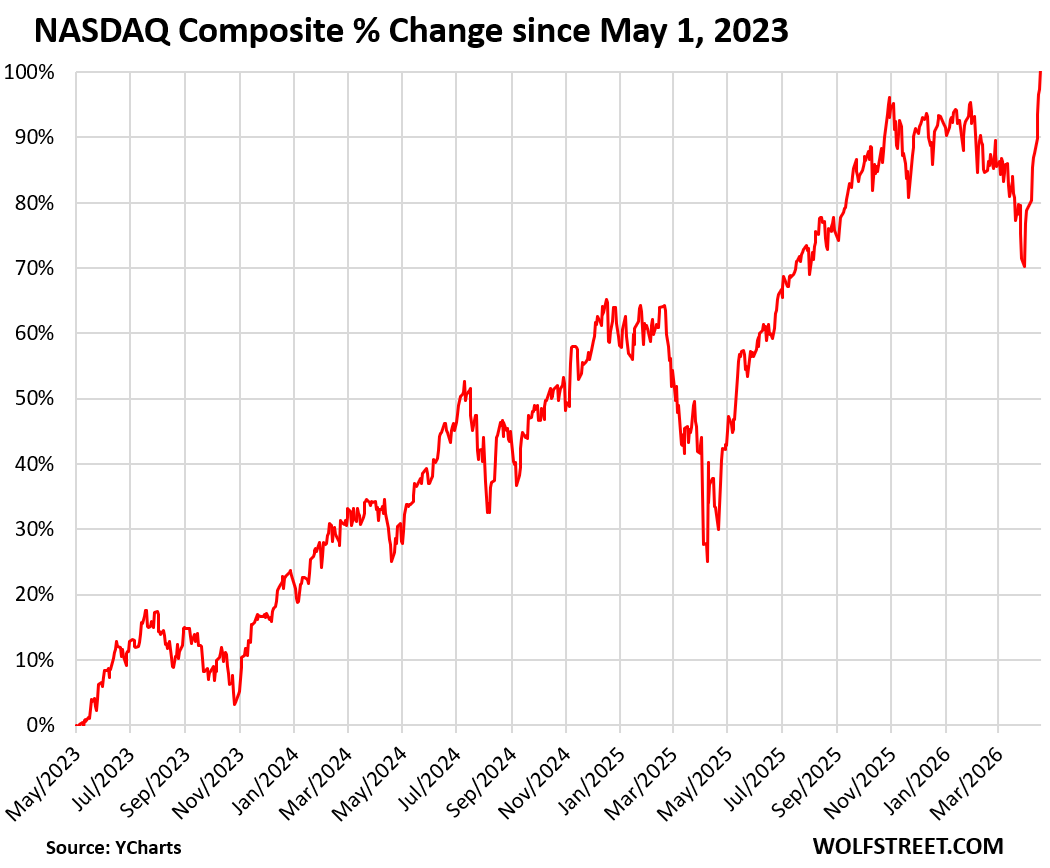
The Nasdaq Composite Index has reached a significant milestone, recording a 100% gain over the past three years. This surge follows a distinct recovery trajectory since the market selloff associated with Liberation Day, during which the index has climbed 60%. The scale of this appreciation stands in stark contrast to broader economic indicators, as the underlying economy has expanded by only 15% in nominal terms over the same three-year period.
Decoupling of Equity Valuations and Macro Fundamentals
The widening gap between index performance and economic output suggests that capital allocation is increasingly driven by liquidity dynamics and sector-specific momentum rather than traditional macroeconomic growth metrics. While the economy has experienced modest nominal expansion, the Nasdaq has effectively doubled in value. This divergence indicates that equity markets are pricing in future expectations that significantly outpace current industrial and consumer output. The reliance on tech-heavy indices as a proxy for broader economic health has become increasingly tenuous as the index composition leans further into high-growth, high-multiple assets.
Sector Concentration and the Search for Yield
Investors are increasingly favoring equity indices over alternative asset classes, including cryptocurrencies, as the primary vehicle for capturing volatility and potential returns. The concentration of capital within the Nasdaq suggests that market participants are prioritizing the growth narratives of dominant tech firms over diversified exposure. This shift reflects a broader trend where investors seek outsized returns in established equity markets, viewing them as a more reliable mechanism for wealth accumulation than speculative digital assets.
- The Nasdaq has achieved a 100% return over a three-year window.
- Post-selloff recovery since Liberation Day stands at 60%.
- Nominal economic growth remains at 15% for the corresponding period.
Market Context and Structural Implications
The current environment is defined by a disconnect where asset prices are decoupled from the real economy. As the Nasdaq continues to outperform, the sustainability of these valuations will depend on the ability of constituent companies to maintain margins that justify current price-to-earnings ratios. When equity growth consistently outstrips economic expansion, the market becomes sensitive to shifts in liquidity or changes in the cost of capital. For further reading on how specific firms navigate these valuation pressures, see our stock market analysis.
Future market direction will likely be dictated by the next round of corporate earnings reports and the subsequent adjustment of long-term growth forecasts. Investors should monitor whether the current momentum persists or if the gap between index performance and economic reality triggers a revaluation of growth expectations. The next concrete marker will be the upcoming quarterly guidance updates from major index components, which will serve as a test for whether the current valuation levels can be supported by actual operational performance.