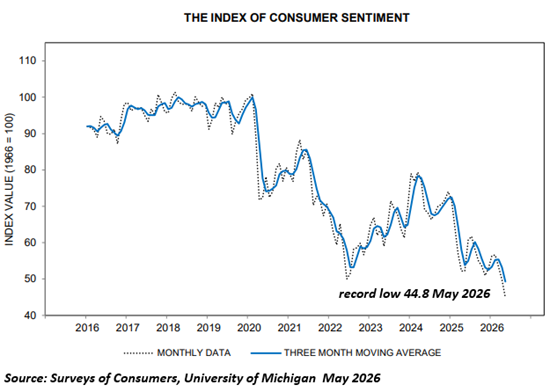
Record-Low Consumer Sentiment Hits the Tape
The University of Michigan Consumer Sentiment index printed its lowest level in the survey's history. This headline triggers a contrarian reflex: buy when pessimism is extreme. The reflex works when the economy shows a visible catalyst for recovery. The current environment lacks that catalyst.
Persistent inflation, high borrowing costs, and a softening labor market are squeezing household budgets. Wages have not kept up with shelter and food costs. The Federal Reserve has not signaled a pivot. This is structural pressure on spending, not a fleeting shock. Consumer discretionary stocks and the retail sector face direct earnings risk as reduced discretionary spending hits revenue.
The Better Read: Sentiment Without a Catalyst
The naive trade is to buy SPY or XLY on the sentiment trough. The better read separates two states: sentiment as a reflection of current economic reality versus sentiment as a contrarian timing tool. When sentiment hits a low in a recession with a clear recovery catalyst (rate cuts, fiscal stimulus), the trough often aligns with the market bottom. When it hits a low without a policy catalyst, the market can continue to grind lower as earnings revisions accelerate.
The next potential catalyst is the FOMC meeting and the October CPI print. Neither has arrived. Until then, the risk-reward favors waiting for a confirmed reaction level rather than buying the headline.
Technical Confirmation and Invalidation Levels
The S&P 500 is testing a support zone that held in prior pullbacks. The index has not yet printed a higher low on the weekly chart. Relative Strength Index (RSI) on the daily chart is near oversold. Oversold readings in a structural downtrend often require multiple touches before a durable low forms.
Confirmation requires:
- Two consecutive weekly closes above the 50-week moving average.
- Sustained outperformance of consumer discretionary (XLY) relative to defensive sectors.
Invalidation is a break below the prior swing low on elevated volume. That would signal that sentiment is leading earnings estimates lower rather than pricing in a rebound.
October Data Provides the First Test
The follow-up University of Michigan survey and the October retail sales report will test the thesis. A stabilization in sentiment combined with an in-line retail print would support the contrarian case. A further drop in confidence paired with a spending miss would confirm that the record-low sentiment is a coincident indicator of ongoing weakness, not a buy signal.
Until those prints land, the setup is unconfirmed. The contrarian trade needs a catalyst, not just a headline.
For a broader framework on sentiment and market positioning, see our stock market analysis.