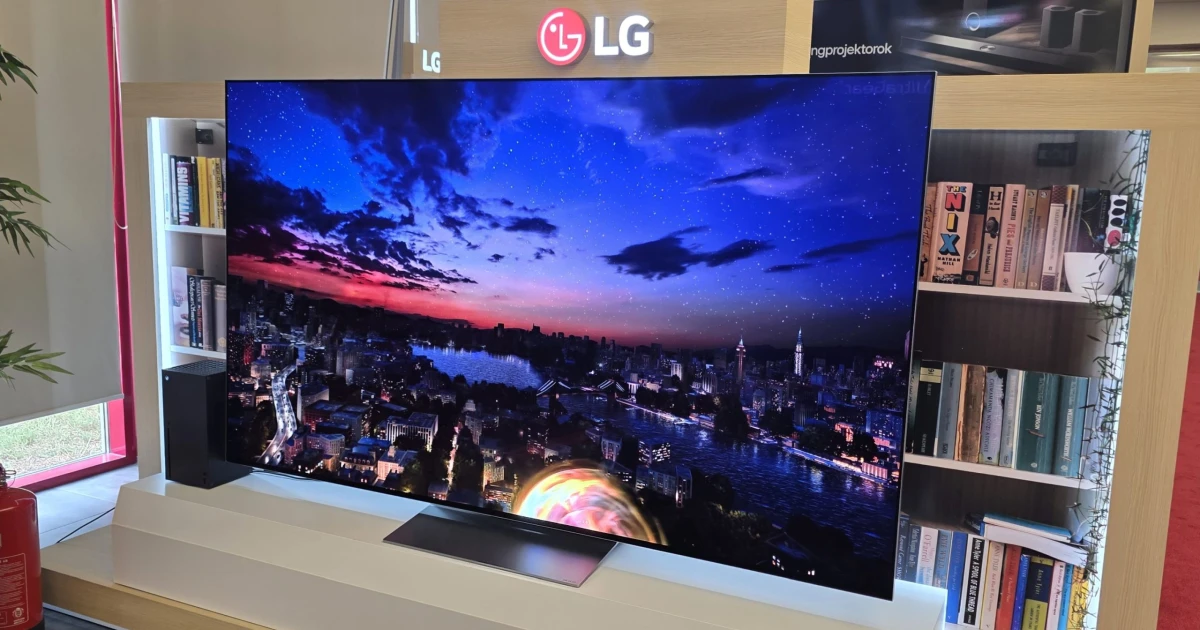
LG Electronics has launched its 2026 television lineup in Hungary, led by the distinctive Wallpaper W6 OLED model that mounts flush to the wall. The move arrives as Chinese rivals such as TCL and Hisense flood the market with aggressively priced LCD sets. LG is betting that a mix of exclusive premium hardware, a phased rollout timed to the summer World Cup, and a conservative jump into RGB LED will keep its TV business profitable while the price war intensifies.
The Catalyst: LG's 2026 TV Lineup Launch
LG held a launch event in Hungary to present its full 2026 television range. The centerpiece is the W6 Wallpaper series – an OLED panel so thin that all electronics and connectors have been moved to an external box, with the image sent wirelessly via a proprietary system capable of handling ultra-high-resolution, high-dynamic-range content with multi-channel audio.
Three additional OLED families are entering the market, spanning sizes from 42 to 83 inches. LG's strategy covers the full price spectrum: a premium tier where the Wallpaper competes, a mid-range grouping it calls the "sweet spot," and entry-level OLED models priced to undercut previous generations.
The Wallpaper W6 as a Differentiator
The W6 is engineered to solve a specific problem for high-end buyers: the bulky protrusion of a typical TV's electronics. By offloading ports and processing to a separate box, the screen itself is literally paper-thin and sits against the wall without any visible bulge. LG claims this is a unique product in the market today, giving it a marginal pricing power that the company hopes will draw ultra-premium buyers away from Chinese premium LCD alternatives.
OLED Families: From 42 to 83 Inches
LG is expanding its OLED reach downward with a 42-inch model aimed at smaller rooms and secondary TVs, while keeping 83-inch panels for the home-theater segment. The breadth of the lineup – four distinct families – means LG offers the largest OLED selection globally. This depth is a deliberate defensive move: if a customer walks into a store wanting an OLED at any price point, LG wants the first option they see to be its own.
Why OLED Still Matters
LG has been the sole large-scale champion of OLED for years, enduring a period when most rivals treated the technology as a niche. That era has ended – more than 20 brands now sell OLED TVs. Yet LG still controlled nearly 50% of the global OLED market in 2025, according to market researchers. The company refuses to treat OLED as a commodity. It continues to invest in higher brightness, AI-driven image processing, and the thinnest form factors, arguing that the contrast and color accuracy of OLED still outperform alternative premium technologies.
The Alternative: QD-OLED and RGB LED
Samsung and Sony have pushed QD-OLED (quantum-dot OLED) as a competitor, while Chinese makers aggressively market RGB LED – an LCD-based approach using red, green, and blue LED backlights to improve brightness. LG acknowledges RGB LED but views it as most viable in 85-inch-plus sizes, where the cost per inch is dramatically lower than OLED's. At the launch event, LG demonstrated an RGB LED model alongside an OLED, and the contrast and off-angle color uniformity visibly favoured the OLED. LG frames this not as a technological dead end but as a niche for very large screens where buyers prioritise sheer brightness over black levels.
Sector Read-Through: Chinese Competition and LG's Defence
Chinese brands have shaken the TV industry by offering feature-packed LCD sets at margins that Japanese incumbents (Sony, Panasonic, Sharp) could not survive. Japan's once-dominant TV makers are pulling back. LG's defence is not to match those prices but to create a walled garden of differentiation:
- Proprietary smart TV operating system – LG develops its own webOS platform, giving it control over software updates and service revenues.
- Security suite – the new LG Shield cyber-security package promises users their data will not be accessible to third parties.
- Five years of major OS updates – LG guarantees annual feature updates for half a decade, reducing planned obsolescence complaints.
Hardware alone cannot sustain a premium. By bundling software differentiation, LG hopes to convince customers that paying more today buys a longer useful life.
Execution Risk: Price Points and Timing
LG has not yet released exact pricing for the 2026 models. The company said most models will reach store shelves by the start of the summer football World Cup, a natural sales catalyst. Launch promotions are planned. The risk is that Chinese rivals cut prices during the same period, eroding the premium LG needs to justify its R&D spend. If LG cannot command a margin spread large enough to cover its OLED production costs, the volume ramp in the 42-inch and entry-level OLED categories may compress operating profit faster than expected.
Decision Point for LG Stock
For investors tracking LG Electronics (ticker: LGEIY) , the TV launch is a test of a broader thesis: Can a Korean hardware company defend a premium niche against a wave of Chinese scale? The answer will show up in two metrics:
1. OLED unit growth. If LG's 2026 OLED sales accelerate, especially in the new smaller sizes, it confirms that the company's brand and technology can still command a price premium. 2. Operating margin in the Home Entertainment segment. This has been under pressure from rising logistics costs and price competition. A margin stabilisation above 5% would signal that the defence is working.
AlphaScore proprietary data currently shows neutral sentiment on LG shares, with no insider cluster buying. The stock has lagged the broader MSCI Korea index over the past six months.
What This Means for Traders
A bullet list of the main models and their positioning:
- W6 Wallpaper OLED – ultra-thin, premium, wireless connection.
- G-series OLED – high-brightness flagship for enthusiasts.
- C-series OLED – mid-range best-seller in 42-83 inches.
- B-series OLED – entry-level, price-sensitive buyers.
- QNED (LCD) – mid and low tiers, with mini-LED or standard LED backlights.
- RGB LED – limited to 85-inch-plus, targeting high-brightness home cinema.
Risk to Watch: Chinese Price War Escalation
TCL and Hisense have already launched 2026 models with aggressive pre-order discounts in China and the United States. If those discounting spreads to Europe before the World Cup, LG may be forced to cut prices on its QNED line – which carries much thinner margins – just as it absorbs the cost of the OLED ramp. The primary risk is an inventory build in the low-margin LCD segment that drags down the entire division's profitability.
For more context on how individual stocks react to product launches in the consumer electronics space, see the stock market analysis section. Traders building watchlists around this theme should also compare margin profiles across the sector using data from best stock brokers.
Summary
LG's 2026 TV lineup repeats the core bet it has made for a decade: that OLED's image quality will continue to justify a premium price, and that a broad catalogue from 42 to 83 inches will capture every customer who even considers paying more for a better picture. The Wallpaper W6 adds a unique form-factor differentiator. The risk is that buyers, faced with a global cost-of-living squeeze and ever-cheaper Chinese alternatives, stop caring about the difference. The World Cup window will provide the first real test. If LG can move units on the high end without sacrificing margin, the company's TV business remains a valuable earnings contributor. If it cannot, the segment becomes a cash drain that drags on the parent company's valuation.