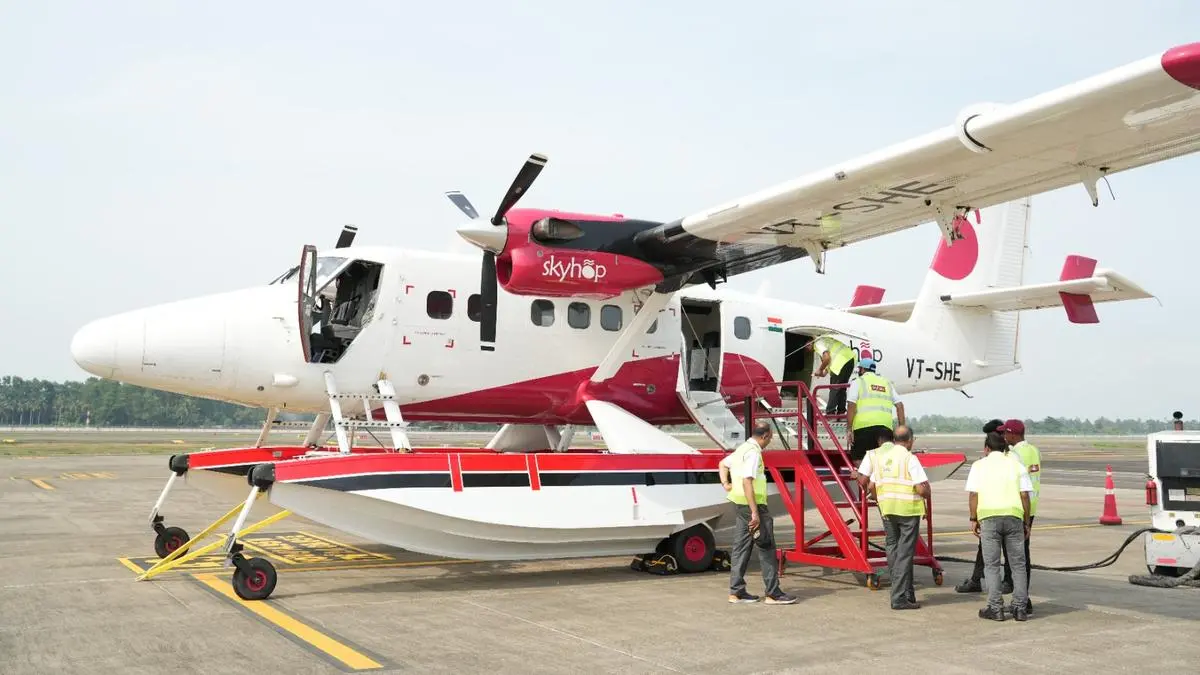
Three seaplane trial flights between Kochi and Agatti island tested a single DHC6-400 Twin Otter aircraft on Wednesday, launching an operational assessment that could reshape the map for regional air connectivity stocks and Lakshadweep tourism infrastructure. The trials, facilitated by Cochin International Airport Limited (CIAL), are small in scale but large in signal: a government-backed push to make island access commercially viable for 19-seat aircraft.
The event matters because seaplane operations up to now have been a policy ambition, not an operational reality. A scheduled trial programme that reaches four more islands across May 14 and 15 gives traders a concrete sequence of catalysts, not a one-off headline.
The CIAL Seaplane Trial: What Changed
A 19-Seat Aircraft and a Water Aerodrome
The aircraft used was a De Havilland Canada DHC6-400 Twin Otter (registration VT-SHE), configured for 19 passengers. The plane falls under Category 3 RFFS (Rescue and Fire Fighting Services) requirements and carries a maximum take-off weight (MTOW) of 5,670 kg. These are not widebody numbers; they describe a utility aircraft suited to short hop, water-landing routes that bypass the need for paved runways on small islands.
The three Wednesday operations included a COK–AGX sector (departing 09:30, arriving 11:30), a local AGX–AGX training sortie at the Agatti water aerodrome (11:35 to 13:30), and the AGX–COK return sector (15:00 to 16:45). Running a full training cycle inside the trial tells the market that the exercise is about operational readiness, not just a symbolic flyover.
The Schedule and Next Targets
CIAL confirmed the programme continues: May 14 adds sectors connecting Kochi, Kalpeni, Agatti, and Kavaratti; May 15 takes in Kochi, Agatti, Kadmat, and Kiltan before returning to Kochi. Expanding the footprint to five islands in three days gives enough data to assess water aerodrome conditions, passenger loading, and turnaround times across different atoll environments.
Practical rule: When a government-linked entity issues a multi-date schedule with named destinations, the project has already moved past concept-stage and into the infrastructure procurement pipeline. That shifts the watchlist from “maybe someday” to “who supplies, operates, and insures these routes.”
Sector Readthrough: Aviation Infrastructure and Tourism
Airport Operators and Ground Services
The trial touches two types of infrastructure: the departing Cochin International Airport itself, and the receiving water aerodromes at the islands. CIAL is not a listed entity, so no direct equity exists. The readthrough, however, lands on listed airport operators that manage regional airports or handle ground services for short-haul turboprop routes. Seaplane operations require minimal landside infrastructure compared to A320-class runway extensions, which means a successful commercial launch could accelerate small-airport utilisation metrics without large capex.
For traders, the watchlist includes companies with regional airport concession portfolios or ground-handling contracts at multiple small airfields. The DHC6-400’s water-landing capability also nudges demand toward floating dock and pontoon maintenance services, a niche supply chain.
Lakshadweep Tourism: Hotels and Resorts
The trial explicitly aims to promote island tourism. Lakshadweep’s tourism capacity is tightly constrained by limited air access. A reliable seaplane service changes the occupancy calculus for existing resorts and makes new project approvals more likely. Stocks with hotel or resort exposure to the Union Territory, or those that hold land or development rights on the islands, get a catalyst that did not exist before Wednesday.
A secondary effect flows through tour operators and inter-island ferry companies. Seaplanes could become the premium transfer option, replacing longer boat rides. Even at 19 seats per flight, a twice-daily service adds meaningful carrying capacity for high-value tourists who currently skip the destination because the logistics are too slow.
Regional Connectivity and Government Backing
The trial sits inside the UDAN (Ude Desh ka Aam Nagrik) regional connectivity framework, which subsidises routes to underserved airports and water aerodromes. The government’s willingness to test a 19-seat seaplane on routes that have no runway alternative suggests the subsidy mechanism is being widened beyond traditional fixed-wing operations. If the operational assessment succeeds, the next step is a bidding round for commercial seaplane routes; that is when regional airlines and helicopter service operators would evaluate fleet additions.
Key insight: The Category 3 RFFS requirement and 5,670 kg MTOW limit the addressable market to small operators. This is a niche watchpoint for aircraft leasing firms and maintenance, repair, and overhaul (MRO) companies with DHC6-400 expertise, not for carriers built around ATRs or Boeing 737s.
The May 14–15 Flights: Confirmation for the Thesis
What the Expanded Schedule Delivers
Adding Kalpeni, Kavaratti, Kadmat, and Kiltan across two days does four things. First, it tests water aerodrome readiness at islands with different lagoon depths and wind exposure. Second, it generates real-world block times that can be compared against ferry schedules. Third, it provides concrete load factor and demand data if passenger numbers or interest are tracked. Fourth, it gives the Directorate General of Civil Aviation (DGCA) observations that will shape operating regulations for commercial seaplane AOC (Air Operator Certificate) holders.
- Kalpeni: deeper lagoon, potential for multiple landing paths
- Kavaratti: administrative capital, highest baseline passenger demand
- Kadmat: known for dive tourism, tests willingness-to-pay for speed
- Kiltan: smaller atoll, probe for minimum viable infrastructure
If the May 14–15 trials produce no incident and reasonable block times, the probability that the government opens a commercial tender rises. That is the signal traders want.
Data Points Traders Should Track
Numbers that matter: published block times versus ferry durations; any mention of passenger feedback or interest from tour operators; and the DGCA’s post-trial report timeline. The trial’s success is not measured by a stock price move on Thursday; it is measured by whether a Request for Proposal (RFP) for seaplane services lands within the next three to six months.
What the Trial Does Not Yet Prove
Execution Risk: Weather, Maintenance, Demand
The southwest monsoon reaches Kerala and Lakshadweep by late May. Seaplane operations are sensitive to swell and visibility; a trial in mid-May does not approximate monsoon reliability. Maintenance infrastructure for the DHC6-400 is thin in India, which means any commercial operator would face spares and engineer availability constraints. And 19-seat capacity, while right-sized for entry, raises unit economics questions: ticket prices will have to be high enough to recover costs on routes that likely serve fewer than 10 passengers on many days.
Risk to watch: If the government or operators signal that commercial viability requires a subsidy beyond current UDAN levels, the market may reprice the opportunity as a policy-dependent story rather than a demand-driven one.
Regulatory and Investment Hurdles
Water aerodrome licensing, security screening for remote islands, and compliance with Category 3 RFFS at each landing point are not trivial. The trial uses a single aircraft under a limited programme; scaling to commercial service means multiple AOC approvals, permanent pontoon and terminal structures, and insurance underwriting for overwater turboprop operations. Each step needs budget allocation, and budget timing is uncertain.
The trial is a necessary first link in a chain that still needs investment grade conviction. For now, it puts regional aviation infrastructure and Lakshadweep hospitality stocks on a watchlist that did not exist on Tuesday.
For a broader framework on how infrastructure catalysts play out in listed markets, see our stock market analysis.