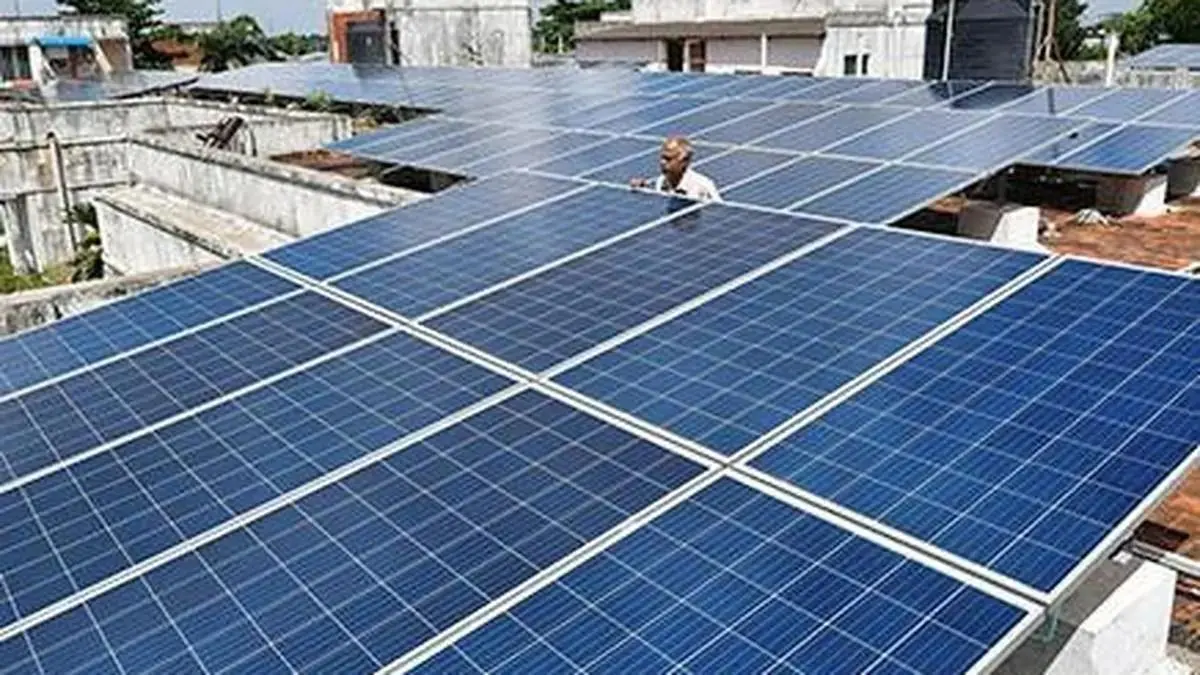
A fresh broker note on KPI Green Energy lands with a concrete number: ₹562 as a 12-month target, supported by a 24% upward revision in fiscal 2028 profit estimates. The trigger is not another solar capacity headline. It is the earnings mix change that turns every additional megawatt of the independent power producer (IPP) business into an 85–90% EBITDA margin stream. The call upgrades FY27 and FY28 top- and bottom-line forecasts across the board, and it adds a battery storage catalyst that starts contributing only after FY27.
FY26: CPP Engine Pushes Revenue 55% Higher, EBITDA Jumps 70%
KPI Green exceeded broker estimates in the March quarter and the full year even as power evacuation for the recently commissioned 376 MW GUVNL IPP project at Khavda, Gujarat, stayed gridlocked. The revenue beat rests squarely on the captive power producer (CPP) vertical.
| Metric | FY26 (₹ crore) | YoY Growth |
|---|
| Revenue | 2,696 | 55.3% |
| EBITDA | 958 | 70.0% |
| PAT | 476 | 49.0% |
The Captive Power Vertical Delivers the Beat
The CPP business grew 61.2% year-on-year on strong execution. That segment accounted for the bulk of the revenue outperformance, masking the fact that the high-margin IPP asset was ready but not yet producing at nameplate capacity. The broker’s note flags that the IPP business carries EBITDA margins around 85–90%, so the current income statement understates the operating leverage that will arrive once the grid bottleneck clears.
Volume Drives EBITDA; IPP-Driven Structural Lift Is Priced In
EBITDA margin expansion in FY26 was volume-driven. The next leg will be mix-driven. When a 90% margin business becomes the marginal unit, every gigawatt-hour of incremental generation feeds disproportionately into profit. That is the mechanism behind the broker’s estimate bumps of 10–24% for FY27 and FY28 revenue, EBITDA, and PAT.
The IPP Margin Profile: 85–90% EBITDA Redraws the Earnings Map
Key insight: The 85–90% IPP EBITDA margin is the earnings leverage that turns additional megawatts into disproportionately higher profit growth.
Why the High-Margin IPP Segment Changes the Valuation Argument
KPI Green energised 447 MW in the March quarter, taking total operational capacity to 975 MW. Units generated rose 64.5% year-on-year to 41 crore units. The number missed the internal target because of project commercialisation delays. The exact bottleneck is the power evacuation infrastructure for the GUVNL IPP project. Once that is resolved, a large block of commissioned capacity starts generating at margin rates multiples above the company average.
Estimate Revisions: Revenue, EBITDA, PAT Lifted by Double Digits
The broker raised FY27 and FY28 estimates for all three line items by 10% to 24%. The high end of that range – the 24% jump in FY28 PAT – reflects the compounded effect of IPP ramp-up plus the eventual contribution from battery energy storage systems (BESS). EPS growth gets a slight haircut from a 5% equity dilution caused by a recent warrant issuance to promoters, leaving the broker’s FY27 earnings per share estimate at ₹31.2.
Capacity Ramp: 447 MW Added in Q4; Grid Bottlenecks Clip Generated Units
- Total operational capacity reached 975 MW after the March-quarter energisation.
- Units generated jumped 64.5% year-on-year to 41 crore units.
- The number missed the internal target because of delays in power evacuation for the 376 MW GUVNL IPP project at Khavda.
- The CPP vertical grew 61.2% year-on-year, driving the majority of the revenue beat.
376 MW GUVNL IPP at Khavda: Commissioned, Awaiting Power Evacuation
The Khavda project is operational on paper. In practice, grid connectivity has not caught up, so the asset is not yet converting sunshine into reported IPP revenue. That makes the evacuation timeline the single largest execution variable in the thesis. The broker’s note treats the delay as temporary and is already counting the full contribution in forward estimates.
Total Operational Capacity Hits 975 MW; 41 Crore Units Generated
The 64.5% growth in units generated shows volume momentum independent of the mix shift. Combined with the margin profile change, the setup is a double-barrelled earnings upgrade: more units at a structurally higher margin.
Valuation Reset: ₹562 Target Based on 18x FY27E EPS Post-Revisions
How the 5% Warrant Dilution Subtracts from EPS Growth
The broker flags that the recent warrant issue to promoters creates about 5% equity dilution. That trims headline EPS growth, leaving FY27E EPS at ₹31.2 rather than the figure that undiluted earnings would produce. The ₹562 target price is constructed by applying an 18x multiple to that diluted EPS, implying the broker sees the dilution as a one-off financing event rather than a valuation reset.
Target Multiple: 18x on Forward Earnings for a Mix Shift Play
An 18x multiple on a utility-adjacent name looks full. The number holds only if the market accepts that KPI Green is no longer a pure CPP volume story. The 85–90% IPP margin is the core justification. For broader context on how IPP re-rating is flowing through the sector, see our stock market analysis page.
Next Catalyst: BESS Capacity Fully Operational by FY27, Revenue from FY28
Battery Storage Adds a Second High-Margin Revenue Stream
The broker’s model introduces a new line item: BESS capacity is expected to become fully operational by FY27 and start generating revenue from FY28 onward. Battery storage economics benefit from the same infrastructure tailwinds as IPP solar, plus an additional revenue layer from ancillary grid services. The broker’s top-end estimate revision – the 24% FY28 PAT jump – embeds this second lever.
For traders, the actionable signal is a clear estimate upgrade cycle driven by a structural margin shift. The grid evacuation timeline is the only near-term speed bump; its resolution would unlock the full IPP earnings stream and likely push FY28 estimates higher again. The broker’s ₹562 target now marks the level that a mix-shift re-rating must defend.