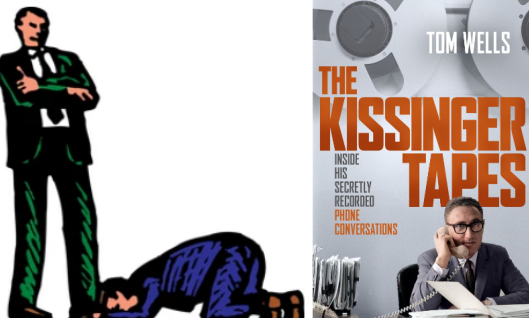
The Kissinger Tapes: A Historical Baseline for Geopolitical Risk
Historian Tom Wells has published The Kissinger Tapes – Inside His Secretly Recorded Phone Conversations, covering January 1969 through August 1974. The archive of roughly 15,000 telephone records and 20,000 pages of transcript from the Nixon era was released only after Henry Kissinger died in November 2023. The tapes offer investors something more useful than a history lesson: a direct comparison point for President Donald Trump's private language, bombing orders, and confidence in Vladimir Putin.
What the Archive Changes
Until now, comparing Trump's behavior to a past administration required reliance on memoirs and sanitized records. The Kissinger tapes provide unedited recorded evidence. The differences between Nixon and Trump are not about character. They are about what the public and media accepted then versus now. For geopolitical risk models, the archive establishes a floor: executive behavior considered extreme today was standard practice half a century ago. Markets priced that behavior then. They are pricing it now. The question is whether current pricing already accounts for the pattern or whether a new escalation would break it.
Foul Language as a Market Distraction
The Nixon-Kissinger Record
The tapes settle the claim that Trump's coarse language is historically unusual. It is not. "Bullshit" was the Nixon-Kissinger favorite, recorded 13 times. On February 5, 1972, Nixon used it to insist his bombing orders for North Vietnam were carried out without Pentagon delay. He demanded that carriers move and B-52s hit the B-3 area in the Central Highlands. "Shit" appeared four times from Nixon, three times from Kissinger. "Fuck" appeared three times from Kissinger, once from Nixon. "Prick" appeared once in five years.
The Practical Inference
Nixon and Kissinger kept their expletives a state secret. Trump made his public. For a trader, the relevant point is that coarse language in the Oval Office has zero correlation with policy outcomes. Nixon bombed North Vietnam and Cambodia. Trump bombed Iran. The words are noise. What matters is the order itself: targets, escalation path, and market sectors that absorb the cost. A watchlist screening for rhetorical shifts is looking at the wrong variable. The mechanism is command and execution, not vocabulary.
Bombing for "Real American" – Nixon and Trump
Nixon's Directives
The tapes record Nixon describing bombing as "real American" in Kissinger's phrasing. On March 26, 1970, Nixon asked Kissinger to confirm that bombing of anti-aircraft missile battery sites in North Vietnam had been carried out, along with taking out troops coming through SAM sites. Kissinger replied: "That's done…That's also done." Nixon had his 20-year old daughter Julie with him and put her on the line.
Trump's Parallel
Trump's bombing of Iran has been publicly framed as making America great again. Nixon and Kissinger operated with the same conviction in secret. The structural similarity is the willingness to escalate without public debate or Congressional authorization. Markets priced Nixon's bombing campaigns as a Vietnam War continuation. They are pricing Trump's Iran strikes as a Middle East escalation with implications for crude oil, defense contractors, and regional currencies.
The Execution Question
The practical question for a watchlist is whether Trump's bombing follows the Nixon pattern of sustained escalation or the more modern pattern of limited strikes. The tapes suggest Nixon's instinct was to hit hard and repeatedly. Key insight: If Trump shares that instinct, follow-up strikes are more likely than a one-off signal. The next concrete event to watch is whether the administration orders additional strikes on Iran or expands operations to a different theater.
Russian Leaders and Jewish Fondness – A Persistent Assumption
Kissinger's Remark
On June 11, 1973, Kissinger was on the phone with the chief executive of Paramount Pictures about dubbing films for Soviet leader Leonid Brezhnev's state visit. Kissinger said: "I think he would love, particularly given the Russian fondness with Jews." On paper and in retrospect, this could be read as sarcasm. The telephone record from 53 years ago suggests it was not. Kissinger believed Brezhnev had a genuine affinity for Jewish people.
The Trump Connection
The Trump White House has expressed similar confidence in Putin's attitude toward Jews. The Kissinger tape shows this belief is not new. It was a working assumption inside the Nixon administration half a century ago. Whether the assumption was accurate then or now is a separate question. The practical point for geopolitical risk analysis is that multiple US administrations have operated on the premise that Russian leaders hold a pro-Jewish bias. That premise affects policy toward Russia, Israel, and Middle East alliances.
For investors, this matters when assessing sanctions risk. If Trump trusts Putin on Jewish issues, he may resist sanctions on Russia that other allies demand. The Russian ruble, Turkish lira, and Israeli shekel are directly exposed to that dynamic.
Journalists as Insiders
Seymour Hersh's Sycophancy
The tapes also reveal how prominent journalists of the era spoke to Kissinger. Seymour Hersh, the investigative reporter who broke the My Lai massacre story, is recorded on May 15, 1973, advising Kissinger sympathetically on how to do a better job of keeping national security operations secret. Hersh expressed support for Kissinger's secret wire-tapping and some of Nixon's secret bombing runs in Cambodia.
Risk Check for Traders
The practical lesson for markets is that media coverage of executive actions is not independent of the source. The same pattern exists today. Traders who rely on media narratives about escalation risk should cross-reference those narratives with actual command signals: troop movements, budget allocations, and closed-door diplomatic channels. The Kissinger tapes show that even hostile reporters can become collaborators in secrecy when given access.
NYT and Communication Sector
For AlphaScala's NYT stock page , the Alpha Score is 48/100, labeled Mixed, in the Communication Services sector. The score reflects the tension between the newspaper's investigative mandate and the market's preference for predictable earnings. The Kissinger tapes are a reminder that even NYT reporters like Hersh operated inside the system they were supposed to cover. For investors in media stocks, the archive raises a structural question: will today's journalists face similar compromises, and will the market punish or reward outlets that maintain independence?
The Kissinger tapes do not change any valuation metric. They provide a historical context that should make investors skeptical of treating Trump's rhetoric as a unique risk. The same behaviors have been priced before. The question is whether today's geopolitical risk premiums are adequate or whether they rely on a false assumption of executive restraint.
The next concrete marker is whether Trump orders follow-up strikes on Iran. If he does, the Nixon comparison holds. If he does not, that deviation itself becomes a signal – suggesting that the current administration's escalation pattern is less persistent than the historical template.
For a broader view, see AlphaScala's stock market analysis for sector-specific risk models.