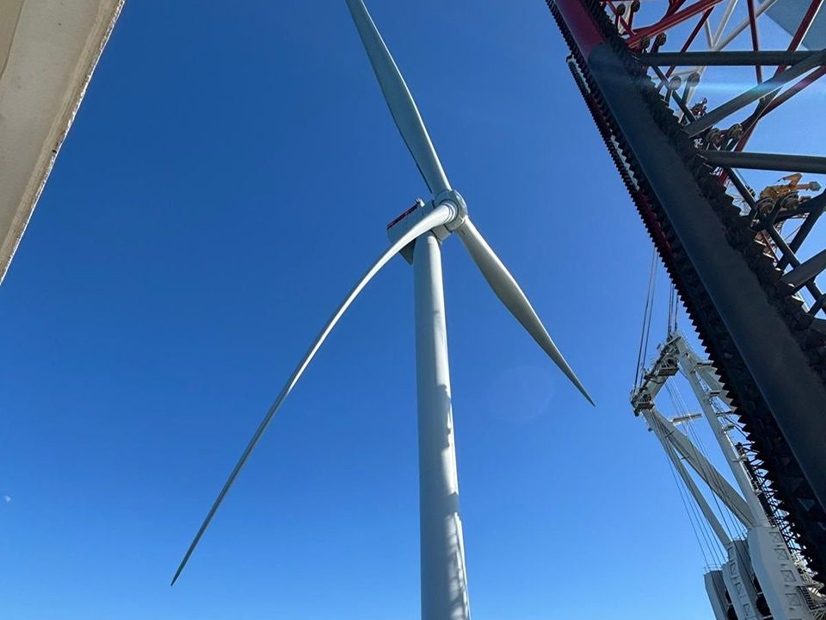
A federal judge in Portland, Ore., barred the Defense Department and Federal Aviation Administration from pausing national security reviews of wind projects, forcing the agencies back to work on at least 106 onshore and offshore wind projects in 21 states.
U.S. District Judge Karin Immergut issued the injunction Aug. 6. The reviews, required by Congress and run through the DOD's Military Aviation and Installation Assurance Siting Clearinghouse, ensure turbines do not obstruct government or military radar and flight paths. They had not occurred since April, the judge wrote.
Developers and clean energy groups filed suit May 31, with 18 states and Washington, D.C., joining last month. The stalled projects represent at least $47 billion in investment, the complaint said. Immergut, appointed by President Donald Trump in 2019, found the DOD had missed regulatory deadlines. She wrote that the agency "cannot pick and choose which parts of this legal regime to follow," and ordered status reports every 30 days.
The plaintiffs called the halt a politically motivated, de facto moratorium. The DOD said last month it was "actively evaluating" land-based wind projects to ensure they do not impair national security or military operations, a process it said must balance renewable energy development with the protection and preservation of testing and training. The court noted the agency had not flagged any project-specific risk before stopping all reviews.
Phelps Turner, senior attorney for clean energy at the Environmental Defense Fund, said the delay had needlessly blocked projects "capable of supplying millions of homes and businesses with low-cost power, as electricity costs and demand soar." The plaintiffs argued the delays could push projects past federal tax credit deadlines and prompt investors to pull out.
Federal judges have also rejected other administration moves against wind. Stop-work directives against five offshore Atlantic coast projects were overturned in January and February, and those projects are now mostly built.
The administration has had more success paying developers to exit, ENR reported.
RWE's $1.22B Exit
RWE became the sixth company to accept a federal refund for giving up U.S. offshore wind leases. The German developer said Aug. 6 it will surrender sites off New York and California, plus Louisiana, for $1.22 billion, the largest payout so far. The leases were won in Biden-era auctions. The deal resolves RWE's claims against the federal government, though it did not say whether the payment covers its lease payments and other development costs.
The projects were in early development. "After careful consideration, it was determined there is no path forward to permit these projects in the U.S. for the foreseeable future," RWE said. The company plans to invest about the same amount in U.S. natural gas projects, though it told industry publication Recharge the reinvestment was not required. "RWE determines where and how to deploy capital across its energy portfolio based on where it can deliver the greatest, more immediate value," a spokesperson said.
Outside the U.S., RWE remains a major offshore wind operator, with 18 farms running, four under construction, and 6.9 GW of capacity secured in the latest U.K. auction.
The six buyouts total nearly $4 billion in refunds. Hillary Bright, executive director of wind advocacy group Turn Forward, said the deals are not simple swaps for lost capacity. "Replacing coastal offshore wind with LNG in Louisiana does nothing to address rising ratepayer affordability concerns, reliability challenges, or potential gaps in power supply in the Northeast and mid-Atlantic," she said.
Seven Democratic-run states, including New York, sued the administration in June over the first deal with TotalEnergies. California has sent a notice of intent to sue over two cancelled projects off its central coast.
Dominion's Tariff Hit
In Virginia, Dominion Energy's 2.6-GW Coastal Virginia Offshore Wind project, the largest in the U.S., is facing higher costs tied to tariffs. CEO Robert Blue said Aug. 7 that the project now costs about $11.7 billion, up $288 million from the company's April estimate. Tariffs raised costs for imported steel and aluminum by 50%, and copper costs also climbed. PJM Interconnection assigned higher network upgrade costs.
The project relies on imported components, including 176 Siemens Gamesa 14.7-MW turbines and monopiles made in Germany. Blue said 31 turbines with more than 450 MW of capacity are installed, with each installation taking about two days, "in line with our prior assumptions [and] rivaling the magnitude of some of our fossil units." Dominion has already used the wind power to help meet record demand peaks in Virginia this summer. "This allows the project to clearly demonstrate technical feasibility and deliver energy to the grid well before the final turbine begins to spin," Blue said.
Dominion expects to complete the project by the end of 2027, later than the original early-2026 target. NextEra, the would-be buyer, carries an Alpha Score of 47 out of 100 from AlphaScala, a mixed rating. The company also plans to seek state and federal approvals next quarter for its merger with NextEra Energy, which could reach financial close by the end of 2027.