Apple, Microsoft, and every big AI user now face a compliance question that did not exist three years ago. How does a company prove its AI systems are safe, fair, and auditable?
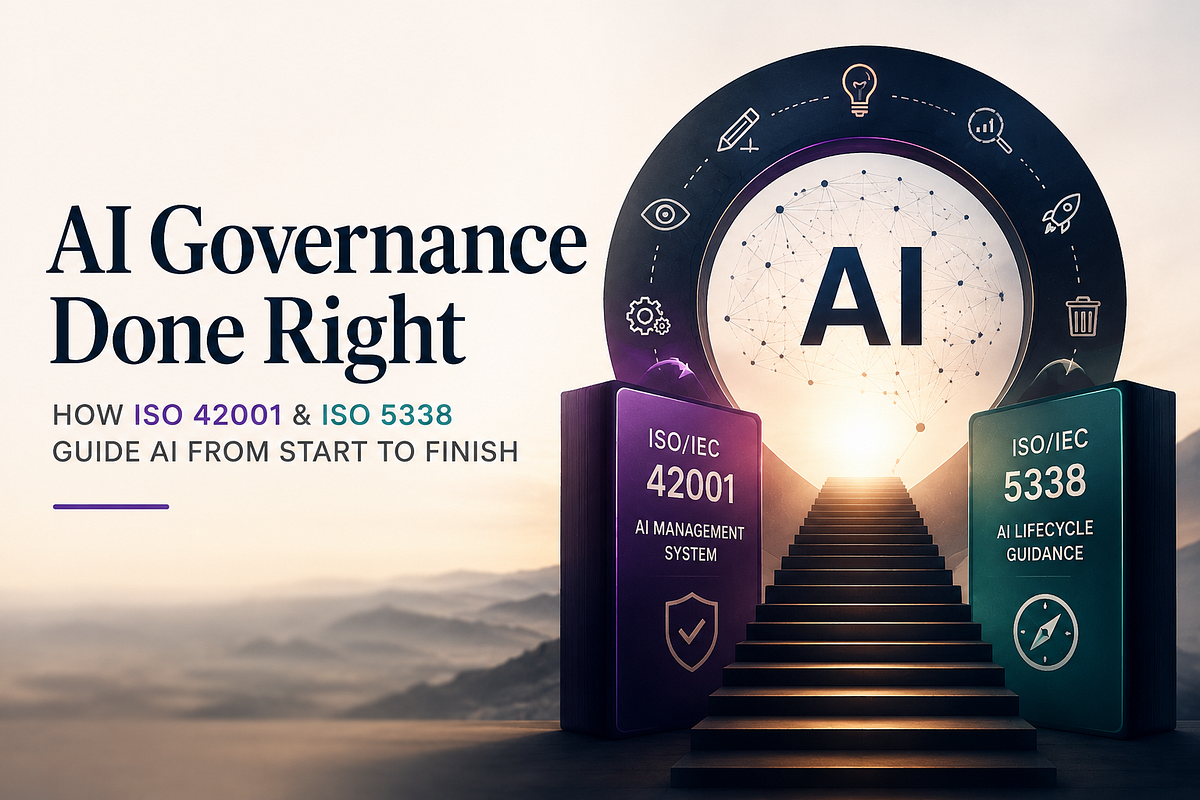
The answer is two ISO standards that regulators and auditors are starting to cite. ISO/IEC 42001 defines the controls an AI management system should have. ISO/IEC 5338 maps those controls to specific phases of an AI project's life cycle. Together they form a governance timeline, not just a checklist.
ISO 5338 splits the AI life cycle into seven stages. Each stage has a natural question.
Before any data collection or model training, an organization should ask what problem the AI solves, what data it needs, and what could go wrong. This is the planning stage. Most governance failures start here, because no one documents the assumptions.
When data is gathered and a model is built, the organization must document the data sources, the algorithm choices, and the training metrics. Poor data produces poor decisions, even with a perfect algorithm.
Before release, the system undergoes verification. Testing should check accuracy, fairness, security, and alignment with the original intent. This is the stage where bugs become trust problems. A model that passes test A but fails test B in production is a governance gap.
Deployment is not the finish line. The organization must log every decision the AI makes, track changes to inputs, and keep records that allow future audits. Transparency here reduces investigation time later.
After deployment, monitoring is continuous. Changes in user behavior, market conditions, or data distribution can degrade model performance. Regular monitoring catches drift before it becomes a compliance issue.
Periodic review ensures the model stays accurate, fair, and aligned with business goals. The world changes. So should the AI.
Finally, retirement. When an AI system is decommissioned, the organization should archive the data, document the reasons, and ensure no residual bias leaks into successor systems. Even the end of an AI's life is a governance event.
ISO 42001 provides the control set for each of these stages. ISO 5338 provides the sequence. One standard says what to govern. The other says when. Together they give a concrete framework that auditors and regulators can test against.
For investors, the implication is simple. Companies that have adopted both standards are building governance into the product development cycle, not bolting it on after a problem. That reduces regulatory risk, litigation risk, and reputational risk. Companies that treat AI governance as a post-launch paperwork exercise will eventually face a surprise.
Apple, a company that embeds AI across iOS, Siri, and its supply chain, has begun referencing ISO standards in its supplier guidelines. The market has not priced the governance gap yet. When a regulator demands proof of life-cycle controls, the companies with ISO 42001 and 5338 documentation will adapt faster. The others will scramble.