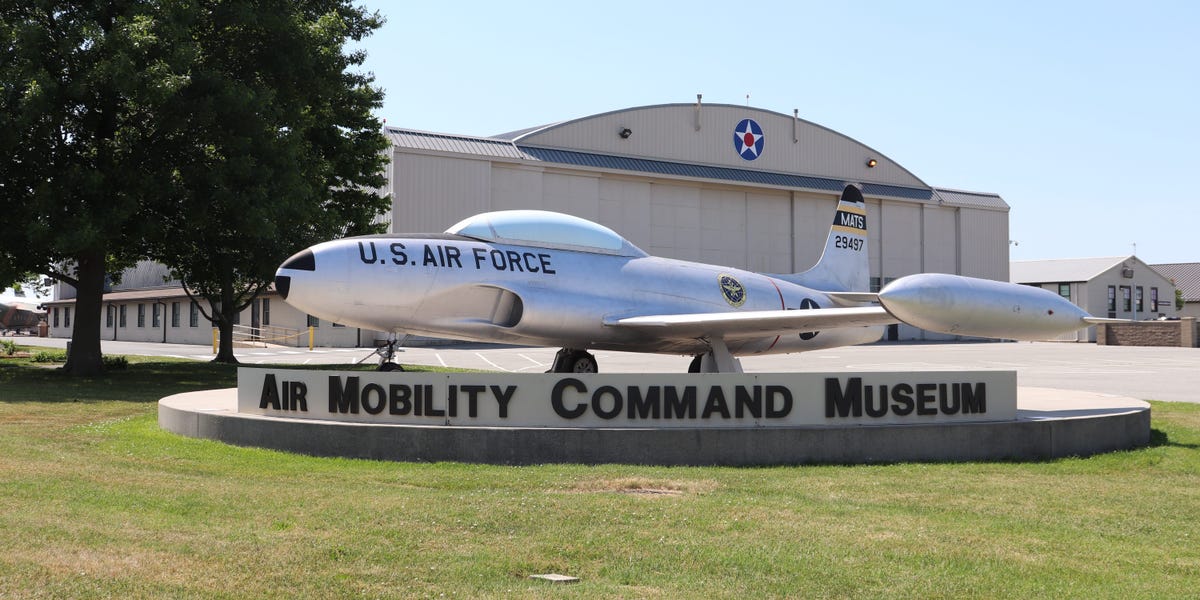
DOVER, Del. – The Air Mobility Command Museum on Dover Air Force Base holds more than 35 aircraft that have moved troops, fuel, and supplies for the U.S. military. Among the most prominent are Lockheed Martin's C-130 Hercules, C-5 Galaxy, and C-141 Starlifter – planes that have defined airlift for decades.
Lockheed Martin has been building C-130s for more than 70 years. The museum's examples include a C-130E that flew in Vietnam and a C-130H used for Antarctic resupply, Michael Hurlburt, the museum's operations manager, told Business Insider. The C-5A Galaxy, first flown in 1970, could carry 264,440 pounds of cargo plus 73 passengers. It was also the only aircraft to launch an ICBM in flight, the museum's display notes.
Dozens of countries operate the C-130 for cargo, troop transport, humanitarian aid, aeromedical evacuation, and aerial firefighting. The plane can be configured as a gunship or fitted with skis for icy runways. Lockheed Martin continues to produce modernized versions, including the C-130J, from its Marietta, Georgia factory.
The museum also displays a VC-9C that served as the vice presidential plane from 1975 to 2011 and occasionally flew as Air Force One. The VC-9C is a McDonnell Douglas DC-9-32, not a Lockheed product. A KC-10A Extender, the first built by McDonnell Douglas, shows the refueling boom used to transfer fuel midair. The KC-135E Stratotanker, built by Boeing, could carry 200,000 pounds of transferable fuel.
Lockheed Martin's LMT stock page carries an Alpha Score of 46/100, labeled Mixed, reflecting the company's steady defense revenue offset by valuation concerns. The museum's collection underscores the durability of Lockheed's air mobility franchise – contracts that span decades and are hard to displace.
The C-5A was retired in 2017 and modernized into the C-5M Super Galaxy. The C-141 was replaced by Boeing's C-17. The C-130, however, remains in active production, a testament to the design's longevity. For investors, the museum visit is a reminder that Lockheed Martin's airlift business is not just historical; it is ongoing, with the C-130J still rolling off the line in Marietta, Georgia.
A new $16.2 million air traffic control tower replaced the old 1956 tower that now serves as an exhibit. The old tower, staffed 24 hours a day through 2009, handled over 40,000 operations per year. Dover Air Force Base also served as an alternate landing site for the space shuttle, though no shuttle ever landed there.
The museum is free and open to the public, with its own entrance separate from the active base. Visitors can walk through the cargo bay of a C-133B Cargomaster that held fully assembled Thor, Jupiter, or Atlas ballistic missiles. Inside the KC-10A, they can see the joystick used to maneuver the refueling boom.
For defense investors, the museum offers a tangible look at the hardware that drives Lockheed Martin's air mobility segment. The company's backlog includes multi-year contracts for C-130J variants and sustainment work on older models. The next major catalyst is the fiscal 2026 defense budget, expected to include funding for additional C-130Js and C-5M upgrades. The budget proposal is due in February.