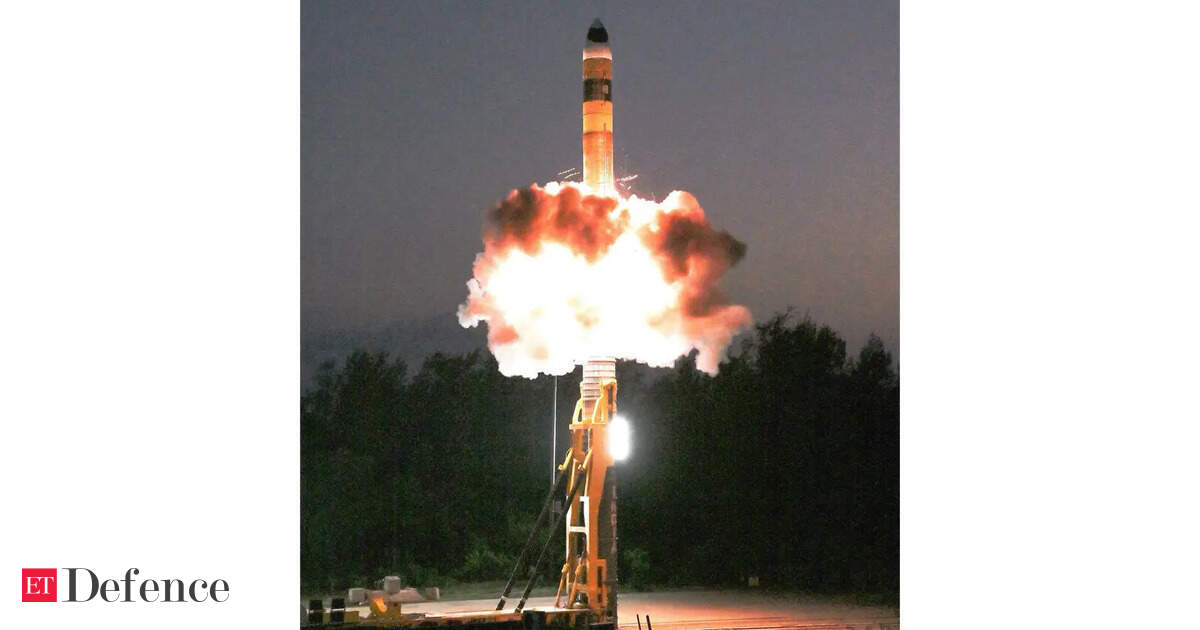
India’s successful test of an advanced Agni missile with a multiple independently targetable reentry vehicle (MIRV) system on May 8, 2026, is not just a demonstration of technological prowess. It reshapes the deterrence landscape in South Asia and introduces a new variable for defense stocks, regional risk premiums, and energy-shipping routes. Multiple payloads struck different targets across the Indian Ocean Region, confirming the system can deliver several warheads from a single booster. For markets, the immediate question is not whether India has MIRV, but how quickly neighbors accelerate their own programs and who captures the resulting budget flows.
MIRV and the Single-Missile Multiple-Target Shift
The simple read is that Indian defense contractors will rally on a successful trial, but that overlooks the mechanism. MIRV changes the arithmetic of missile defense. A single interceptor can no longer neutralize a single incoming threat when that threat splits into multiple warheads, each on an independent trajectory. The test signals that India can now hold at-risk several strategic locations simultaneously, raising the required investment in early-warning and intercept systems for Pakistan and China. This is not a one-time headline; it resets the baseline for regional arms procurement.
The better market read is that the test forces a multi-year spending supercycle in missile defense and counter-strike systems across the Indo-Pacific. Funds that had already priced in steady-state Indian modernization must now factor in reactive programs from Islamabad and Beijing. The ripple effect extends to radar, satellite surveillance, and command-and-control infrastructure, the exact categories that appear in recent US and European defense authorizations but with a new urgency in the Indian Ocean theater.
Regional Arsenal Race and Defense Contractor Exposure
The MIRV milestone arrives as India’s defense capital expenditure already runs well above pre-pandemic levels. State-owned producers like Bharat Dynamics and Hindustan Aeronautics, along with private suppliers building subsystems, could see order-book expansion beyond the current pipeline. But the less obvious exposure is in companies that supply missile-guidance electronics, composite casings, and thermal-protection materials because MIRV demands miniaturization. Foreign manufacturers with licensed production in India may also benefit if New Delhi fast-tracks follow-on tests.
The risk is not symmetrical, however. Pakistan will almost certainly escalate its own MIRV program, possibly with Chinese technology. This introduces a dual-track spending path that history shows is hard to stop once it starts. Defense stocks in both countries could run, but the premium comes with a persistent conflict-pricing tail. Meanwhile, logistics and shipping firms dependent on Indian Ocean sea lanes face a repricing of war-risk insurance if the strategic messaging is read as more than a test.
What Caps the Risk Versus What Accelerates It
The MIRV test can be absorbed without broad market dislocation if three conditions hold:
- India frames the test as a deterrence upgrade within existing nuclear doctrine rather than an operational shift.
- The test is not immediately followed by a high-profile Pakistani or Chinese counter-test in the same waters.
- Ship insurers and energy traders treat the trial as a one-off demonstration rather than a permanent change in threat level.
Conversely, conditions that would accelerate the risk premium include:
- Official statements from Islamabad or Beijing that explicitly link the MIRV test to a new arms race.
- Exercise activity in the Indian Ocean that ties the missile capability to a naval posturing shift.
- A spike in credit-default-swap spreads for Indian or Pakistani sovereign debt, signaling that fixed-income markets begin pricing in instability.
Traders tracking Indian defense primes should watch the next biannual defense procurement council meeting for any accelerated MIRV-related line items. Energy desks with exposure to the Strait of Malacca or Arabian Sea transit routes should monitor war-risk rates from London marine insurers in the forty-eight hours following any official Chinese response. The real signal is not the test itself, but the speed of the response cycle it triggers.