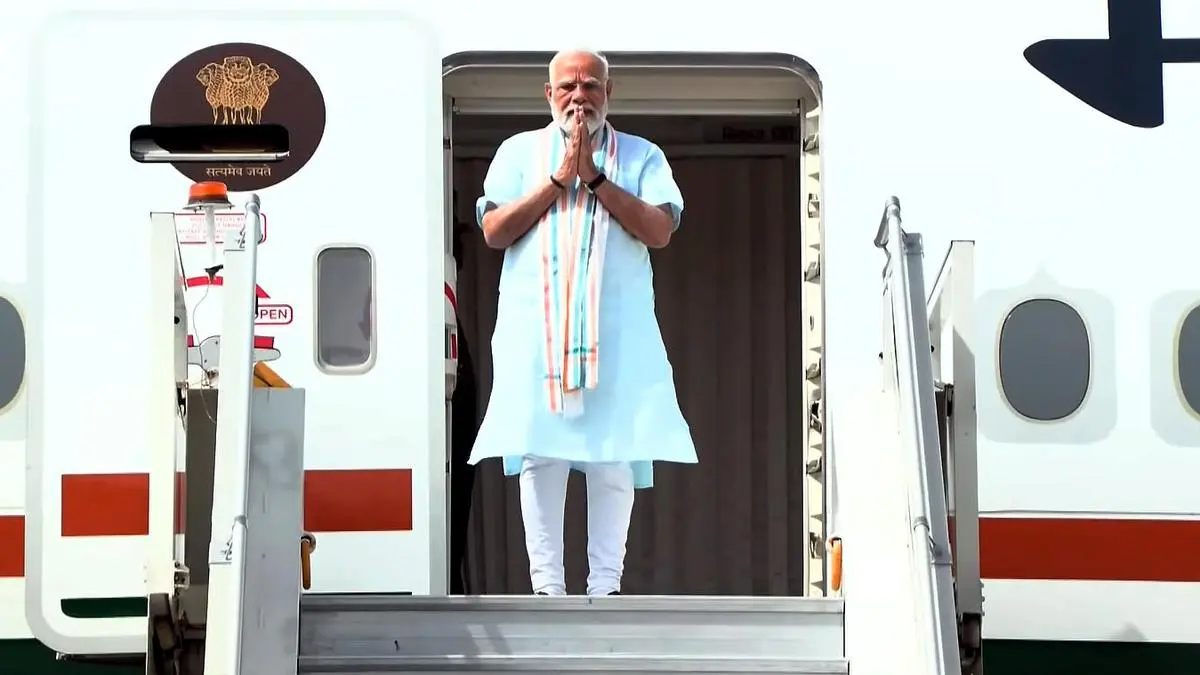
Prime Minister Narendra Modi returned to New Delhi on Thursday after a five-nation tour that ended in Italy with the upgrade of bilateral ties to a Special Strategic Partnership. The practical question for Indian equity traders is which sectors carry genuine exposure to the deliverables and which are priced on narrative alone.
The tour covered the UAE, the Netherlands, Sweden, Norway, and Italy. The final stop produced the most concrete outcomes: a joint target of €20 billion in bilateral trade by 2029, several Memorandums of Understanding (MoUs), and a commitment to conclude the India-European Union Free Trade Agreement negotiations. Modi is scheduled to chair a Council of Ministers meeting at Sewa Teerth at 5 PM Thursday, with sources flagging governance and fuel prices as likely agenda items.
The Special Strategic Partnership and Its Trade Mechanism
Modi and Italian Prime Minister Giorgia Meloni agreed to elevate the relationship to a Special Strategic Partnership. In a post on X, Modi said the decision "will add new momentum to our cooperation in the years to come."
The simple read is that deeper diplomatic ties boost bilateral trade. The better market read requires parsing the specific MoUs signed. According to the Ministry of External Affairs, the two sides inked agreements in:
- Defence
- Connectivity
- Agriculture
- Traditional medicine
- Education
- Mobility
- Critical technologies
Each area maps to a distinct set of Indian industries. Defence MoUs open the door for joint production and technology transfer – a tailwind for defence manufacturing stocks. Critical technologies cover semiconductors, AI, quantum computing, and space, which directly touch the IT services and electronics manufacturing ecosystem. Agriculture and traditional medicine benefit exporters of pharma, spices, and ayurvedic products.
The €20 Billion Trade Target: Ambitious and Conditional
The bilateral trade target of €20 billion by 2029 is roughly double the current level. The mechanism to reach it is the India-EU FTA, which the source says was "concluded earlier this year." If ratified, the FTA would slash tariffs on Indian textiles, leather, and auto components – sectors that have long complained about European protectionism.
Risk to watch: MoUs are non-binding. Past India-Italy trade growth has averaged about 5% annually over the last decade. Hitting €20 billion requires a step-change in execution, particularly on the FTA ratification timeline. Any delay from the European Parliament or the Italian government would weaken the thesis for trade-exposed stocks.
Council of Ministers Meeting: The Near-Term Catalyst on Fuel Prices
The Council of Ministers meeting scheduled for Thursday evening is the near-term catalyst that matters more than the diplomatic tour. Sources cited in the source say the agenda includes governance and fuel prices, the latter driven by rising global crude and the West Asia conflict disrupting the Strait of Hormuz.
India imports about 85% of its crude oil, and roughly 60% of that passes through the Strait of Hormuz. Any disruption – even a temporary one – forces the government to choose between absorbing higher costs (hurting fiscal math) or passing them on to consumers (hurting inflation and consumption).
Practical rule for energy stocks
If the Council of Ministers signals a subsidy or price freeze, oil marketing companies (OMCs) take the margin hit. If it signals a pass-through, OMCs benefit. Consumer-facing sectors – auto, FMCG, aviation – face demand risk from higher fuel prices. The market will price this trade-off within hours of the meeting's outcome.
Sector Readthrough: Defence, Technology, and Trade-Exposed Names
Without named tickers in the source, the readthrough is sectoral. The mechanism is clear enough to build a watchlist framework.
Defence
The defence MoU is the most tangible deliverable. Italy is a major defence exporter, and India is the world's largest arms importer. Joint ventures in naval systems, avionics, and cyber security are plausible. The readthrough is positive for Indian defence primes and mid-cap suppliers. Execution risk is high – past defence MoUs with European nations have often stalled on technology transfer clauses.
Technology and Critical Technologies
The critical technologies MoU covers semiconductors, AI, quantum computing, and space. Italy has strong R&D in photonics and microelectronics. For Indian IT services and electronics manufacturing, this could mean co-development contracts and IP licensing – a higher-margin revenue stream than plain outsourcing. The sector's current valuation already prices in a strong FTA outcome. Any disappointment on ratification would hit multiples.
Trade-Exported Sectors
- Textiles and apparel: High tariff sensitivity. An FTA would cut EU duties of 10–12% to near zero.
- Pharma and traditional medicine: India already exports $2 billion in pharma to Italy. The traditional medicine MoU could open a new category for ayurvedic and herbal products.
- Auto components: EU tariffs on auto parts average 4–6%. A zero-tariff regime would boost exports of castings, forgings, and electrical components.
Risks: Execution, Geopolitical Headwinds, and Fuel Price Pass-Through
The bullish case for the India-Italy partnership rests on three assumptions: the FTA is ratified quickly, the MoUs convert into contracts, and energy prices stay stable. All three are fragile.
Execution risk is the biggest. India has signed dozens of strategic partnerships over the last decade. Few have produced measurable trade acceleration. The €20 billion target is a political statement, not a binding commitment.
Geopolitical headwinds are also real. The West Asia conflict and the Russia-Ukraine war were discussed during the Modi-Meloni talks. Any escalation that disrupts energy supply chains would hurt India's trade balance and force the government to prioritize energy security over trade liberalization.
Fuel price pass-through is the immediate risk. If the Council of Ministers opts for a subsidy, the fiscal deficit widens and bond yields rise, compressing equity valuations across the board. If it opts for a pass-through, inflation ticks up and the RBI delays rate cuts – a headwind for rate-sensitive sectors like real estate and auto.
Next Decision Point: Council of Ministers Outcome and FTA Timeline
The Council of Ministers meeting today is the first concrete test of the government's policy direction post-tour. Traders should watch for:
- Any announcement on fuel price caps or excise duty cuts.
- Signals on FTA ratification timeline.
- Specific defence procurement mentions.
The next major catalyst is the India-EU FTA ratification vote in the European Parliament, expected in the coming months. Until then, the sector readthrough remains a narrative trade. Real money will flow only when contracts replace communiqués.
Bottom line for traders: The India-Italy partnership is a long-term narrative. The real near-term driver is the Council of Ministers meeting on fuel prices. Watch that outcome first, then build sector exposure.
For broader context on how diplomatic shifts affect equity positioning, see our stock market analysis. For energy sector specifics, the APFWX Q1 Outperformance Signals Value Income Energy Play piece covers the oil marketing dynamics that apply here.