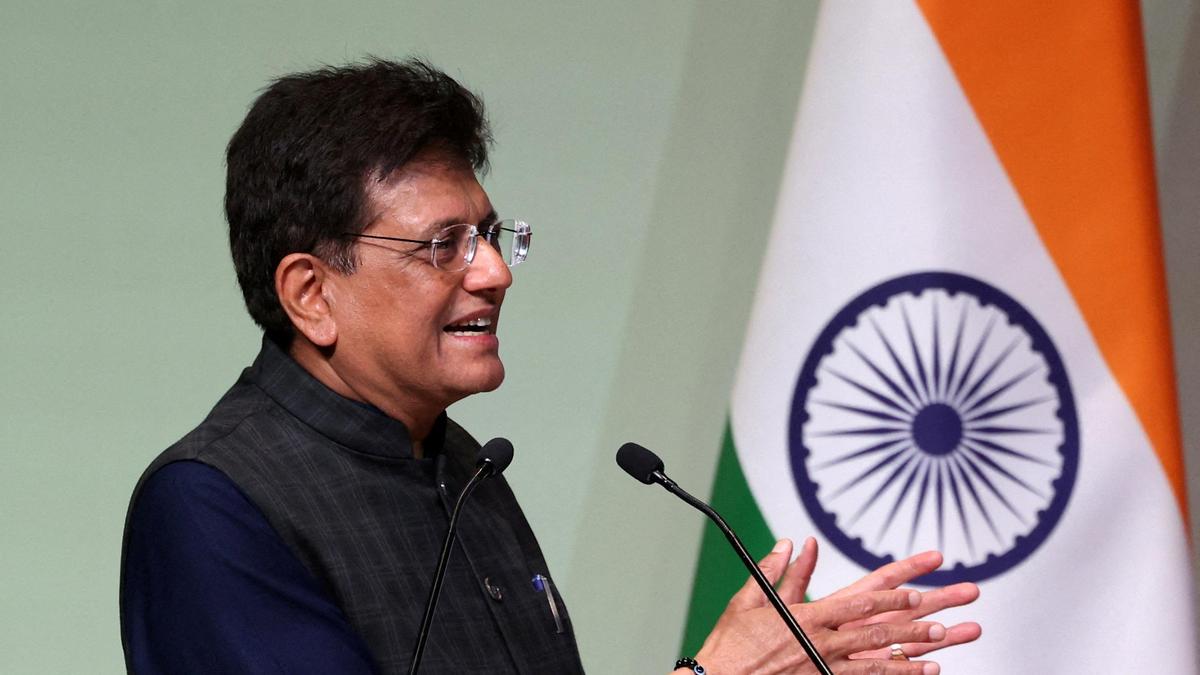
India's Commerce Minister Piyush Goyal will lead a delegation of about 150 Indian industry leaders to Canada from May 25 to May 27, the government announced on Saturday. The visit targets a reset in bilateral economic engagement after diplomatic tensions stalled trade talks.
Goyal told a news briefing that the delegation will hold meetings with Canadian ministers, business leaders, and industry groups in Ottawa and Toronto. The trip follows Prime Minister Mark Carney's visit to New Delhi in March, when both countries agreed to finalise the terms of reference for negotiating a comprehensive economic partnership agreement.
The $50 Billion Bilateral Trade Target
India and Canada aim to reach $50 billion in bilateral trade over the next five years and increase Canadian investment, Goyal said. Canadian pension funds and companies have already invested nearly $100 billion in India. About 600 Canadian companies operate in India, with both sides aiming to raise that number to 1,000.
The trade target implies a roughly 50% increase from current levels. India's exports to Canada were about $4 billion in fiscal 2024, while imports from Canada stood near $3 billion, according to government data. The $50 billion figure likely includes services and investment flows, not just merchandise trade.
Sector Focus: Energy, Critical Minerals, and Textiles
Goyal said India expects to sign a free trade agreement with Canada covering sectors such as energy and critical minerals, while creating opportunities for Indian textile and leather companies. Discussions during the trip will focus on cooperation in technology, food processing, clean energy, and critical minerals.
Critical minerals are a strategic priority for India, which imports most of its lithium, cobalt, and rare earth elements. Canada holds significant reserves of these minerals, making it a natural supply-chain partner. The energy angle includes potential Canadian investment in India's oil and gas infrastructure and clean energy projects.
The Diplomatic Reset Mechanism
The visit marks the most high-profile Indian trade delegation to Canada since diplomatic tensions escalated in 2023. The two countries had paused trade agreement talks after a diplomatic dispute. Carney's March visit to New Delhi reopened the channel.
Key insight: The Carney government's willingness to restart trade talks signals a pragmatic shift. India is Canada's 10th-largest trading partner, and Canada is India's 17th-largest. Both economies have complementary strengths: Canada has energy, minerals, and pension capital; India has a large consumer market, IT services, and manufacturing capacity.
What Confirms the Thesis
- Finalised terms of reference for the comprehensive economic partnership agreement, expected to be announced during or shortly after the visit.
- Concrete investment commitments from Canadian pension funds in Indian infrastructure, renewable energy, or data centers.
- Sector-specific MOUs in critical minerals, food processing, or technology.
What Would Weaken the Thesis
- No FTA timeline emerging from the visit. If the trip produces only general statements without a negotiation roadmap, the $50 billion target remains aspirational.
- Renewed diplomatic friction on any issue, which could freeze talks again.
- Canadian domestic political headwinds that slow ratification of any eventual agreement.
The Canadian Pension Capital Angle
Canadian pension funds – Canada Pension Plan Investment Board, Ontario Teachers' Pension Plan, Caisse de dépôt et placement du Québec – have been among the most active foreign investors in Indian infrastructure, real estate, and financial services. Their nearly $100 billion in Indian exposure makes them a key constituency for deeper trade ties.
These funds seek stable, long-term returns in a growing economy. India's infrastructure push – roads, ports, renewable energy, data centers – offers exactly that. A trade deal would reduce regulatory uncertainty for these investors and potentially open new sectors.
The Textile and Leather Opportunity
Indian textile and leather exporters face high tariffs in Canada under the current most-favored-nation regime. A free trade agreement would eliminate or reduce these duties, making Indian products more competitive against suppliers from Bangladesh, Vietnam, and China. The Indian textile industry, which employs about 45 million people, has been losing market share in developed economies. Canada is a relatively small market – about $1.5 billion in Indian textile exports annually – but a trade deal could serve as a template for similar agreements with other developed markets.
Bottom Line for Traders
The Goyal visit is a concrete step toward resetting India-Canada economic relations. The $50 billion trade target and 1,000 Canadian companies goal are ambitious but not impossible if both governments maintain political will. The sectors to watch are critical minerals, energy, textiles, and pension fund investments. A successful visit would confirm that the diplomatic reset is real and that the FTA negotiation has a clear path forward.
For investors tracking India's trade story, this is a signal that the government is actively pursuing alternative supply-chain partners outside China. Canada's resource wealth and capital markets make it a natural fit. The next concrete marker is the finalised terms of reference for the trade agreement, which Goyal said is expected soon.