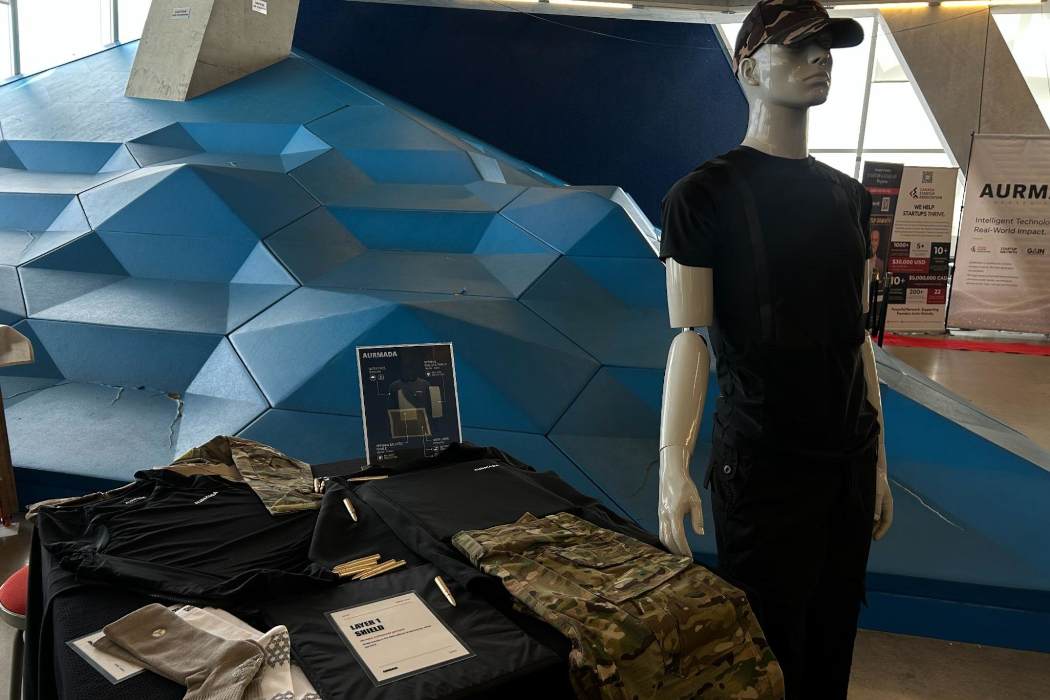
Aurmada founder and CEO Zavosh Zaboliyan held up a T-shirt at Toronto Tech Week on Thursday and reminded the audience that the humble garment began as a US Navy undergarment in the 1910s. His startup wants to take that military-to-civilian arc one step further – embedding bulletproof fabric and environmental sensors into everyday clothing.
“It’s less about ‘bulletproof’ as a function or feature, and more about an infrastructure layer for clothing to begin with,” Zaboliyan told BetaKit, which is Toronto Tech Week’s official media partner. The event was co-hosted by the non-profit Canada Startup Association and Toronto Metropolitan University’s Fashion Zone. TMU student volunteers walked attendees through the technology on display.
Aurmada’s Base Layer vs. Heavy-Duty Vests
Aurmada has developed a line of base layer tops woven with Kevlar material. The company positions these as a lighter alternative to heavy-duty ballistic vests. The current product line focuses on ballistic protection alone. Future iterations will add sensor modules.
One jacket prototype on display inflates to cool the wearer. The cooling function requires a connection to a power bank kept in the jacket pocket – a current limitation that highlights the energy-density challenge the company must solve before commercial deployment.
Sensor modules for mining, police, military
The sensors demonstrated at the event process external data including moving objects, sounds, temperature, and pressure. Zaboliyan explained that the sensor suite can be customized per end user.
- A worker in the mining sector might need external air quality sensors.
- Military personnel could require sensors for monitoring body temperature.
- Police forces might prioritize threat detection from moving objects.
Zaboliyan described the roadmap: “With each layer, the technologies we embed will get smarter.” The company envisions a modular platform where each garment layer adds a new function, from protection to environmental monitoring to communication.
Private Security Firms as First Adopters
Selling directly to the Canadian Armed Forces is a known challenge for defence tech startups due to existing procurement rules. Aurmada sidesteps that bottleneck by focusing on private security firms, industrial companies, and police forces as initial customers. Those buyers typically have faster purchasing processes and less regulatory friction than military procurement.
Zaboliyan noted that any data collected by the sensors would be stored locally to preserve data privacy. That design choice addresses a common regulatory hurdle for wearable tech in sensitive sectors.
The dual-use investment case
Aurmada’s pitch to investors rests on a simple premise: the addressable market is not just body armor but the entire clothing industry. If the company can embed its sensors and ballistic fabric into everyday apparel, it competes with traditional textile manufacturers, not just defence contractors. The global body armor market is valued in the billions. A dual-use strategy that adds industrial and security clients expands that ceiling.
Key insight: Aurmada is not selling a single product. It is selling a platform for clothing-based infrastructure. The base layer is the entry point. Future revenue would come from sensor subscriptions, data analytics, and licensing the fabric to larger apparel brands.
The company’s strategy mirrors a broader trend in defence technology – startups building commercial applications first to generate revenue while military procurement cycles drag. For more on how defence budget dynamics affect emerging tech companies, see our analysis of the Massie Primary Loss Lowers Defense Budget Hurdle.
Power Bank Dependency and Scaling Challenges
Several risks are material at this stage. The jacket prototype’s reliance on a power bank highlights the current energy-density limitation. Scaling sensor integration while keeping garments washable and durable is a known engineering challenge. The company’s reliance on Kevlar – a branded material from DuPont – introduces supply chain concentration risk.
Competition is also fragmented. Established ballistic vest makers like Point Blank Enterprises and Safariland have decades of relationships with law enforcement. Aurmada will need to prove that its lighter base layer offers comparable protection at a competitive price. The company’s edge is not ballistic performance alone but the integration of sensors into a comfortable, everyday garment.
Next Catalyst: Pilot Contract with a Security Firm
A confirmed thesis would look like a pilot contract with a large private security firm or a police department. A weakened thesis would emerge if the company fails to move beyond prototypes within 12 months or if a major textile competitor launches a similar sensor-integrated fabric.
For now, Aurmada is an early-stage bet on the convergence of defence materials and consumer wearables. The Toronto Tech Week demo showed the concept is real. The next step is commercial traction. Readers tracking emerging technology companies can monitor the broader stock market analysis landscape for signs of how these private startups eventually reach public markets.
All images courtesy Madison McLauchlan for BetaKit.