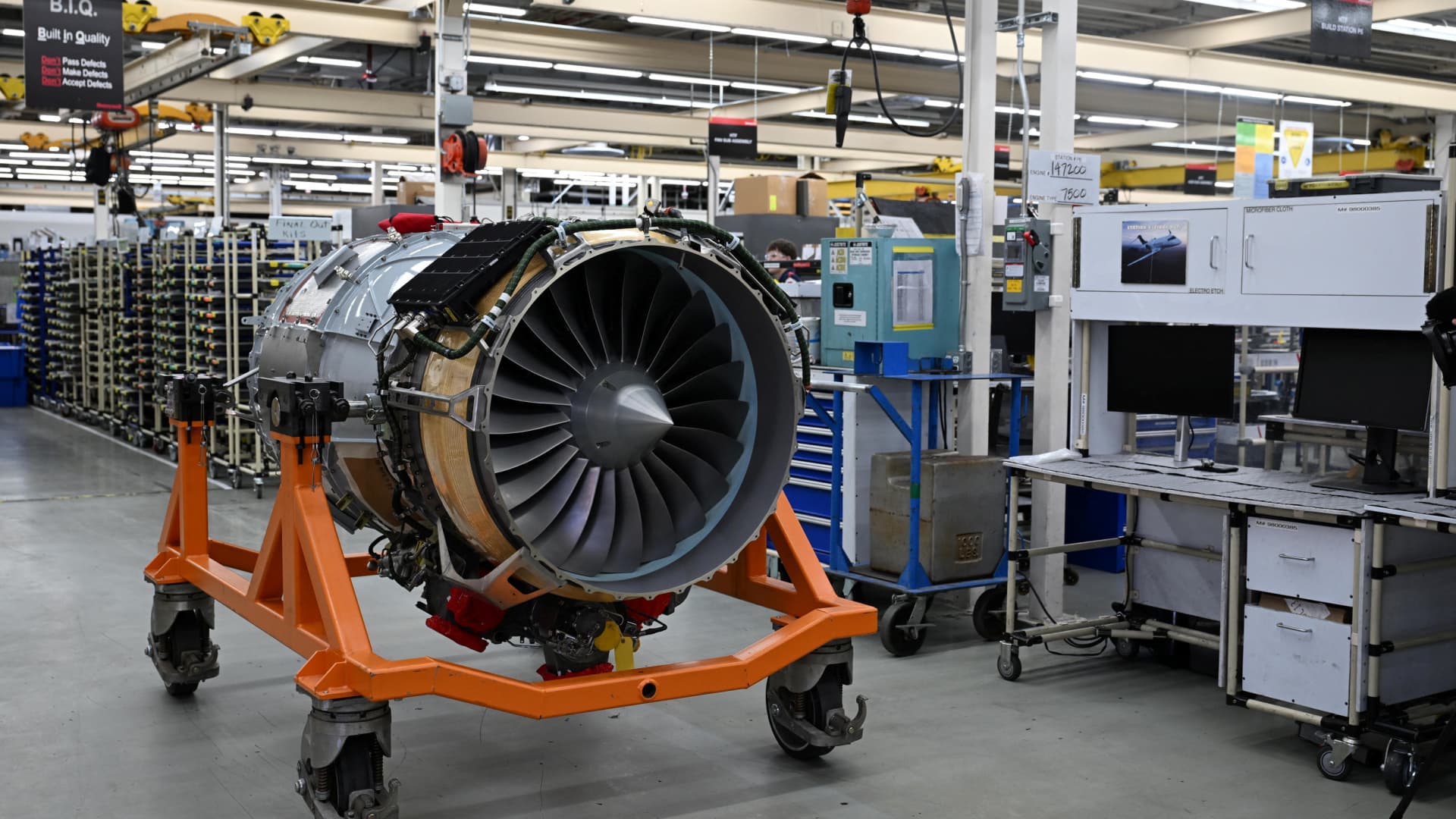
Honeywell Aerospace is set to complete its spin-off from Honeywell International later this month, and CEO Jim Currier is making the case that the standalone company can deliver significant growth. At an investor day in Scottsdale, Arizona, Currier laid out 2026 and 2030 targets that will form the benchmark for investors evaluating the pure-play aviation and defense supplier.
The company expects full-year 2026 adjusted earnings before interest and taxes of $4.65 billion to $4.75 billion, with free cash flow in the second half of the year of $1 billion to $1.5 billion. By 2030 the targets rise to annual earnings of at least $6.5 billion and free cash flow of at least $4 billion.
"We have a purpose-built management team just solely focused on one strategy, one mission as opposed to disparate missions of a conglomerate," Currier told CNBC.
2026 Guidance and Free Cash Flow Trajectory
Currier expects organic annual sales growth of 6% to 8% through 2030, with annual earnings growth of 9%. The 2026 EBITDA range implies a 24% to 25% margin on roughly $19 billion in projected revenue, consistent with the 24.5% margin the business generated last year on profits topping $4.2 billion.
The Pure-Play Premium: GE Aerospace as a Template
The spin-off is a direct response to Honeywell International's prolonged stock underperformance. Since June 2023, Honeywell shares have gained about 20%, compared to the S&P 500's roughly 77% return. The conglomerate structure depressed valuations and obscured the aerospace division's results.
GE Aerospace provides a clear blueprint. Since becoming a standalone company in April 2024, its stock has jumped about 125%, easily outpacing the S&P 500 (up nearly 45%) and Honeywell International (up roughly 20%).
Currier believes Honeywell Aerospace can replicate that success. "The greatest growth for us is occurring in the commercial transport market and in defense and space," he said. The company has "record" backlog orders from Airbus and Boeing.
Supply Chain Disruptions Cast a Shadow on First Quarter
Honeywell Aerospace faced questions about recent supply chain challenges during the first quarter. The company said the temporary issues were tied to the war in the Middle East, which weighed on its engines and control systems divisions in January and February.
Middle East Conflict and Supplier Corrective Actions
Management stated that problems with some suppliers have been corrected since then. Still, analysts are likely to press Currier for more detail on the state of the supply chain and whether any residual risks remain.
Wolfe Research analyst Nigel Coe wrote in a recent note that the investor day is "an opportunity for management to convert a generally skeptical crowd of aerospace specialists."
What this means: Honeywell Aerospace must demonstrate that its supply chain is fully stable. Any disruption to the record Airbus and Boeing backlogs would undermine the standalone growth story.
AlphaScala Read: Honeywell International's Mixed Score and the Spin-off Calculus
Honeywell International (ticker HON) carries an AlphaScala Alpha Score of 49/100, labeled Mixed. That rating reflects the overhang from the conglomerate structure and the underperformance relative to pure-play peers.
The spin-off removes that discount. Honeywell Aerospace will trade as a focused entity with direct exposure to commercial aviation and defense spending. Investors can now evaluate the business on its own margins, backlog, and cash flow generation rather than as a division buried in a multi-industry report.
Solstice Advanced Materials, the third spun-off entity, carries an Unscored label and trades under SOLS in the Technology sector. The separation leaves Honeywell Technologies as the remaining industrial conglomerate.
Key insight: The 20% gain in Honeywell International shares since mid-2023 masks the aerospace division's performance. Standalone, the aerospace business may warrant a higher multiple in line with GE Aerospace.
What Would Confirm the Standalone Thesis
For Honeywell Aerospace to justify its 2030 targets, investors need to see consistent execution on three fronts:
- Backlog conversion: The "record" Airbus and Boeing orders must translate into revenue without margin erosion. Any delivery delays would weaken Currier's 6% to 8% organic growth projection.
- Defense and space momentum: Currier called defense and space a key growth area. U.S. defense budgets and international demand for military aircraft systems are macro variables that can accelerate or impede that segment.
- Free cash flow delivery: The 2026 H2 free cash flow target of $1 billion to $1.5 billion implies the company can convert roughly 25% of EBITDA into cash. Investors will watch for any deviation in quarterly cash flow statements after the spin-off.
The 2030 target of $4 billion free cash flow requires the company to nearly quadruple current cash generation in seven years. That is an aggressive target that will need double-digit earnings growth and sustained capital discipline.
The Risk: Execution Gap Between Guidance and Reality
Honeywell Aerospace's past results were obscured by the conglomerate structure. Now they are fully visible. The first quarterly report as a standalone company will face intense scrutiny. Any miss on the 2026 trajectory will reset expectations quickly.
Currier's team has a clear strategy. The question is whether the supply chain is fully healed and whether the commercial aviation cycle remains robust enough to support 9% annual earnings growth.
For AlphaScala readers, the HON stock page tracks the parent company's rating, which will likely change as the spin-off progresses. The broader stock market analysis section provides context on industrials and aerospace valuations. Honeywell Aerospace's investor day has set a high bar; now the market will judge whether the standalone structure can deliver returns that match the rhetoric.