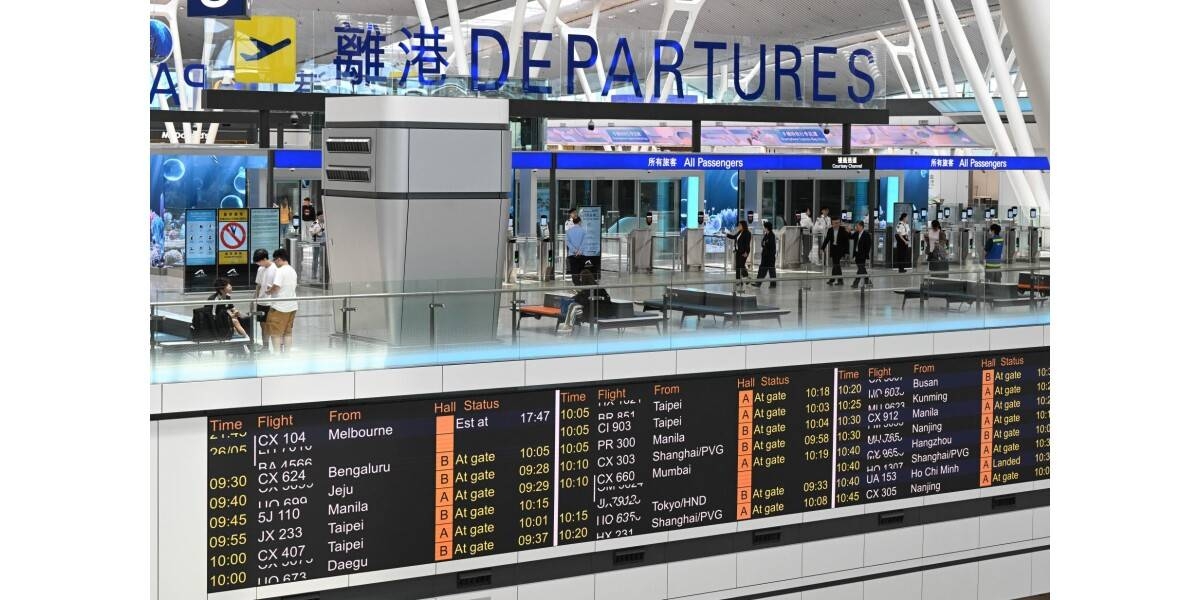
Catalyst: Terminal 2 Goes Live at Hong Kong International Airport
Hong Kong International Airport (HKIA) opened its expanded Terminal 2 (T2) on 27 May, adding 300,000 square metres of passenger space. The launch is not just a capacity event. It is a test of whether automation can reduce labor dependency while maintaining throughput in one of the world's busiest aviation hubs.
The simple read: a new terminal means more gates, more shops, more passengers. The better read: the operational design of T2 – specifically the 68 express self-bag drop counters, 58 smart check-in kiosks, and 108 hybrid check-in counters – targets a 45-second self-check-in process that could materially change the airport's cost structure and passenger flow.
The 45-Second Self-Check-In Target
Vivian Cheung, Chief Executive Officer of Airport Authority Hong Kong (AAHK), said the in-house self-check-in system requires 45 seconds to complete the entire process. "We want to help the airlines to migrate to a full-automation process, which will actually help passengers have better experiences and also reduce the labour needs," she said.
For an airport that handled 61 million passenger trips in 2025 (up 15% year-on-year), every second saved at check-in compounds into higher throughput per square metre and lower staffing costs. The risk is system reliability: a 45-second promise breaks if even one component – kiosk software, bag-tag printers, immigration e-gates – lags.
Technical Context: Passenger Throughput and Cargo Dominance
HKIA's 2025 passenger count of 61 million represents a recovery trajectory, though still below pre-pandemic peaks. The airport also retained its ranking as the world's busiest air cargo airport for the 15th time since 2010, handling 5.07 million tonnes of cargo last year.
Awards as Operational Signals
HKIA was named "Best Airport in the World" at the Global Travel Awards 2026 and "Best Airport in China" at the 2026 TTG China Travel Awards for the third consecutive year. These recognitions reflect performance in security processing, aviation infrastructure, and passenger services – all areas that T2's design targets directly.
- Security processing: T2's layout integrates large LED displays with 3D content and ocean-themed videos, which AAHK says creates a "vibrant atmosphere" that can reduce perceived wait times.
- Aviation infrastructure: The terminal has eight check-in aisles and 12 shops plus a food court with eight catering outlets, four of which operate 24 hours.
- Passenger services: The self-check-in system is designed to reduce labour needs, a structural cost advantage if adopted across the airport.
Confirmation: What Would Validate the T2 Thesis
The T2 launch is a catalyst, the setup is not confirmed until three conditions are met.
Airline Migration and Passenger Adoption
AAHK said it was "delighted to see the smooth relocation of airline partners to T2 and the positive passenger response." The next data point is whether airlines expand their self-check-in usage beyond the current 68 express bag-drop counters. If adoption rates push toward 80% of departing passengers using automated check-in, the labor reduction thesis gains credibility.
Throughput Per Square Metre
T2 spans 300,000 square metres. HKIA's total terminal area will now be larger, the key metric is passengers per square metre per hour. If T2 achieves higher density than Terminal 1 without longer queues, the design becomes a template for future expansions.
Cargo Synergy
HKIA's cargo volume of 5.07 million tonnes is a separate revenue stream, T2's automation could free up ground-handling resources for cargo operations. The airport's cargo dominance – 15 years as the world's busiest – means any efficiency gain in passenger processing indirectly supports cargo capacity by reducing congestion on shared infrastructure.
Invalidation Risk: System Reliability and Labor Pushback
The 45-second self-check-in target is ambitious. Any systemic failure – a software crash during peak hours, a bag-drop jam, or immigration e-gate delays – would undermine the automation narrative. AAHK has not disclosed redundancy measures or fallback procedures.
Labor Reduction as a Double-Edged Sword
Cheung explicitly cited "reduce the labour needs" as a goal. In a tight Hong Kong labor market, that is a selling point. Labor unions and service quality advocates may push back if automation leads to reduced staffing at help desks or baggage claim. The airport's awards for passenger services could be at risk if the human touch is stripped too far.
Macro Headwinds
Hong Kong's aviation recovery depends on outbound Chinese travel and regional competition from Shenzhen and Guangzhou. The National 15th Five-Year Plan supports Hong Kong's role as an international aviation hub, as noted by Acting Financial Secretary Michael Wong. Any slowdown in Chinese travel demand would reduce the throughput that T2 was built to handle.
Next Event: Full Automation Migration Timeline
AAHK has not published a timeline for migrating all airlines to the full-automation process. The next concrete marker is the percentage of passengers using self-check-in at T2 by the end of Q3 2026. If that figure exceeds 60%, the setup is intact. If it stays below 40%, the 45-second claim was marketing, not engineering.
For traders tracking Hong Kong's aviation sector, the T2 launch is a structural efficiency event, not a one-day headline. The stock market analysis context matters: any listed airline or airport services company with exposure to HKIA will see margin implications from automation adoption. The best stock brokers can provide access to Hong Kong-listed names if the setup confirms.
Bottom line for traders: T2's automation is the real catalyst, not the square footage. Watch the self-check-in adoption rate and labor cost disclosures from AAHK's airline partners. A miss on either invalidates the efficiency thesis.