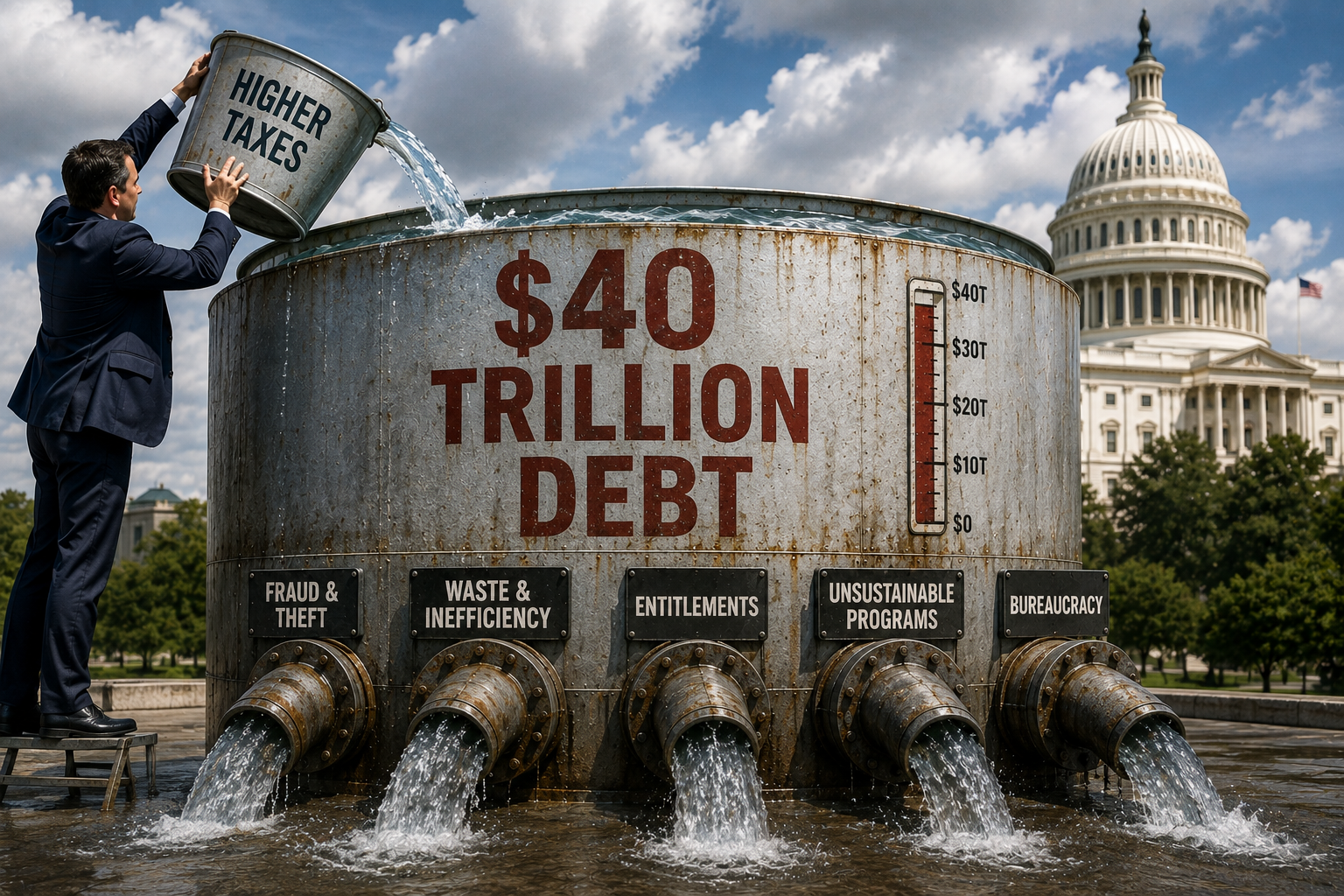
The U.S. national debt crossed $40 trillion this week, a milestone that has reignited debate over how to close the gap. A new analysis argues that raising taxes on the rich will not solve the problem, pointing to eight decades of data showing that tax revenue as a share of GDP has barely budged despite wild swings in rates.
The piece, published online, uses the World War II era as a starting point. In 1944, the top income tax rate hit 94%, the highest in U.S. history. Americans bought war bonds and paid elevated taxes to fund the fight. Yet total government revenue that year reached just 20.5% of GDP.
That figure has been the ceiling. Over the next 80 years, revenue averaged between 17% and 18% of GDP. The low came in 1950, at 14.2%, during a recession. The high was 20% in 2000, at the peak of the dot-com boom when capital gains taxes surged. The pattern holds: rates change, revenue stays in a narrow band.
Tax Revenue Stuck at 17–18% of GDP for Decades
The analysis attributes the stability to human behavior. When marginal tax rates rise, people and businesses restructure their affairs. They shift income into tax shelters, defer revenue, or find legal ways to reduce what they owe. The same logic applies to wealth taxes.
According to the piece, imposing a 90% tax on income above $2 million a year would theoretically generate $200 billion to $300 billion in additional revenue. But after accounting for behavioral changes, the real take would collapse to less than $50 billion annually.
A wealth tax on unrealized gains would face similar problems. The analysis warns that forcing billionaires to sell stock to pay the tax would depress share prices and reduce capital gains revenue elsewhere. If Elon Musk had to sell 10% of his Tesla (TSLA) stake, the stock would fall. That would slash tax revenue from other investors, offsetting much of the gain.
The piece cites the Government Accountability Office, the federal government's own watchdog, which estimates that hundreds of billions of dollars are lost to fraud and theft each year. Cutting that waste, the analysis argues, would be the easiest step toward reducing deficits. Harder reforms include streamlining government operations, fixing entitlements, and slashing regulations.
None of these steps are being taken, the piece notes. Congress has shown little appetite for tackling fraud. The courts and media often block those who try to cut spending. The result is a $40 trillion debt with no credible plan to stabilize it.
The analysis holds out hope that artificial intelligence and nuclear power could supercharge economic growth enough to shrink the debt as a share of GDP. Until then, it warns, the country needs a Plan B.