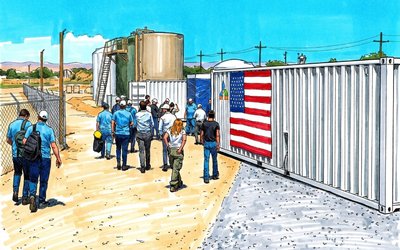
Anson Resources secures final major government approval for its Green River lithium project in Utah, clearing the path for a 10,000tpa plant as the company moves into the financing phase.
Anson Resources has received small-scale mining approval for its Green River lithium project in Utah, a step the company calls the final major government permit needed for its planned 10,000-tonne-per-annum lithium carbonate plant.
The permit covers the direct lithium extraction processing site and the brine extraction field. It also includes the spent-brine disposal field. All sit on land Anson owns near Green River city, about 1.3 kilometres east of the river and north of Interstate 70.
Chief executive officer Bruce Richardson said the approval "is a significant step forward in the development of the project." He credited three years of relationship-building with government departments. "The end of the permitting process takes the company into the next critical phase of project financing."
Anson plans to build the plant on a 59.6-hectare parcel it bought in 2023, already zoned for industrial use. The property enables extraction, processing, transport and disposal within its boundaries under a simpler approvals framework.
An internal review of the front-end planning scoping study identified potential capital savings from shifting the planned plant south and removing some infrastructure. The definitive engineering study under way will quantify those savings and provide cost estimates for discussions with strategic partners, investors and lenders.
The site has access to interstate roads and the national rail network. Power and gas infrastructure are on hand, along with a local workforce. Process water will come from Green River city supply or the river itself. Anson plans to use previously disturbed areas for well pads to reduce the environmental footprint.
The Utah Department of Environmental Quality has already approved an underground injection control application. Anson will drill new disposal wells during construction to reinject spent brine into subsurface formations. The company built three-dimensional subsurface models to guide well design and fluid-flow simulations.
Historical oil and gas wells in the area intersected comparable brine-bearing formations, some later converted into disposal wells. The current plant layout places processing within 200 to 600 metres of proposed extraction wells, with disposal wells 250 to 1,750 metres away connected by dedicated pipelines.
For a broader view of commodity project financings and the lithium market backdrop, see our commodities analysis.
Prepared with AlphaScala research tooling and grounded in primary market data: live prices, fundamentals, SEC filings, hedge-fund holdings, and insider activity. Each story is checked against AlphaScala publishing rules before release. Educational coverage, not personalized advice.