Government Reaffirms Delimitation Act Stability Amid Seat Expansion Debate

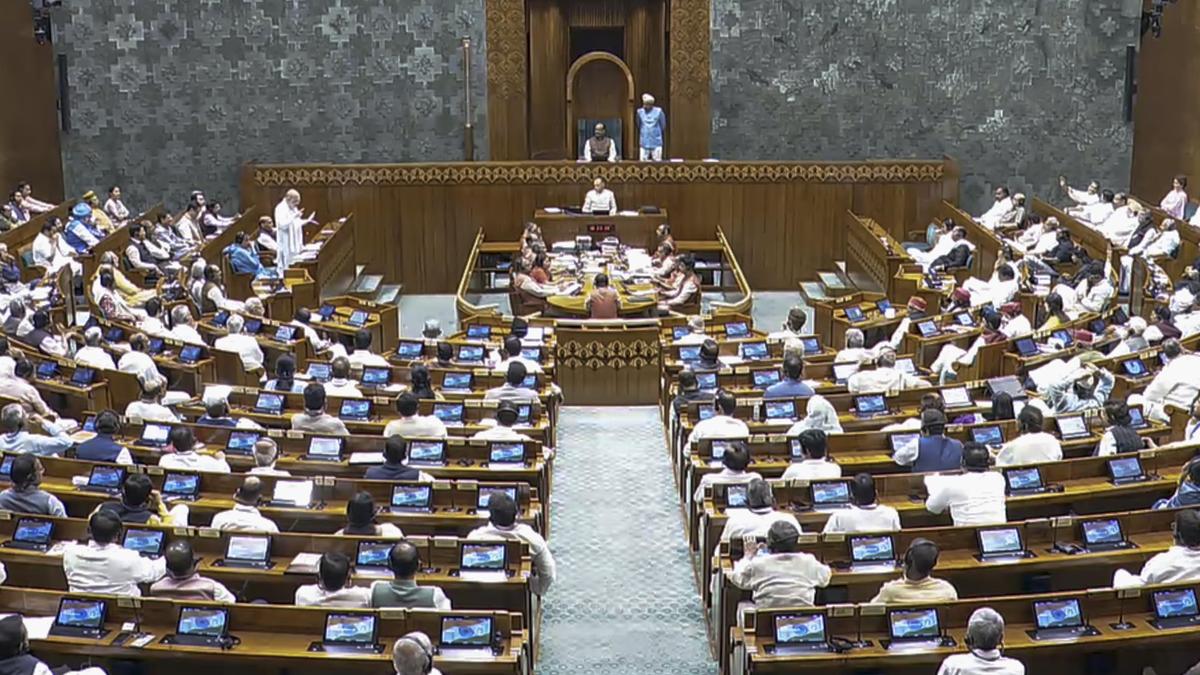
The Indian government has ruled out changes to the Delimitation Commission Act, effectively halting immediate plans to expand Lok Sabha seats despite significant population growth since 1971.
Alpha Score of 47 reflects weak overall profile with moderate momentum, poor value, moderate quality. Based on 3 of 4 signals — score is capped at 90 until remaining data ingests.
Alpha Score of 55 reflects moderate overall profile with moderate momentum, moderate value, moderate quality. Based on 3 of 4 signals — score is capped at 90 until remaining data ingests.
Alpha Score of 48 reflects weak overall profile with poor momentum, strong value, strong quality. Based on 3 of 4 signals — score is capped at 90 until remaining data ingests.
Alpha Score of 40 reflects weak overall profile with strong momentum, poor value, poor quality. Based on 3 of 4 signals — score is capped at 90 until remaining data ingests.
The Indian government has officially clarified that it holds no intention to propose changes to the Delimitation Commission Act. This statement serves as a direct response to ongoing public discourse regarding the discrepancy between current parliamentary representation and the country's population growth. While the government acknowledged the statistical reality that the population has expanded from 54 crore in 1971 to over 140 crore today, it maintains that the existing legislative framework remains unchanged.
Legislative Constraints and Population Dynamics
The current limit for Lok Sabha seats was established at 550 in 1976. Proponents of reform have argued that the significant demographic shift necessitates an expansion to 850 seats to ensure adequate representation for the electorate. Despite these calls for structural adjustment, the government's stance indicates a preference for maintaining the status quo regarding the legal mechanisms that govern electoral boundaries and seat allocations.
This decision carries weight for long-term policy planning and regional political stability. By confirming that the Delimitation Act will not be modified, the government has effectively paused speculation regarding a near-term overhaul of the parliamentary structure. The focus remains on the existing constitutional provisions that define how representation is distributed across the nation, including the specific protections for Scheduled Castes and Scheduled Tribes.
Impact on Political and Economic Stability
Market participants often monitor such legislative stability as a proxy for broader governance predictability. When major structural reforms are signaled as off the table, the focus shifts back to standard fiscal policy and economic management. For investors tracking stock market analysis, the clarity provided by the government helps in assessing the continuity of the current regulatory environment.
While the debate over seat expansion highlights the tension between demographic growth and legislative capacity, the government's refusal to amend the Act suggests that political capital will be directed elsewhere. This development provides a clear boundary for those analyzing the potential for constitutional or electoral shifts that could influence the national policy trajectory.
AlphaScala data currently tracks various technology sector entities, such as NOW stock page and ON stock page, which maintain mixed Alpha Scores of 48/100 and 40/100 respectively. While these firms operate in a different sphere than legislative policy, the broader environment of regulatory certainty remains a foundational element for all domestic market participants.
The next concrete marker for this issue will be the upcoming parliamentary sessions, where the government's adherence to this stated policy will be tested against any new private member bills or renewed demands from opposition factions. Observers should watch for any subsequent official white papers or committee reports that might address the population-to-seat ratio without requiring a formal amendment to the Delimitation Act itself.
AI-drafted from named sources and checked against AlphaScala publishing rules before release. Direct quotes must match source text, low-information tables are removed, and thinner or higher-risk stories can be held for manual review.