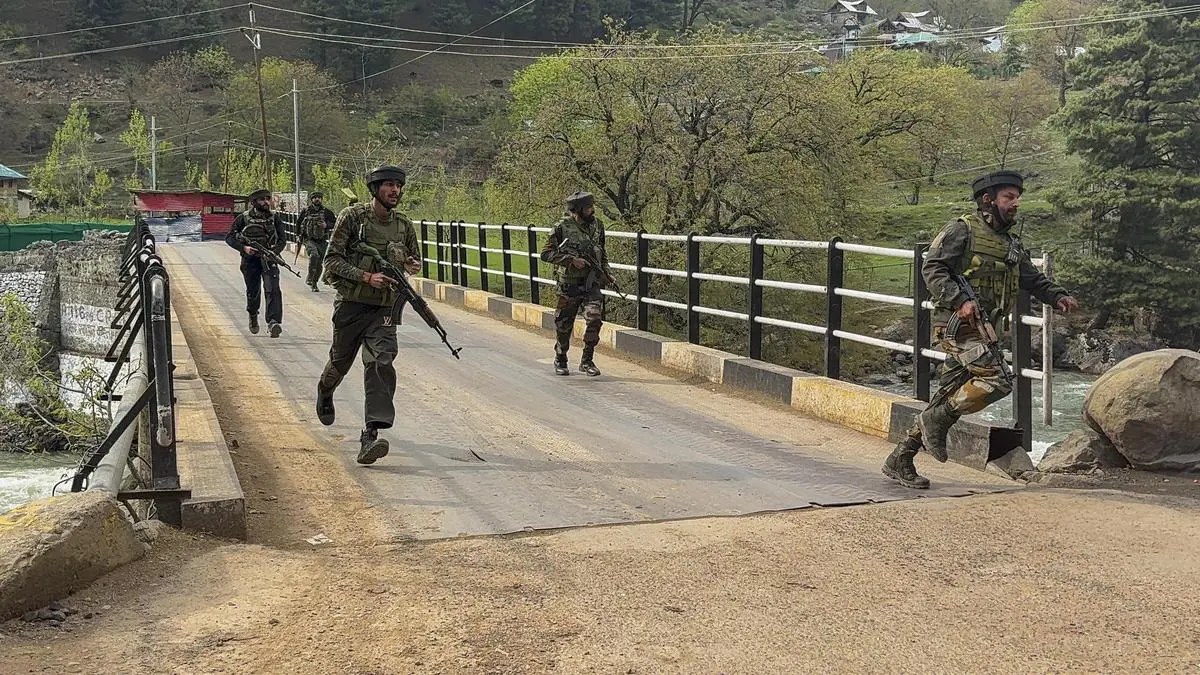
Geopolitical Stability and Indian Market Resilience Post-Pahalgam Anniversary

Prime Minister Narendra Modi's reaffirmation of India's stance against terrorism highlights the ongoing focus on regional stability as a prerequisite for sustained economic growth and investor confidence.
Alpha Score of 45 reflects weak overall profile with strong momentum, poor value, poor quality, weak sentiment.
Alpha Score of 47 reflects weak overall profile with moderate momentum, poor value, moderate quality. Based on 3 of 4 signals — score is capped at 90 until remaining data ingests.
Alpha Score of 55 reflects moderate overall profile with moderate momentum, moderate value, moderate quality. Based on 3 of 4 signals — score is capped at 90 until remaining data ingests.
Alpha Score of 58 reflects moderate overall profile with weak momentum, strong value, moderate quality, weak sentiment.
Prime Minister Narendra Modi reaffirmed India's stance against terrorism on the anniversary of the Pahalgam attack, emphasizing that the nation will not yield to external security threats. This declaration serves as a reminder of the geopolitical environment that influences investor sentiment regarding the stability of the Indian subcontinent. For domestic and international capital, the commitment to maintaining security is a foundational element of the broader stock market analysis that underpins long-term growth projections in the region.
Security Policy and Economic Continuity
The government's focus on national security is often linked to the continuity of economic reforms and infrastructure development. By maintaining a firm position on regional stability, the administration aims to mitigate risks that could otherwise disrupt supply chains or deter foreign direct investment. Investors typically view such rhetoric as an indicator of the state's intent to protect industrial assets and maintain the operational integrity of the domestic market. The consistency of this policy is a key variable for firms operating within the Indian manufacturing and service sectors.
Sectoral Impact and Risk Assessment
While the political narrative remains focused on security, the secondary effect on market participants involves the assessment of regional risk premiums. Companies with significant exposure to cross-border operations or those reliant on regional stability for logistics often monitor these policy signals closely. The government's emphasis on strong action against terrorism is intended to provide a predictable environment for businesses to operate without the threat of sudden, large-scale disruption. This stability is essential for maintaining the momentum of recent economic initiatives that rely on sustained domestic peace.
AlphaScala Data Context
Market participants evaluating regional stability often contrast these geopolitical developments with the performance of global staples and technology firms. For instance, PM stock page currently holds an Alpha Score of 47/100, reflecting a mixed outlook within the consumer staples sector. Similarly, ON stock page maintains an Alpha Score of 45/100, while T stock page sits at 58/100. These scores highlight the varied sensitivity of different sectors to global and regional stability metrics.
Moving forward, the primary marker for investors will be the continued integration of security policy with fiscal planning. The government's ability to balance these security commitments with the ongoing requirements for capital expenditure and infrastructure expansion will remain a central theme in upcoming budget discussions. Any shift in the intensity of regional security operations or a change in the diplomatic approach to neighboring states will serve as the next concrete indicator for market participants assessing the long-term risk profile of the Indian equity landscape.
AI-drafted from named sources and checked against AlphaScala publishing rules before release. Direct quotes must match source text, low-information tables are removed, and thinner or higher-risk stories can be held for manual review.