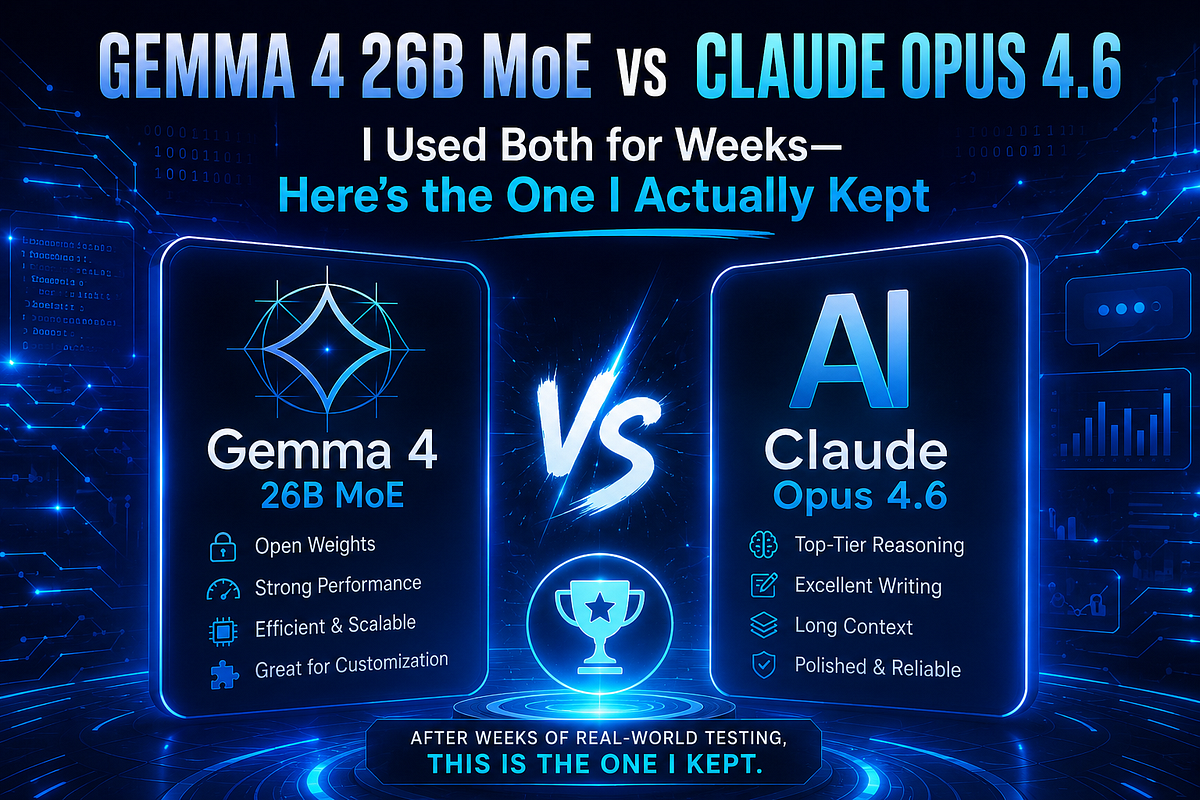
Three weeks of side-by-side testing between Google DeepMind's Gemma 4 26B MoE and Anthropic's Claude Opus 4.6 produced a split verdict that surprised the developer who ran the comparison. The user, a freelance developer and technical writer, set out to cut his API bill and ended up keeping both models for different tasks.
Gemma 4 26B MoE is a Mixture of Experts model with roughly 26 billion total parameters but only about 4 billion active per token. It runs locally on a laptop, costs nothing per query, and works without an internet connection. Claude Opus 4.6 is a proprietary API-only model with a 1-million-token context window and adaptive reasoning. It costs money per token but offers deeper reasoning and longer context.
The comparison started with a simple coding task: write a Python module to validate a CSV file. Gemma produced working code in 40 seconds on a laptop with no internet. The structure was clean, type hints correct, and test coverage functional. One edge case around empty rows needed fixing, but the patch took five minutes. Claude Opus 4.6 took longer but delivered more thorough error handling, clearer separation between validation and I/O, and tests that covered the edge case Gemma missed. The user described the difference as a strong junior engineer versus someone who had shipped similar pipelines before.
Over the following week, the pattern held. For simple, well-defined coding tasks, both models were usable. For larger codebases or multi-file refactors, Claude pulled ahead. One moment stood out: a refactor of a messy authentication module. Gemma made local improvements but missed the architectural problem. Claude flagged the structural issue in its first response, without being asked to look for one.
Benchmarks from mid-2026 show the gap. On MMLU-Pro, which measures general knowledge, Gemma 4 26B MoE scored 72.4% against Claude's 73.1% – a near tie. On GPQA, a harder graduate-level reasoning test, Claude scored 71.2% versus Gemma's 62.8%. On long-context retrieval tests, Claude's 1M-token window allowed it to track details from page 4 and page 76 of a 90-page technical spec in the same answer. Gemma started losing earlier details past roughly 40–50 pages.
Privacy became a decisive factor. Gemma runs entirely offline. Every prompt, file, and piece of client code stayed on the machine. The user works with contract clients whose agreements restrict where code and data can go. For those clients, the decision was made before quality entered the conversation. Claude runs through Anthropic's servers. The company's API data is not used for training by default, and privacy practices are solid by industry standards. But "solid privacy practices" and "the data never leaves my hardware" are different guarantees. The user tested Gemma on a flight with no WiFi. It kept working.
Gemma stayed installed for day-to-day coding, quick drafts, brainstorming, and anything involving sensitive data. It costs nothing per query, works without internet, and is good enough for the majority of what the user actually does in a day. Claude stayed in the toolbox for large-codebase refactors, long documents, multi-step agentic workflows, and anything requiring a first-time success rate that justifies the cost. The user spent about $50 in API costs over the three-week test, even while trying to reduce spending.
The user acknowledged that the space moves fast. Anthropic has likely shipped something newer than Opus 4.6 by the time of reading, and Google is iterating on Gemma. The specific version numbers will change. What will not change as fast is the underlying tradeoff: a capable open model under full control versus a frontier proprietary model rented by the token. The user's advice: test both on real tasks, not benchmarks. Benchmarks measure something real, but they do not measure the moment you are on a plane with a deadline and no WiFi, or the moment a client's NDA makes the decision for you before you open a chat window.
The user ended up keeping both models, a split they did not expect going in. The model that wins on paper might not be the one you reach for at 11 PM when you just need something fixed and do not want to think about API costs or terms of service.