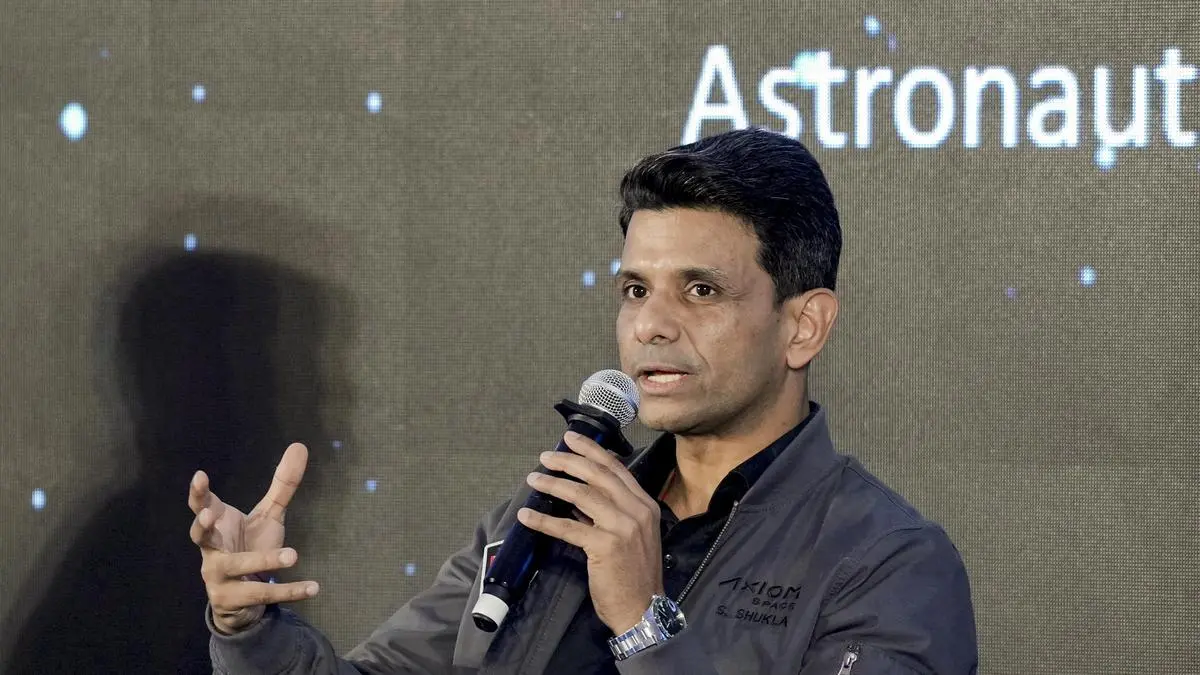
Indian astronaut and IAF Group Captain Shubhanshu Shukla is training for Gaganyaan, India's first indigenous human spaceflight mission, tentatively scheduled for mid-2027. The mission aims to launch three crew members to a 400-kilometre low-Earth orbit for three days and return them safely to Indian sea waters. Shukla, one of four astronaut-designates selected by ISRO, already spent 18 days aboard the International Space Station on NASA's Axiom-4 mission last June. That experience gives him a direct comparison between a commercial international mission and India's home-grown programme. For traders tracking the Indian defence and aerospace supply chain, Gaganyaan's mid-2027 target creates a measurable set of milestones that could trigger procurement cycles and re-rate listed suppliers.
The Catalyst: Gaganyaan's Mid-2027 Target and Shukla's Design Role
Shukla described Gaganyaan as a 'prototype' mission, a shift in magnitude from ISRO's previous robotic launches. “Globally, there is a lot of respect for the Indian space community, specifically ISRO… transitioning to a human space mission is a change of magnitude – it is a big shift from what we have been doing and what we are going to do,” he said in an interview with PTI Videos. The astronaut, who received the Ashoka Chakra in January, is now based at the Human Space Flight Centre in Bengaluru. He is involved in the design and refinement of the crew-carrying system.
Key technologies being developed include engineering and human-centric systems for safety, according to an ISRO factsheet. In April, ISRO completed the second Integrated Air Drop Test (IADT-02) for Gaganyaan at the Satish Dhawan Space Centre in Sriharikota. IADT-02 is a precursor unmanned mission to prove safety and reliability. Once the system design is finalised and frozen, mission-specific training will begin.
Why This Juncture Matters: The Fourth-Nation Stakes
Shukla acknowledged the current moment is a “crucial juncture for space missions” with a race “going back to space and back to the moon and onwards.” If Gaganyaan succeeds, India will become only the fourth nation – after the US, Russia, and China – to demonstrate manned spaceflight capability. That exclusivity signals a step-change in technological autonomy. Shukla said the mission will “give a lot of courage to other nations who are looking at doing something like this, because it feels possible.”
The Axiom-4 Comparison
The Axiom-4 mission last June marked the return of an Indian to space after 41 years – the previous being Wing Commander Rakesh Sharma in 1984. That mission was a commercial collaboration using existing SpaceX and NASA infrastructure. Gaganyaan is entirely indigenous, requiring a new crew capsule, launch abort system, and recovery suite. The scientific experiments from Axiom-4, including stem-cell research for muscle damage and microalgae growth studies, were curated with a view to future Indian human space missions. This overlap means data from Axiom-4 directly informs Gaganyaan's medical and life-support designs.
Practical rule: Missions like Gaganyaan create a multi-year development pipeline for suppliers of life-support systems, thermal protection, propulsion, and crew escape systems. Investors tracking Indian defence and aerospace contractors can map these milestones to procurement cycles.
The Affected Asset: Indian Space Sector and Its Listed Suppliers
ISRO itself is a government entity and not publicly traded. The Gaganyaan programme flows through to listed companies in the defence and engineering space. Larsen & Toubro (L&T) has supplied critical hardware for ISRO's launch vehicles. Godrej & Boyce manufactures propulsion systems. Hindustan Aeronautics Limited (HAL) produces components. Bharat Heavy Electricals Limited (BHEL) has fabricated cryogenic tanks. These companies stand to benefit if the mission timeline accelerates or if follow-on missions are approved.
Precursor Milestones to Watch
- IADT-02 completion (April) – already done. Next step is the uncrewed orbital test flight.
- Crew module design freeze – Shukla is part of this process; until it occurs, specific supplier contracts may not be firmed up.
- Mid-2027 launch window – any major delay would reset expectations for procurement.
Risk Factor: The Prototype Nature
Shukla explicitly called Gaganyaan a prototype mission. That means high execution risk. The difference between Axiom-4 and Gaganyaan is not just commercial versus indigenous – it is proven hardware versus new development. Axiom-4 used existing SpaceX and NASA infrastructure. Gaganyaan requires a new crew capsule, launch abort system, and recovery suite. Any failure in precursor tests would push the timeline beyond 2027.
The Decision Point: What Confirms or Weakens the Thesis
What confirms the thesis: Successful completion of the uncrewed orbital test flight, followed by the crew module design freeze. If ISRO discloses a supplier list or issues new tenders for production, that would signal commercial volumes for the supply chain. A public commitment from the government for follow-on Gaganyaan missions (beyond the first) would extend the investment horizon.
What weakens the thesis: A failed test in the precursor sequence, any crew safety incident during ground testing, or a budget reallocation that pushes the mid-2027 target. Also, if international partners (like NASA) do not cooperate on docking interfaces or crew transfer agreements, the mission scope may narrow.
Shukla's own experience highlights the emotional weight of spaceflight. “There are times I tried to suppress them so that I could keep functioning normally,” he said of the emotions tied to being the first Indian in space in 41 years. That human element reinforces the high stakes – and the high political visibility – of Gaganyaan. For traders, that visibility means the government cannot afford a public failure, which may create a bias toward safety over schedule. That could slow procurement while also reducing tail risk.
Learning from Shukla's Axiom-4 Experience
Shukla described a typical day aboard the ISS: 6:00 am wake-up, 7:30 am briefing, work until 6:00 pm, sometimes 13-hour days. The schedule replicates a disciplined operational environment. The scientific experiments from India were “curated with a basic theme in mind that we want to execute our own human space missions in the future.” This linkage means data from Axiom-4 directly informs Gaganyaan's medical and life-support designs.
Next Decision Point: IADT Success and Crew Module Freeze
The immediate catalyst is the integration of the uncrewed orbital test flight (likely in 2026 if the prototype schedule holds). Following that, the design freeze for the crew module will allow vendors to begin production. Shukla's involvement in the design refinement suggests that freeze could occur within the next 12 to 18 months.
For traders monitoring the Indian space sector, the next logical check is ISRO's quarterly updates on Gaganyaan milestones. Any announcement of a specific launch date for the uncrewed test will be a stronger signal than the broad mid-2027 target. Until then, Shukla's ongoing training and the IADT-02 success keep the narrative alive, though not yet tradeable on a concrete calendar. The next material event is the design freeze: that is the moment when the prototype transitions from concept to hardware, and suppliers begin to see orders.