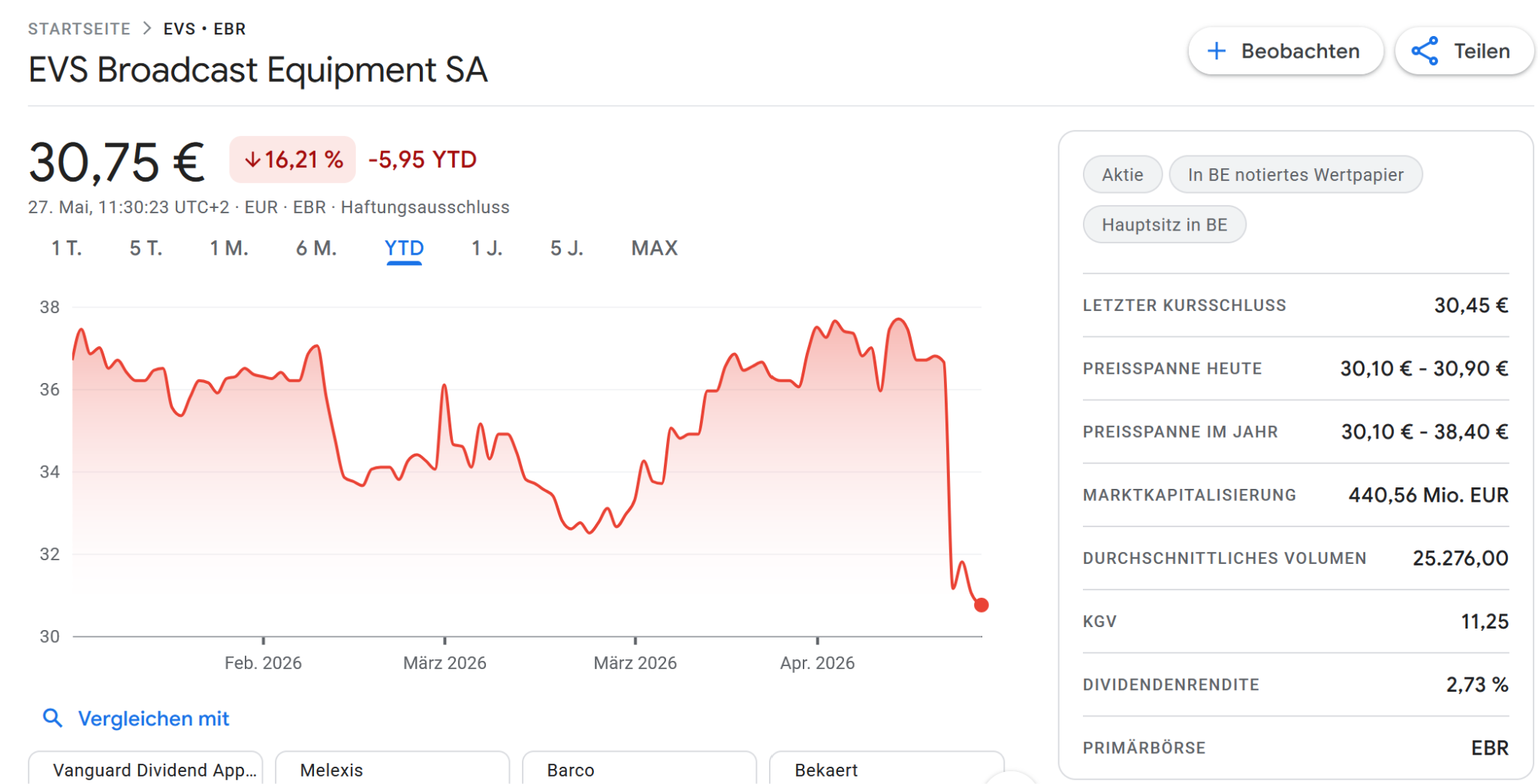
Four European stocks delivered updates this week that reshaped their investment cases in very different ways. EVS Broadcast slid after a Q1 trading statement that introduced Middle East risk into its 2026 outlook. Jensen Group extended its growth streak with a new buyback and a book-to-bill above 1. Wise Plc peaked on its Nasdaq listing day then dropped, partly on a JP Morgan price target cut. Installux executed a family buyout at €500 per share, a 72% premium to the last trade. Each case offers a distinct lesson in how guidance language, valuation, listing mechanics, and shareholder structure drive real portfolio decisions.
EVS Broadcast: Middle East Risk Reshapes 2026 Outlook
EVS Broadcast (Euronext Brussels) got slammed after its Q1 trading statement. The source text identifies three specific triggers that spooked investors.
The Outlook Sentence That Changed Everything
After confirming guidance in both the CEO and CFO statements, the press release added this line in the Outlook section:
That single sentence introduces a concrete downside scenario. The market read it as a de facto warning that the 2026 event year – which should have been materially better than 2025 – may now deliver only marginal improvement. Longer-term shareholders know EVS guides cautiously, the explicit mention of the Middle East as a risk factor changes the narrative.
Back-Loaded 2026 and CFO Departure
Two additional items compounded the disappointment. First, management reiterated that 2026 will be “back loaded”, meaning investors will have little visibility until late Q4. Second, the CFO departed without a direct replacement. The source describes this as “not optimal” and hints at board tension.
Practical rule: When a company that normally guides cautiously adds a specific geopolitical risk to its outlook, the market will price in the lower end of the range until execution proves otherwise. The lack of a permanent CFO reduces confidence in that execution.
What Would Change the Setup
A large share buyback program could shift sentiment. Without one, the source indicates a cautious stance. The stock’s reaction suggests the market is now discounting a weaker 2026 than previously assumed.
Jensen Group: 11x P/E with a 10% Buyback
Jensen Group (Euronext Brussels) is the polar opposite of EVS. The company started the year with a strong quarter and is described as “firing on all cylinders.”
Numbers That Speak for Themselves
The headline numbers look fantastic. Revenue growth is robust, book-to-bill is above 1, and the company has approved a new 10% share buyback program. The only question in the source is why net income rose only 10%, possibly due to a tax effect.
Despite hitting a new all-time high, the stock remains cheap at 11x P/E because earnings are growing as fast as the price. The source notes there is “absolutely nothing to complain about” other than the market’s refusal to assign a higher multiple.
Key insight: When a company with a book-to-bill above 1, a new buyback, and double-digit earnings growth trades at 11x P/E, the valuation itself becomes a catalyst. Either earnings slow and the multiple stays low, or earnings continue growing and the multiple re-rates. The buyback adds a floor.
Why the Market Might Be Wrong
Investors often anchor on historical multiples for small-cap industrials. Jensen’s consistent execution and buyback discipline argue for a higher multiple. The source’s frustration is understandable: the stock is cheap by any fundamental measure, yet the market treats it as a value trap.
Wise Plc: Nasdaq Listing and the Sell-the-News Pattern
Wise Plc listed on the Nasdaq, and the stock peaked on the listing day (May 11) before dropping significantly afterward. The source draws a parallel to Ferguson (Wolseley) and Sunbelt Rentals (Ashtead), both of which saw relative underperformance after moving their primary listing to the US.
The JP Morgan Price Target Cut
One factor behind the post-listing drop: JP Morgan reduced its price target by more than 10% following the listing. That is a concrete catalyst, not just profit-taking. The source notes that fundamentally nothing changed about Wise’s prospects, so no action was taken.
Historical Precedent
The Ferguson comparison is instructive. Ferguson outperformed significantly before its US listing in March 2022, then underperformed for some time. Sunbelt Rentals also saw a relative drop a few days after its listing in early March 2026, though that was attributed to the start of the Iran war rather than the listing itself.
Risk to watch: A US listing can create a “sell the news” event, especially when the stock has already rallied into the listing. The price target cut from a major bank amplifies the effect. Investors should distinguish between fundamental deterioration and listing mechanics.
AlphaScala Context: Sunbelt Rentals
The Wise listing comparison to Sunbelt Rentals (ticker SUNB) is worth noting. Sunbelt Rentals, the former Ashtead, moved its primary listing to the US in early March 2026. According to AlphaScala’s proprietary data, SUNB carries an Alpha Score of 28/100 (label: Weak) in the Industrials sector. That score reflects the post-listing volatility and geopolitical overhang (Iran war) that hit the stock shortly after the move. Investors considering US-listed foreign companies should factor in both listing mechanics and macro risk.
For more on the broader market, see our stock market analysis. For individual stock profiles, visit the SUNB stock page.
Installux: Family Buyout at €500 Ends a Decade-Long Wait
Installux (Euronext Paris) published an unexpected announcement: the Canty family bought out the largest minority shareholder, French value asset manager Amiral, at €500 per share versus the last trade of €290. The family now holds about 88% of the shares and is extending the offer to all other shareholders.
The 72% Premium and All-Time High
The €500 price is almost exactly the all-time high from 2021. The source, who owned Installux from 2012 to 2021, calls it an interesting case study in family-controlled micro-caps. The Canty family had little incentive to show the outside world how good the business actually was; their long-term mission was clearly to gain full control.
What This Means for Minority Investors
Amiral showed remarkable patience. The buyout validates the thesis that family-controlled companies can eventually deliver outsized returns when the family decides to take full control. The source notes that the Canty family never did anything fishy, and the final offer seems fair.
Bottom line for traders: Investing in micro-cap family-controlled stocks requires either buying at extremely cheap valuations or being present when the family finally wants full control. Timing and patience are everything. The 72% premium is a real outcome, it took over a decade to materialize.
Common Thread: Guidance, Valuation, and Structure
Each of these four updates revolves around a different mechanism:
- EVS: Guidance language that introduces a specific downside risk, compounded by a CFO departure.
- Jensen: Strong execution plus a buyback at a low multiple – a classic value-growth setup.
- Wise: Listing mechanics and a price target cut that create short-term selling pressure.
- Installux: Family control dynamics that eventually reward patient minority holders.
None of these stories is about a broad market trend. They are about company-specific catalysts that require a trader to read beyond the headline. The practical takeaway: when a stock moves sharply on an update, identify whether the change is structural (EVS’s Middle East risk), tactical (Wise’s listing), or structural in a positive direction (Jensen’s buyback). That distinction determines whether to hold, add, or exit.