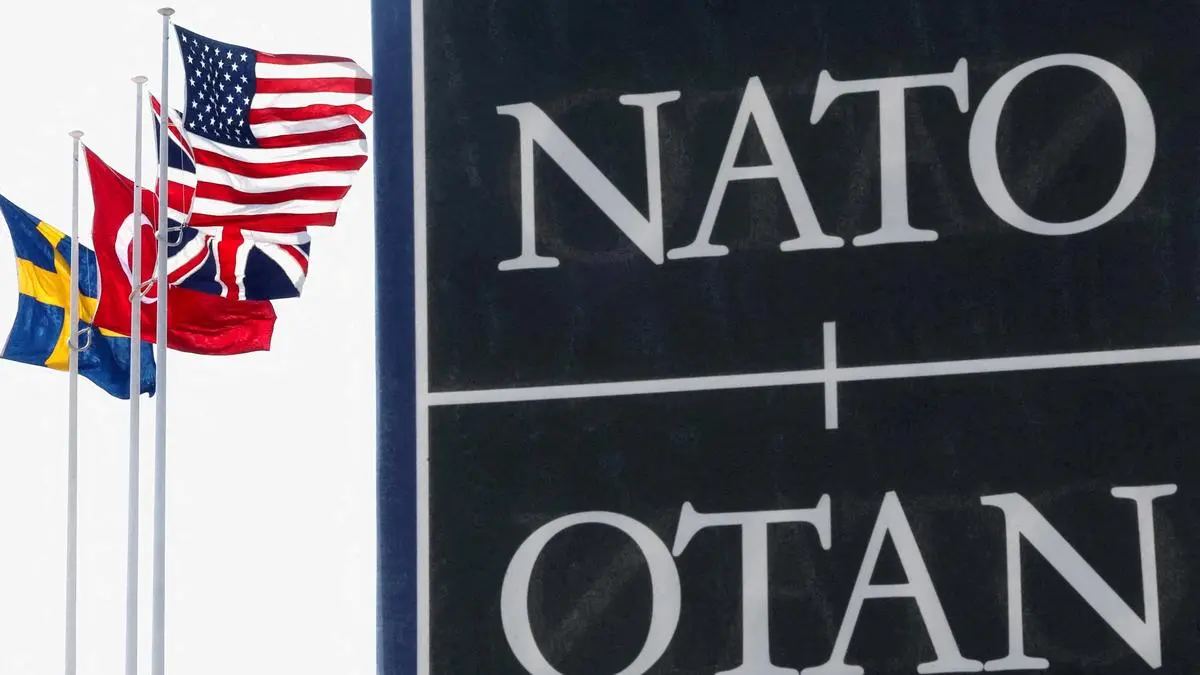
European allies have replaced most US cuts to NATO forces, deputy commander says. Defense spending targets rise to 3.5% GDP. Defense stocks in focus.
European NATO allies have mostly replaced the assets the US cut from its rescue plans for a war in Europe, Deputy Supreme Allied Commander Europe Sir John Stringer said in an interview with Bloomberg Television.
Stringer made the assurance ahead of the alliance’s summit in Ankara next week, where allies will try to smooth over recent US signals of a pivot away from the continent.
“European allies have definitely stepped up in terms of backfilling the adjustment in the US forces in Europe,” Stringer said. He called it a demonstration of “a stronger Europe in a stronger NATO.”
The US recently announced massive cuts to the forces it would send to Europe in case of war or crisis. NATO’s military command then asked European countries to make their uncommitted forces known.
Stringer, a former Royal Air Force fighter pilot, said that in categories where Europe couldn’t provide equivalent forces, they would match the effect with different assets.
Burden-sharing and burden-shifting “is now being done in a sensible, proportionate way, absolutely driven by military logic,” he said, emphasizing European preparedness for the shift in US priorities.
The need to rebalance has been a factor for years, and Europeans have stepped up, he added.
President Donald Trump’s rhetoric toward NATO since his return to the White House has unnerved allies and prompted a rethink of defense spending in Europe. US Secretary of Defense Pete Hegseth shocked allies at NATO headquarters in June by announcing a six-month review of US forces in Europe, a signal that more cuts may be ahead.
“In the air and maritime domain, Europeans can and have stepped up” and even gone beyond 100%, said Colonel Martin L. O’Donnell, spokesperson at NATO’s military command. In certain cases, European allies have the same kit or better equipment than the US inventory, he added, citing the example of a type of F-16 fighter jet to be received by Bulgaria.
Stringer was appointed as NATO’s second in command of operations in Europe this year as the alliance grapples with the war in Ukraine on its borders and an increasingly isolationist US.
Asked about the recent resignation of British Defense Secretary John Healey over what he said was inadequate spending by the UK, Stringer said that all “the nations, all 32 agreed that they would get to 3.5% by 2035 and have a credible path to get there.”
“Nobody gets an opt out on that one,” he said, referring to NATO’s target for governments to spend at least 3.5% of gross domestic product on core defense. “That’s what we agreed and that obviously includes the UK.”
Areas of investment announced by the UK in recent weeks are “absolutely aligned with where NATO sees our forces needing to go to be able to be credible in deterring and defending the billion people under the NATO umbrella,” he said.
“NATO will expect all nations, including the UK, to live by their commitments,” he added.
For investors, the backfill signals sustained demand for European defense equipment. Companies like BAE Systems, Rheinmetall, and Thales have already seen order books swell as governments boost budgets. The Ankara summit next week will test whether the 3.5% GDP target holds and whether the US review leads to further cuts. Any concrete commitment from a major ally could push defense stocks higher, while a failure to agree on burden-sharing would raise questions about NATO’s long-term cohesion.
The summit runs through Thursday. No date has been set for the US review’s conclusion.
Prepared with AlphaScala research tooling and grounded in primary market data: live prices, fundamentals, SEC filings, hedge-fund holdings, and insider activity. Each story is checked against AlphaScala publishing rules before release. Educational coverage, not personalized advice.