Emami (BSE: 531162) shares have fallen about 35% from the ₹615 level where BL Portfolio recommended accumulation in April 2025, touching a 52-week low near ₹399. The investment case at that time rested on rural-led domestic franchise, a strengthening non-seasonal portfolio, distribution expansion, margin resilience and valuation comfort relative to peers. That thesis broke down in FY26, when weather dependence, weak fourth-quarter volumes and pressure on operating margins all materialised at once.
Revenue inched down 0.8% for the full year. Adjusted EBITDA fell 10% and adjusted net profit declined 5%. The fourth quarter was worse: domestic volumes dropped 7%, sharper than the 3% decline in domestic sales, meaning price and mix partly cushioned a weaker underlying off-take rather than signalling real demand.
Yet the same correction that reflects those disappointments has shifted the risk-reward calculation. Consistent ₹700-800 crore annual free cash flow (4-4.5% of market cap), a net cash-positive balance sheet of ₹720 crore, improved working capital and a trailing PE of 22.6 times versus a five-year average that implies a 25% discount on forward earnings are the structural arguments that remain intact. The question is whether the seasonal revenue volatility that caused the FY26 miss is a temporary weather event or a structural ceiling on earnings growth.
The FY26 earnings breakdown: seasonal exposure still dominates
Navratna and Dermicool decline drove the miss
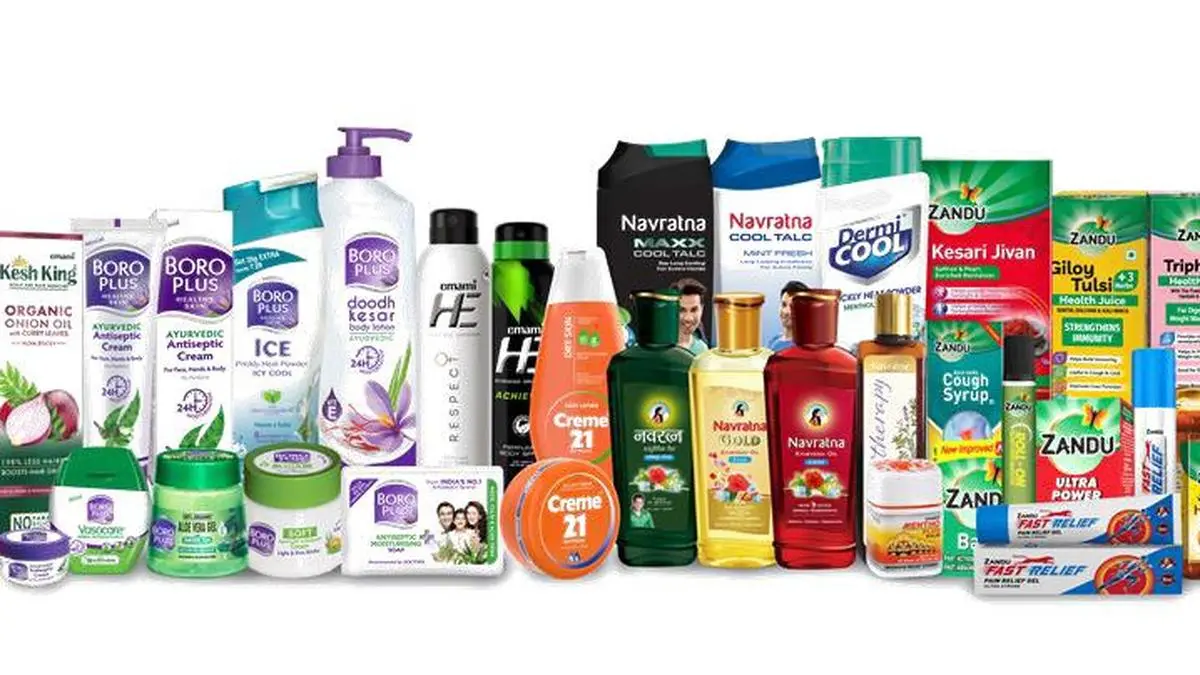
The Navratna and Dermicool range declined 15% in FY26 and 21% in Q4. Talcum powder revenue alone fell about ₹100 crore for the year, with the category dropping 40% in the fourth quarter. The company attributed the weakness to a delayed summer, inconsistent temperatures, unseasonal rainfall and a high base. Whatever the proximate cause, the magnitude shows that one adverse season can still move consolidated revenue and profitability by a material margin.
International business added volatility in Q4
International sales, which account for 18% of revenue, grew 3% for the full year but declined 5% in Q4 after growing 16% during January and February. Management pointed to West Asia supply-chain disruptions as the cause. Half of Emami's international goods are produced in the UAE using imported materials, making the overseas business vulnerable to regional logistics shocks.
The non-summer portfolio: where the better read starts
Ex-summer categories held up in Q4
The ex-summer domestic portfolio grew 11% in value and 7% in volume during Q4. This is the part of the business that matters most for the forward thesis. If the weakness was concentrated in weather-exposed lines while the core portfolio held, the FY26 miss becomes a timing problem rather than a franchise problem.
Kesh King, a hair care brand flagged as an underperformer in the original accumulation call, grew 14% in Q4 after the company implemented a revival strategy. The full-year was still weak at a 2% decline, the quarterly recovery is the first concrete sign that the restructuring is working. The 7 Oils in One range grew 34% in Q4 and 13% for the full year.
Pain Management grew 11% in Q4 and 7% in FY26. Healthcare grew 7% in Q4 and 5% for the year. These categories reduce the company's reliance on a single seasonal cycle and, if sustained, would make earnings more predictable.
Newer brands are scaling, at a cost
The Man Company and Brillare grew 34% in Q4 and 20% in FY26. The strategic investment portfolio grew 34% in Q4, and management expects 30% annual growth from these businesses. Brillare is expected to increase its absolute EBITDA by around ₹15 crore in FY27. These numbers still require delivery, the trajectory is relevant when legacy categories are struggling.
Axiom Ayurveda gives Emami an entry into beverages via an aloe vera-based fruit drink. Management said Axiom currently generates EBITDA of about ₹40-45 crore. IncNut, which houses Vedix and SkinKraft, offers exposure to personalised beauty products with high gross margins and modest EBITDA losses from customer acquisition spending.
- The Man Company & Brillare: 34% Q4 growth, 20% FY26 growth
- Strategic investment portfolio: 34% Q4 growth, 30% target
- Axiom Ayurveda: ₹40-45 crore EBITDA
- IncNut: High gross margins, EBITDA-negative from investment
Practical rule: New brands that grow 30% annually for three consecutive quarters become real earnings contributors. Until then, treat them as optionality, not core valuation drivers.
Margin mechanics: The A&P trade-off
Gross margins expanded, EBITDA contracted
Emami's Q4 gross margin expanded 250 basis points, indicating pricing power and cost management. Those gains did not flow through to the bottom line. Advertising and promotional spending rose to 22.9% of revenue in Q4, up 330 basis points year on year. Full-year A&P came in at 19.6% of revenue versus 18.2% in FY25.
The elevated spend is partly structural: newer brands require sustained investment to reach scale, and the seasonal portfolio needs marketing support to stabilise demand. Investors need to see whether these businesses can grow without keeping consolidated margins under persistent pressure. If A&P remains above 20% of revenue for another 12 months, the EBITDA recovery timeline shifts further out.
| Metric | Q4 FY26 | YoY Change |
|---|
| Gross margin | Expanded 250 bps | Positive |
| A&P spend (% of revenue) | 22.9% | +330 bps |
| EBITDA | Fell ~15% | Negative |
| Domestic volumes | -7% | Negative |
Valuation: The case for buying on the dip
Forward PE is 25% below its five-year average
Emami trades at 22.6 times trailing 12-month earnings, 20.5 times one-year forward earnings and 18.6 times two-year forward earnings, according to Bloomberg. The FY27-based PE is about 25% below its five-year average. Estimated adjusted EPS growth of 14% in FY27 and 11% in FY28 supports the medium-term upside.
The ₹720 crore net cash position provides flexibility to acquire brands and absorb earnings volatility. Consistent ₹700-800 crore annual free cash flow represents 4-4.5% of market cap, a yield that gives the stock a floor even if earnings growth disappoints.
Execution risk: What confirms or weakens the setup
Confirmation signals
The strongest confirmation would be domestic volume growth turning positive for two consecutive quarters. Volume performance in Q4 was materially worse than value, meaning the business needs more than pricing or premiumisation to restore healthy growth. For an FMCG company with good rural exposure, consistent volume recovery is the single most important metric.
Another confirmatory signal would be sustained double-digit growth in Summer brands during H1 FY27. Management expects this, actual performance in the coming quarters matters more than guidance.
Risks to watch
The biggest risk is that seasonal exposure remains a structural constraint. While the ex-summer portfolio held up in Q4, it could not offset the decline in Navratna and Dermicool. If weather conditions again swing demand sharply for talcum powders and cooling oils, earnings predictability will remain low.
BoroPlus declined 8% in Q4 and grew only 2% in FY26. Male grooming fell 4% in Q4 and 5% for the full year. These legacy categories need to recover because faster-growing new businesses are still relatively small and may take time to contribute meaningfully to consolidated profits.
A sustained high A&P spend that keeps EBITDA margins below historical averages would make the earnings recovery slower than valuation alone implies.
Investors with a four-to-five-year time frame and tolerance for potential drawdowns can accumulate the stock at current levels. The thesis now depends on execution against the non-summer portfolio thesis. The next two quarters will determine whether FY26 was a weather-related outlier or a signal that the business model needs a more fundamental reset.