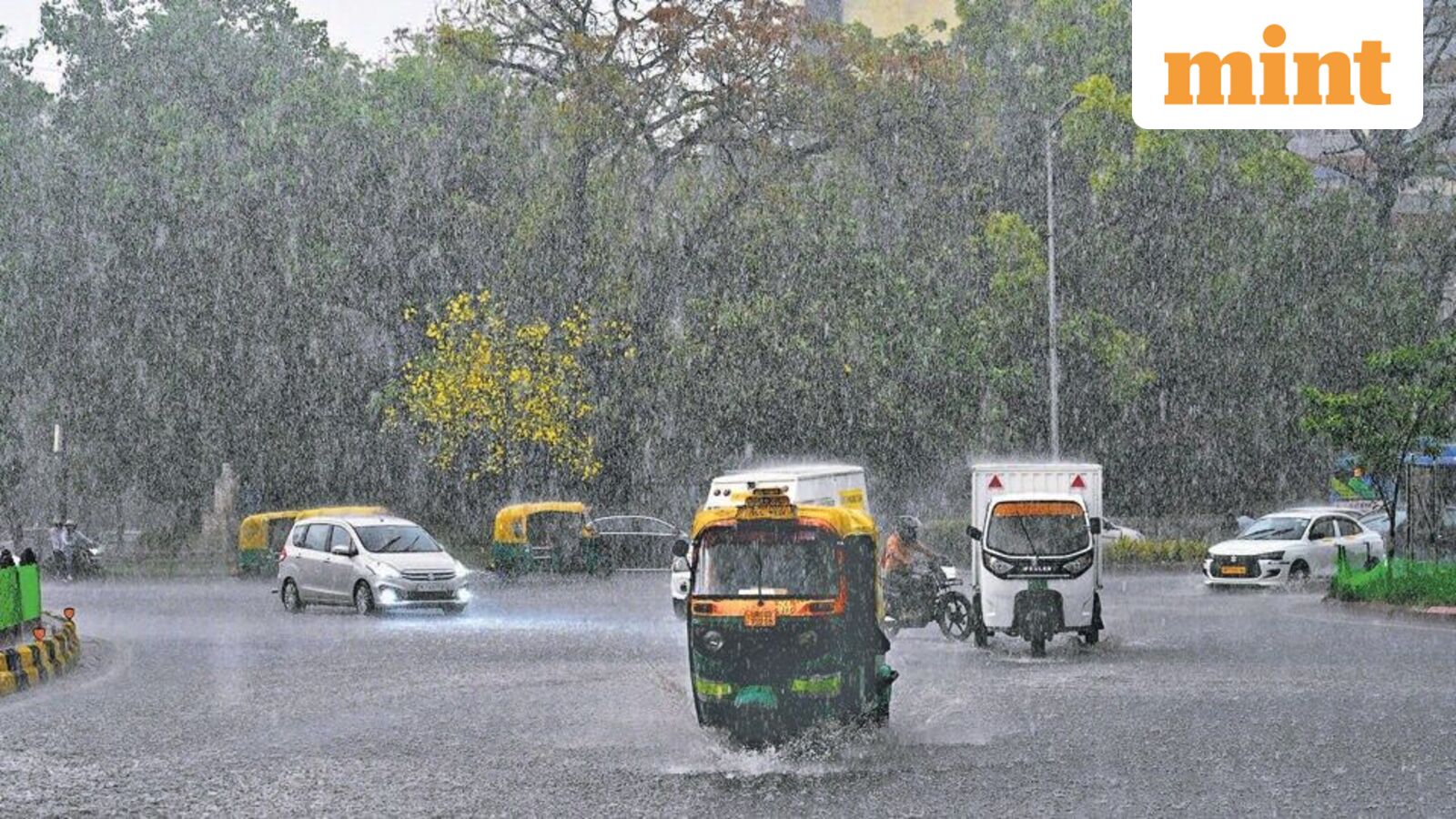
Delhi's weekend rain cut temperatures 2°C below normal and pushed AQI to 85, the cleanest May day since 2023. No heatwave expected in first week of June.
Delhi residents woke to another spell of rain and thunderstorms on Sunday, with the India Meteorological Department (IMD) issuing a yellow alert and forecasting gusty winds up to 60 kmph during the evening. The event extended a stretch of relatively pleasant weather that broke the intense heatwave that gripped the capital earlier in May.
An IMD official said, "A spell of very light to light rain, accompanied by thunderstorm, lightning and strong surface winds of speed 40-50 kmph, gusting to 60 kmph towards the evening is possible on Sunday."
The weekend rainfall followed a pattern of intermittent showers that began Saturday afternoon. Between 2.30 pm and 5.30 pm, weather stations across the city recorded varying amounts:
Strong winds accompanied the rain. Palam recorded wind speeds touching 70 kmph at 4.02 pm. Pragati Maidan and Pusa logged gusts of 59 kmph and 54 kmph, respectively. Safdarjung reported 38 kmph.
The cooling effect was measurable. Safdarjung, the city's base weather station, recorded a minimum temperature of 24.6 degrees Celsius on Saturday – two degrees below normal and 0.7 degrees lower than Friday. The station had logged 25.3 degrees Celsius on Friday and 28.4 degrees Celsius on Thursday, showing a steady downward trend.
Other stations reported even lower minimums:
The maximum temperature at Safdarjung settled at 37.2 degrees Celsius, 3.2 degrees below normal.
The rain and wind had a direct impact on pollution levels. According to data from the Centre for Research on Energy and Clean Air (CREA), Delhi recorded its cleanest May in five years in 2026, with an average Air Quality Index (AQI) of 161 up to May 29. That compares with 170 in May 2025 and 223 in May 2024. The last cleaner May was 2021, when the monthly average AQI stood at 144.
On Saturday, Delhi's 24-hour average AQI improved to 85, placing it in the "satisfactory" category. It marked the city's fourth satisfactory air quality day this month and the cleanest day in May since 2023, when an AQI of 76 was recorded on May 2. According to Central Pollution Control Board (CPCB) standards, AQI values between 51 and 100 are categorised as satisfactory.
Experts attributed the improvement to intermittent rainfall and strong winds, which dispersed pollutants and washed particulate matter out of the atmosphere.
The pleasant conditions at the end of May stand in sharp contrast to the extreme weather Delhi witnessed earlier in the month. The capital recorded its hottest May in two years, with an average maximum temperature of 39.7 degrees Celsius and an average minimum of 25.8 degrees Celsius.
Heatwave conditions prevailed between May 18 and May 21, with temperatures crossing 46 degrees Celsius in some parts. Delhi also experienced unusually warm nights. The minimum temperature touched 32.8 degrees Celsius on May 26 and 31.9 degrees Celsius on May 21 – among the highest night-time temperatures recorded in the city in the past 14 years.
Meteorologists attributed the dramatic swings to a combination of western disturbances, induced cyclonic circulations over Rajasthan and adjoining regions, and moisture-laden winds from the Bay of Bengal.
Looking ahead, weather experts do not expect heatwave conditions to return during the first week of June. Mahesh Palawat of Skymet Weather said that while temperatures may gradually rise as the current spell of rain weakens and moves away, no heatwave conditions are expected in the coming days.
The Air Quality Early Warning System (AQEWS) has forecast Delhi's AQI to remain in the moderate category over the next few days, suggesting air quality may continue to stay relatively better than typical summer levels.
For now, Delhi residents can expect another day of cloudy skies, scattered rainfall and gusty winds as the city begins June on a comparatively cooler note. The key risk to watch is whether the rain pattern weakens faster than forecast, which could allow temperatures to climb back toward seasonal norms and reverse the air quality improvement.
Prepared with AlphaScala research tooling and grounded in primary market data: live prices, fundamentals, SEC filings, hedge-fund holdings, and insider activity. Each story is checked against AlphaScala publishing rules before release. Educational coverage, not personalized advice.