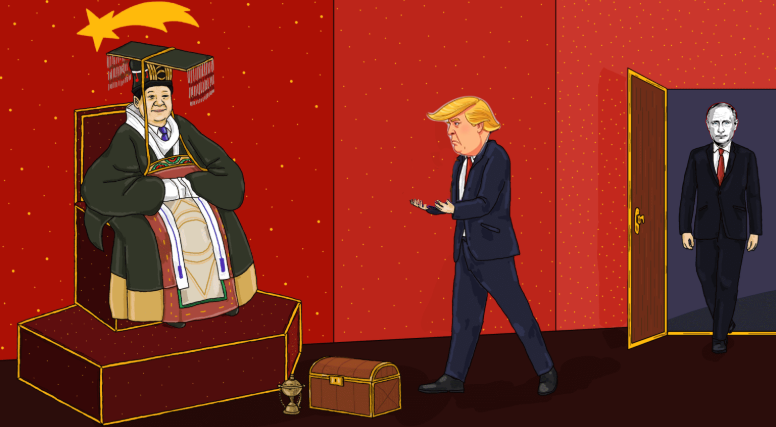
The emergence of a coordinated, pseudonymous media ecosystem—referred to here as "Chiprop"—represents a shift in how geopolitical narratives are projected from Beijing. Figures such as the Substack-based "China Arbitrageur" (ChinArb), Hua Bin, and Jiang Xueqin have gained traction by framing China’s global influence not through traditional military projection, but through the lens of "industrial metabolism." For market participants, the risk lies in distinguishing between this ideological narrative of inevitable Chinese economic dominance and the actual mechanics of global supply chain dependencies.
The Mechanism of 'System B'
The central claim of the Chiprop narrative is that China has successfully constructed "System B," a global industrial network that operates independently of traditional military or diplomatic frameworks. According to this view, China’s influence is not derived from active intervention, but from the existence of its 1.4 billion-person industrial appetite. The argument posits that because resource exporters, shipping companies, and refineries are structurally dependent on Chinese demand, Beijing can dictate terms without needing to engage in conventional conflict or formal treaty negotiations.
This framework suggests that "System A" (the U.S., Israel, NATO, and other allies) is losing strategic relevance because its primary tools—military alliances, sanctions, and nuclear non-proliferation regimes—are increasingly decoupled from the physical flow of goods. In this reading, the nuclear non-proliferation issue is being downgraded from a global imperative to a localized "System A" internal concern. For the investor, the practical takeaway is the assertion that China’s loyalty is strictly to resource flows, specifically oil, rather than to political proxies like the IRGC. If this thesis holds, the primary catalyst for market volatility will not be traditional geopolitical brinkmanship, but rather the ongoing "arbitrage" of resources where China leverages its position as a sole buyer to secure deep discounts on sanctioned commodities.
Assessing the Credibility Gap
The analytical utility of the ChinArb, Hua, and Jiang output is constrained by a lack of verifiable sourcing and the deliberate concealment of their identities. AI-driven analysis tools, including Grok and DeepSeek, indicate that these figures maintain private profiles, with Jiang Xueqin’s background as an education reformer and freelance journalist lacking the deep-state institutional credentials his "Professor" title might imply to an uncritical audience. Their analysis consistently avoids discussing internal Chinese political shifts, such as the recent purges of military leadership, framing Chinese governance as a model of stability compared to Western "cesspools."
Market participants should be wary of treating these narratives as objective intelligence. The reliance on unverified anecdotes—such as the claim that Pakistan’s Chief of Army Staff Asim Munir acted as the invisible coordinator for the April 10-11 Islamabad negotiations—lacks corroborating evidence. Without transparent sourcing, these claims function more as a "mindbend" designed to influence Western perception of Chinese inevitability than as a reliable guide for stock market analysis.
Risk Exposure and Market Signals
The risk for investors is twofold. First, there is the risk of over-allocating to assets that are sensitive to "System B" disruptions, such as shipping, energy, and raw material supply chains. If the Chiprop narrative is correct, the next three to five years will be defined by the marginalization of Western-led regulatory frameworks in favor of bilateral, flow-based agreements. Second, there is the risk of misinterpreting "industrial metabolism" as a guarantee of stability. The reality of global trade remains subject to the very military and political frictions that Chiprop claims are obsolete.
To test the validity of the "System B" thesis, monitor the following indicators:
- Resource Pricing: Watch for sustained price divergence in sanctioned oil markets where Chinese buyers secure consistent discounts compared to global benchmarks.
- Sanctions Efficacy: Observe whether UN Security Council resolutions regarding critical chokepoints, such as the Strait of Hormuz, continue to be neutralized by Chinese vetoes.
- Industrial Output: Track shifts in manufacturing capacity that prioritize internal "System B" integration over traditional export-oriented growth.
Evaluating the 'Victory' Thesis
The Chiprop claim that "WWIII" is already over and that it is a war of "supply-chain interdiction" and "financial weaponization" is an ideological construct rather than a descriptive one. It serves to frame current economic friction as a fait accompli. Investors should remain skeptical of any analysis that claims a total victory for one system over another, especially when that analysis ignores the inherent volatility of the very industrial networks it describes. The "invisible veto" that these commentators attribute to China is a powerful narrative tool, but it does not replace the need for granular, bottom-up analysis of corporate exposure to China-centric supply chains. When evaluating companies with significant exposure to Chinese markets, such as SPOT stock page or WELL stock page, focus on their specific operational resilience to trade policy changes rather than the broader, often hyperbolic, narratives of systemic global shifts.