New US sanctions targeting energy and finance, combined with heightened military rhetoric, create significant compliance risks for international investors.
The geopolitical landscape surrounding Cuba has shifted into a high-stakes confrontation following a series of rhetorical escalations and the implementation of expansive new U.S. sanctions. The Ministry of the Revolutionary Armed Forces of Cuba signaled a hardening of its defensive posture on Monday, utilizing social media to broadcast a message of military readiness. The communication, which featured an image of an armed soldier, invoked the rhetoric of late President Fidel Castro regarding the willingness to face conflict with a commitment to victory or death. This development serves as a direct response to comments made by former President Donald Trump during an event in West Palm Beach, Florida, where he suggested that the United States could take control of Cuba almost immediately and alluded to the potential deployment of military assets near the island.
For market participants, the primary concern lies in the structural expansion of the U.S. embargo via a new executive order signed on the same day as the West Palm Beach event. This order does not merely tighten existing restrictions; it fundamentally alters the risk profile for international entities operating in sectors such as energy, defense, mining, and financial services. By targeting foreign companies, banks, and individual investors who maintain commercial ties with the Cuban government, the policy effectively mandates a compliance-driven withdrawal for any firm with significant exposure to the U.S. financial system. The mechanism of these secondary sanctions is particularly potent. Banks that process transactions deemed significant for sanctioned entities face the existential threat of losing access to the U.S. financial system, including the ability to operate in dollars or maintain accounts on Wall Street. This creates a binary risk environment where the cost of maintaining a relationship with the Cuban market far outweighs the potential commercial upside for global financial institutions.
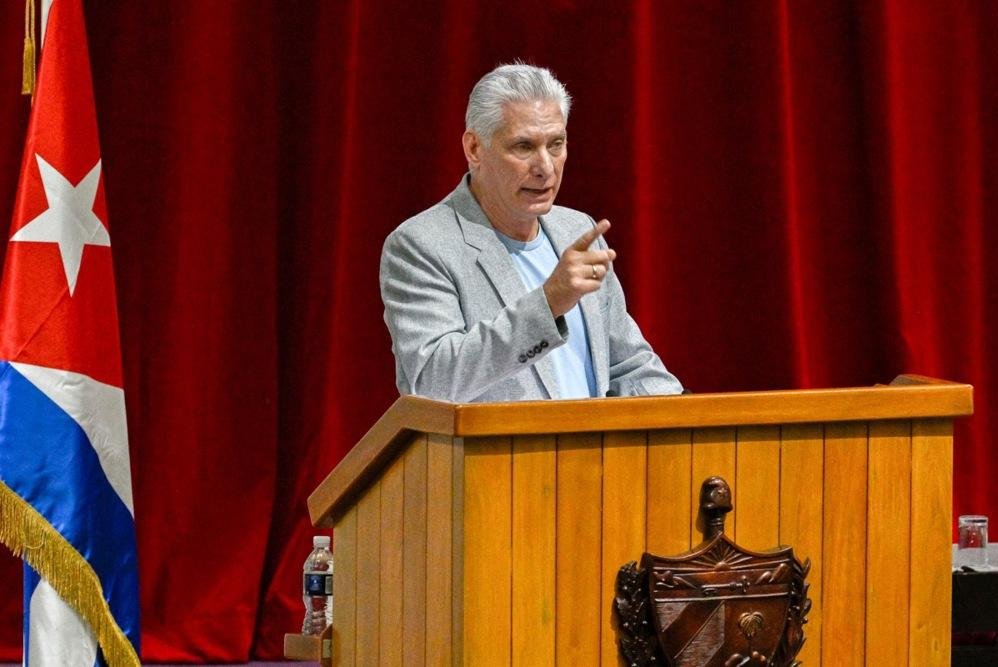
Cuban President Miguel Díaz-Canel has characterized these measures as a dangerous and unprecedented escalation, framing the situation as an imminent threat of military aggression. In a speech delivered to delegates from 36 countries at the International Meeting of Solidarity with Cuba, Díaz-Canel invoked the doctrine of the War of the Entire People, asserting that the civilian population is prepared to take up arms in defense of the island. This rhetoric, while consistent with historical Cuban defensive doctrine, arrives at a moment of heightened sensitivity for regional stability. The diplomatic fallout has been immediate, with the Bolivarian Alliance for the Peoples of Our America and various international intellectual networks condemning the threats of force. Colombian President Gustavo Petro has also publicly emphasized the need to maintain the Caribbean as a zone of peace, signaling that the regional diplomatic environment is becoming increasingly polarized.
From a risk management perspective, the situation necessitates a re-evaluation of exposure for firms with regional operations in the Caribbean or those with complex supply chains involving the sanctioned sectors. The ambiguity surrounding what constitutes a significant transaction under the new executive order creates a high degree of operational uncertainty. Investors should note that the U.S. government is effectively leveraging its control over the global dollar clearing system to enforce its foreign policy objectives, a tactic that has historically forced rapid divestment from targeted jurisdictions. The risk of contagion is not necessarily limited to direct trade with Cuba; it extends to any entity that might be caught in the secondary sanction net due to opaque ownership structures or indirect financial linkages.
What would confirm a further deterioration of the situation is an increase in the frequency of military posturing or the first instance of a major international bank being formally penalized under the new secondary sanction framework. Conversely, a de-escalation would require a shift in the rhetorical tone from Washington regarding the potential deployment of military assets, or a clarification from the U.S. Treasury that provides a more defined safe harbor for existing, non-sanctioned commercial activities. For those tracking the broader stock market analysis, the focus should remain on how these secondary sanctions influence the risk appetite of multinational banks that have historically navigated similar embargo environments. The current environment suggests that the cost of compliance will continue to rise, likely leading to a further isolation of the Cuban economy from international capital markets. As the situation evolves, the primary marker for investors will be the reaction of regional financial institutions and their willingness to continue processing transactions that could be flagged by U.S. regulators under the new, more aggressive mandate.
AI-drafted from named sources and checked against AlphaScala publishing rules before release. Direct quotes must match source text, low-information tables are removed, and thinner or higher-risk stories can be held for manual review.