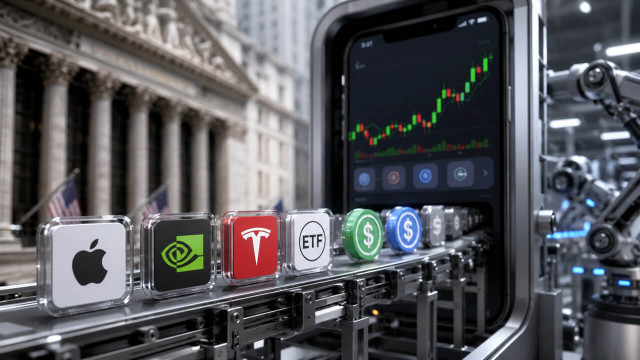
Crypto exchanges are rolling out US stock and ETF trading inside their apps, pulling the retail brokerage relationship toward a mobile-native, stablecoin-funded model. Binance launched direct access to more than 7,000 US stocks and ETFs alongside bStocks, a tokenized product that settles in stablecoins and trades 24/7 on its spot market. Kraken's xStocks reached 100 fully backed tokenized US equities, surpassed $25 billion in transaction volume since June 2025, and targets 500-plus listings by end of 2026. Bybit opened access to tokenized IPOs on June 7, starting with SpaceX. Gemini allows eligible European customers to trade Dinari dShares with zero fees and round-the-clock availability.
Each exchange offers the same proposition: trade Nvidia or Apple using the same wallet, stablecoin balance, and always-on interface already used for Bitcoin and Solana. That forces two simultaneous confrontations – rival crypto exchanges competing for the same users, and Wall Street brokers defending the equity trading relationship they have owned for a century.
Binance's first-week data for its direct stock product shows emerging-market users accounted for over 80% of trading volume. Around 39% of trades were under $100, and roughly 25% of stock users were under 25. These are mobile-first traders who already live inside crypto apps. They now have a direct route to US equities without ever opening a conventional brokerage account, several product managers said in interviews.
With Binance opening that route, every competing exchange faces a simple competitive logic: a user who can buy Apple, hold stablecoins, and trade Bitcoin in one app stays there. Kraken, Bybit, and Gemini are all responding by making equities native to crypto accounts. The battle lines run across inventory depth, liquidity, stablecoin funding, trading hours, fees, wallet withdrawal, and IPO access.
The Regulatory and Rights Gap
The SEC's January 2026 staff statement distinguished issuer-sponsored tokenized securities from third-party products, noting that the latter may be custodial entitlements or synthetic instruments that provide exposure without equity, voting, information, or other rights from the referenced issuer. Binance says bStocks are not stocks or shares and do not allow holders to own the underlying company's shares directly. Kraken says xStocks do not confer ownership, though account balances may adjust to reflect dividends. Robinhood's EU product page describes its stock tokens as derivative contracts priced by reference to the underlying security, granting no rights to it.
Each product delivers economic exposure inside a crypto account, with the holder's legal position determined by the issuer's structure, jurisdiction, and redemption mechanics. At one end of the spectrum, Binance's direct stock product routes orders through an external brokerage and clearing partner, giving users exposure more closely resembling conventional share ownership. At the other end, products structured as synthetic or derivative instruments provide price exposure through a contractual claim on an issuer, wrapper, or counterparty. Most products now on the market sit between those poles, with custodial entitlements backed 1:1 by real shares held by a third-party special-purpose vehicle.
The World Federation of Exchanges has warned regulators that third-party tokenized equities can fragment liquidity, weaken price discovery, and expose investors to custody and enforceability risks absent from conventional share ownership. A trader buying "Nvidia" on a crypto exchange gets price exposure to Nvidia's stock, with a claim that runs to a custodian or derivative counterparty, governed by terms that differ materially from those covering a share purchased through a registered broker-dealer.
The Scale at Stake
Citi's June 2026 tokenization forecast puts the range of outcomes in concrete terms. In the base case, tokenized assets reach $5.5 trillion by 2030, led by public-market securities, including roughly $2.6 trillion in US equities. In the bull case, total tokenized assets reach $8.2 trillion, with US equities approaching $3.9 trillion – a number that would represent a structural reorientation of how global retail capital accesses American markets.
In that scenario, crypto exchanges become the dominant retail brokerage for traders outside the US, and stablecoins eventually replace cash accounts as the funding layer for equities, ETFs, and private-market exposure. IPO access becomes a distribution product that crypto apps sell to their global user bases. The closing bell loses cultural authority when traders across emerging markets have spent years buying Apple on their phones, unaware of 4 p.m. Eastern Time as a constraint.
In the bear case, regulators force third-party tokenized equity products into broker-dealer, derivatives, or exchange registration frameworks, imposing rights disclosures and custody standards that slow rollout by jurisdiction. Tokenized assets land near Citi's $2.7 trillion floor, with public equities remaining a compliance-heavy side product. NYSE and Nasdaq, operating under DTC and SEC approval, capture the regulated tokenization layer, while crypto apps serve traders in markets where conventional brokerage access remains thin.
The global equity market cap reached $126.7 trillion in 2024, with US markets accounting for nearly half, according to SIFMA's 2025 fact book. Goldman Sachs projects US IPO proceeds could reach a record $160 billion in 2026, with SpaceX, OpenAI, and Anthropic among the names driving that cycle. The S&P 500's tech sector accounted for more than 39% of the index's market cap in early June, the highest concentration on record.
NYSE announced a tokenized securities platform in January, designed for 24/7 trading, fractional shares, immediate settlement, and stablecoin funding. In March, the SEC approved Nasdaq's proposal to allow certain Russell 1000 stocks and major index ETFs to trade and settle in tokenized form through the DTC. Traditional market infrastructure is converging on the same product logic as crypto exchanges. The contest between them is over who controls the rails, the rights framework, the custody layer, and the retail distribution relationship.
Binance Research projects that crypto exchanges could channel nearly 300 million new users and approximately $2 trillion in incremental capital into global equities by 2031. The prize is the default financial app for a generation of traders who grew up trading crypto on their phones.
The brokerage war ahead will be fought over whether the world's retail traders buy stocks through Wall Street's infrastructure, or through the apps already sitting on their phones.