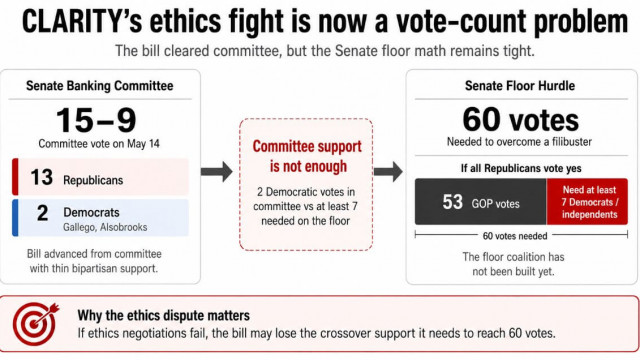
Bipartisan Senate talks on the CLARITY Act hit a snag after a Democratic source said GOP and White House reversed on a provision letting state AGs sue DOJ over crypto ethics.
Bipartisan Senate talks over the CLARITY Act hit a snag this week. A Democratic source described an "about-face" by GOP members and the White House on a prior enforcement agreement. The disputed provision would have allowed state attorneys general to sue the Justice Department for failing to enforce certain crypto ethics requirements.
The source said Republicans and the White House had previously supported the measure. Now they have reversed course. The reason for the shift was not disclosed. The source spoke on condition of anonymity to discuss private negotiations.
The provision was seen as an important enforcement tool. Without it, state attorneys general have no direct means to compel DOJ action on crypto ethics violations. The Justice Department retains discretion over which cases to pursue. State-level officials are left to rely on federal enforcement priorities.
State attorneys general have taken an active role in crypto enforcement. New York's attorney general has brought cases against several exchanges. The provision would have given them a formal role in federal ethics enforcement. The source said the reversal weakens that state-level influence.
The CLARITY Act aims to establish ethics rules for government employees involved in crypto markets. The bill has drawn bipartisan support in principle. Disagreements over enforcement mechanisms have slowed progress. The provision allowing state AG lawsuits was one of the most contentious elements.
The White House had earlier signaled support for the measure. The source said the administration now appears to side with GOP concerns about federalism. The CLARITY Act is one of several crypto bills moving through Congress. The House passed the FIT21 Act earlier this year. Senate action has been slower. Industry groups have called for clear ethics guidelines to avoid conflicts of interest among regulators. The enforcement provision was seen as a way to ensure those guidelines are followed.
The source said the provision's collapse could delay the entire bill, potentially preventing it from advancing this year. A committee markup has not been scheduled. The source said the provision's fate is uncertain. Talks are expected to continue. The momentum behind the bill has stalled.
Prepared with AlphaScala editorial tooling from the source reporting linked above. Indexable analysis may include a cited Alpha Score value. Publishing checks screen each story before release. Educational coverage, not personalized advice.