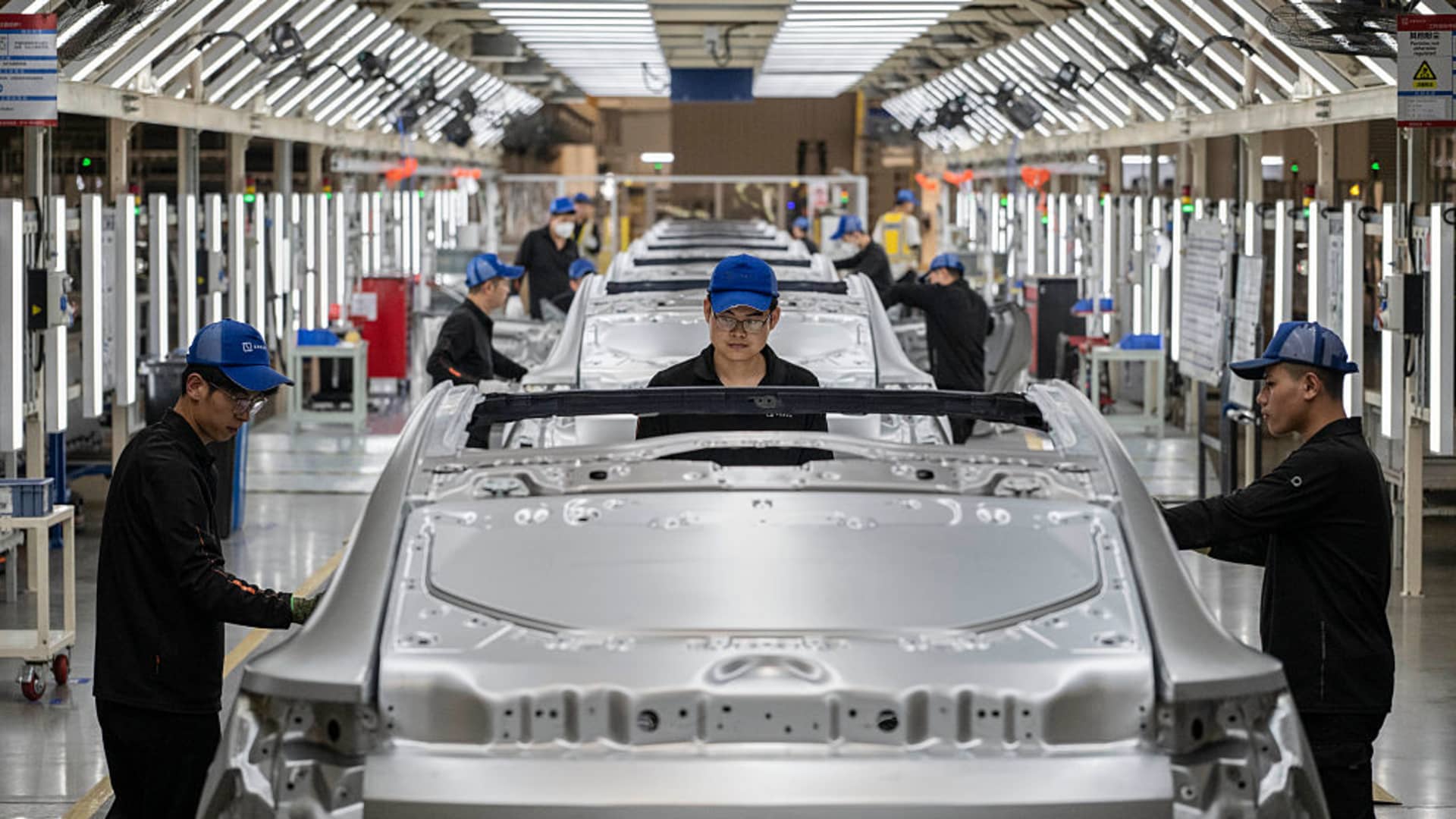
Chinese electric vehicles are finding their way onto American roads within a few years, not as direct imports but through partnerships, Mexican assembly plants, and shifting trade rules. The mechanism is what matters to the Big Three automakers – General Motors (GM) , Ford , and Stellantis (STLA) – which face an existential squeeze: U.S. tariffs of 125% on Chinese-made EVs are nearly airtight, yet the cracks are opening elsewhere.
The Mechanism: How Chinese EVs Cross the Tariff Wall
The 125% Tariff Barrier
Direct imports of Chinese-made EVs face a cumulative 125% tariff, making them uncompetitive. That wall is not the end of the story. Chinese automakers are already exporting more than 2.5 million EVs annually, and the U.S. is the only major market they have not yet penetrated, according to Michael Dunne, CEO of Dunne Insights. “The only market in the world they have not yet penetrated is the United States,” he said.
The USMCA Loophole: Mexican and Canadian Production
The more practical route runs through Mexico and Canada. Under the United States-Mexico-Canada Agreement (USMCA) , a vehicle assembled in Mexico or Canada can enter the U.S. duty-free if 75% of its content – including batteries, motors, electronics, and software – is sourced in North America. China’s BYD and Geely are among finalists vying for a Nissan-Mercedes-Benz plant in Mexico. Guangzhou Automobile Group announced plans to begin assembling vehicles there in the second half of 2025.
Risk to watch: the USMCA renewal negotiations in July will determine whether Chinese EVs can enter through Mexico with preferential tariffs.
Software and Content Rules: The Next Hurdle
Even if physical assembly is in North America, Chinese-developed software for connected and autonomous systems faces restrictions from a Biden-era rule that took effect in March 2026. Volvo , majority-owned by China’s Geely, recently received U.S. government approval to continue selling vehicles using Chinese-maintained software. That precedent matters. Adam Bernard, founder of AutoPerspectives and former GM associate director, noted that Geely could adapt the Volvo factory near Charleston, South Carolina, for other platforms such as Zeekr, which already supplies Alphabet’s Waymo robotaxi fleet.
Exposure by Automaker: Who Has the Most to Lose
General Motors (GM)
GM already imports EV battery cells made by China’s CATL for the Chevy Bolt EV, assembled at GM’s Fairfax plant in Kansas. The company also builds Equinox, Blazer, and Cadillac Optiq EVs at its facility in Coahuila, Mexico – not subject to tariffs under USMCA. GM and its long-standing joint venture SAIC-GM-Wuling are in advanced talks to begin manufacturing ICE vehicles in Mexico. AlphaScala’s proprietary scoring system rates GM at 51/100 (Mixed) , reflecting the uncertainty ahead. GM stock page
Stellantis (STLA)
Stellantis holds a 21% stake in Chinese EV maker Leapmotor and a 51% majority in a joint venture. CEO Antonio Filosa said the company “for sure” sees opportunity in expanding Leapmotor production in Mexico and potentially Canada. “I believe that there is space in Mexico. … There is maybe space in Canada,” he said. Stellantis declined to elaborate. Its Alpha Score is 46/100 (Mixed) , indicating the same competitive pressure. STLA stock page
Ford
Ford is reportedly in talks with Geely for a European partnership and, according to The Wall Street Journal, “also appears to be opening the door to allowing Chinese cars in the U.S. at some point.” Ford is pushing ahead with its Universal Electric Vehicle (UEV) platform, starting with a $30,000 midsize electric pickup truck launching next year. CEO Jim Farley has admitted to enjoying a Xiaomi SU7 sedan.
Tesla
Tesla CEO Elon Musk accompanied Trump to the Beijing summit, and Tesla has a mega-factory in Shanghai. While BYD has eclipsed Tesla as the global EV leader, Tesla retains a U.S. manufacturing base. Any Chinese entry could pressure Tesla’s domestic pricing power.
Timeline: When Will Chinese EVs Actually Arrive?
Expert Predictions: 2030
Dunne is confident: “By 2030, we will see some form of Chinese cars on American roads. One way or another, they’ll find their way in.”
The 18-Month Catalyst: Canadian Sales
Canada signed a deal with China permitting up to 49,000 Chinese-built EVs at a 6.1% tariff rate. Tu Le, founder of Sino Auto Insights, said: “Once Canadians start to buy them in the next 18 months, [while] our Mexican neighbors already are able to buy them, the pressure is going to increase significantly.”
USMCA Renewal Deadline: July 1
U.S. Trade Representative Jamieson Greer told CNBC there will be no “rubber stamp” renewal of USMCA on July 1. The administration is demanding a higher U.S. content requirement. Greer denied a reported goal of 50% but said the administration will press the issue. If the U.S. does not get what it wants, “It will put us on a path to exit it eventually.” A USMCA collapse would remove the tariff advantage for Chinese EVs assembled in Mexico.
Market Reaction and Affected Assets
Detroit Automakers
GM , Ford , and Stellantis face a structural threat. They have scaled back their own EV campaigns while China’s output continues to climb – 55% of all car sales in China were EVs in 2025, and Chinese automakers captured 60% of global EV sales. Stephen Dyer of AlixPartners said: “U.S. companies have stepped back from a lot of their electric vehicle campaigns, because they haven’t been able to develop, in an inexpensive way, a compelling value proposition for U.S. consumers.”
Consumer Sentiment: 38% Open
A recent Kelley Blue Book study found that 38% of Americans would consider buying a Chinese vehicle if they had the choice. Dan Ives of Wedbush Securities said: “The only thing stopping [them] are the restrictions of selling into the U.S.”
| Vehicle | Current U.S. Tariff | Route to U.S. | Timeline |
|---|
| Chinese-made EV | 125% | Direct import blocked | Not viable |
| Chinese EV assembled in Mexico | 25% (USMCA 75% rule) | Via partnership/JV | 2026-2030 |
| Chinese EV assembled in Canada | 6.1% | Via Canadian import deal | 2026-2027 |
| Chinese brand via U.S. factory | Same as domestic | Via Volvo/Geely precedent | 2028-2030 |
What Would Reduce the Risk for Detroit
- A permanent Senate ban on Chinese automakers, as proposed by Senators Bernie Moreno (R-Ohio) and Elissa Slotkin (D-Mich.), would close the partnership route.
- Higher U.S. content requirements under USMCA renewal would make it harder for Chinese components to qualify for duty-free entry.
- Detroit automakers develop competitive low-cost EVs on their own. Dyer noted the core problem: they have not created a compelling value proposition at an inexpensive price.
What Would Make It Worse
- USMCA collapses – Without the trade agreement, there is no framework to prevent Chinese-made content from entering through Mexico or Canada under bilateral deals.
- BYD builds a Canadian factory – BYD executive vice president Stella Li said in March the company is considering a wholly owned factory in Canada and possibly acquiring a struggling legacy automaker.
- Political backlash accelerates protectionist moves – A 10% tariff on Mexico, Canada, and other countries proposed by the Trump administration over forced labor concerns could escalate into broader trade conflict, disrupting supply chains for all automakers.
The Next Decision Point: USMCA Talks and Midterm Elections
The July 1 USMCA renewal is the single most important near-term catalyst. If Greer pushes through higher U.S. content requirements, Chinese EVs assembled in Mexico become less cost-competitive. If the talks stall, the existing 75% rule stands, and Chinese automakers will continue to build partnerships and factories in Mexico and Canada.
Le summed up the long-term arithmetic: “It can’t just be no, never. That will ultimately cripple the U.S. auto industry. It’ll inflate pricing for consumers, because our technology is going to be two or three generations older than anything anyone can buy in Europe and in China.”
For investors, the risk is not that Chinese EVs appear overnight. It is that Detroit’s current strategy of slowing EV investment while relying on trade barriers will prove insufficient by 2030. The companies that hedge – through partnerships, licensing, or joint ventures – may be the ones that remain competitive in the second-largest automotive market after China itself. stock market analysis