Stocks● Neutral
China's Year-Long Space Mission Targets 2030 Moon Landing
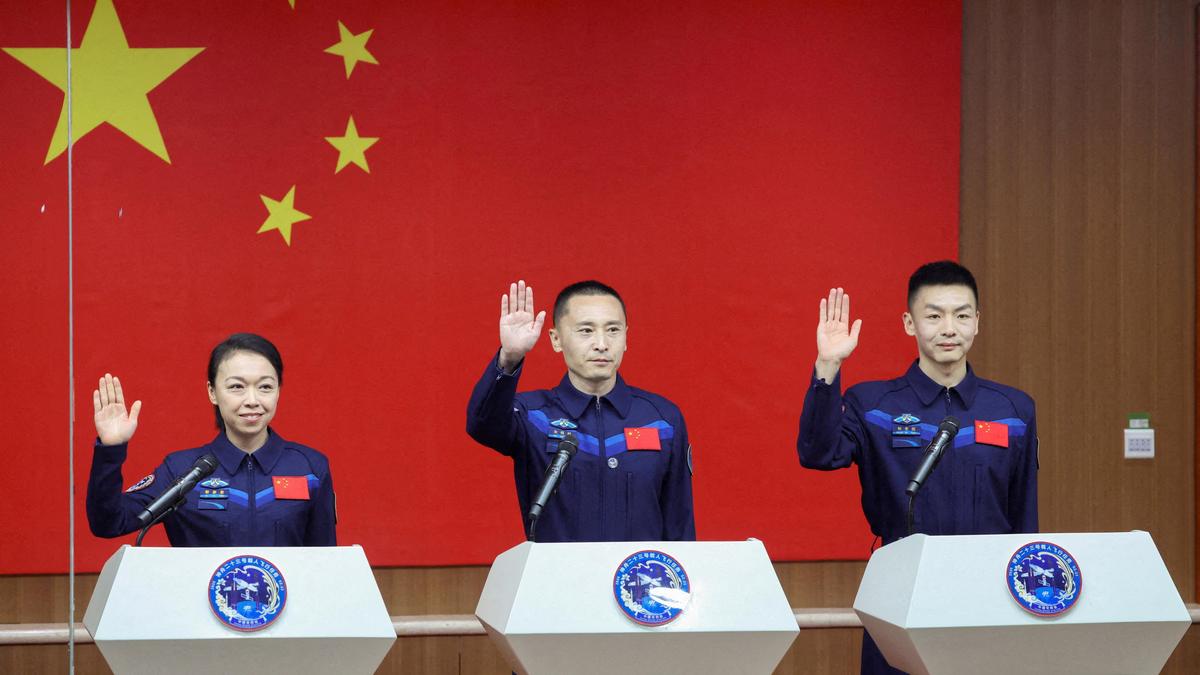
Shenzhou-23 launches with first Hong Kong astronaut; one crew member will stay a year on Tiangong as China races to beat US to crewed moon landing by 2030.
Continue with
China will launch the Shenzhou-23 mission on Sunday, sending three astronauts to the Tiangong space station with one crew member staying for a full year. That duration, a national record, is designed to study long-duration human physiology as Beijing pushes toward a crewed moon landing by 2030.
The mission changes the narrative for the space sector in two ways. First, it demonstrates China's ability to sustain human presence in orbit for extended periods, a prerequisite for lunar operations. Second, it tightens the timeline against the U.S., which aims for a crewed moon landing in 2028 under the Artemis program. For investors tracking space-related equities, the gap between these two timelines now carries real execution risk.
The Shenzhou-23 Mission: What Changed
Shenzhou-23 lifts off at 11:08 p.m. local time (1508 GMT) from Jiuquan Satellite Launch Center in northwest China, using the Long March-2F Y23 rocket. The crew includes commander Zhu Yangzhu, pilot Zhang Yuanzhi, and payload specialist Li Jiaying, a former Hong Kong police inspector who becomes the first astronaut from Hong Kong to join a Chinese space mission.
One of the three will remain on Tiangong for a year. The China Manned Space Agency said Saturday that the specific astronaut will be decided later based on mission progress. That year-long stay will be one of the longest space missions ever, though it falls short of the 14.5-month record set by a Russian cosmonaut in 1995.
Autonomous Rendezvous and Docking
The flight will execute the first autonomous rapid rendezvous and docking procedure with the core module of Tiangong. This is not a routine maneuver. It directly rehearses the automated lunar-orbit rendezvous required for the 2030 mission, where the Mengzhou capsule must dock with the Lanyue lunar lander without manual intervention.
The Year-Long Stay: Physiological Data and Mission Readiness
China has sent trios of astronauts to Tiangong for six-month stays since 2021. The year-long mission extends that baseline, allowing scientists to study the physiological effects of radiation exposure, bone density loss, and psychological stress over a longer period. These data points are directly relevant to a lunar mission, which involves higher radiation exposure and longer isolation than low-Earth orbit.
Artificial Embryo Experiment
Beijing is conducting the world's first human "artificial embryo" experiment in space. State media reported that samples of human stem cells were sent to the Shenzhou-22 crew on Tiangong this month. The experiment aims to study long-term residence, survival, and reproduction of humans in space. For a program targeting a permanent lunar base by 2035 with Russia, this research is foundational.
The 2030 Moon Landing Timeline: Hardware Gaps and Risk
China has less than four years until its 2030 deadline. The country has only sent robots to the moon, though it became the first nation to recover lunar samples from the far side in June 2024. A crewed landing requires entirely new hardware and software.
Hardware Development Status
Over the past year, Beijing has been carrying out safety tests of:
- Long March-10 heavy-lift rockets
- Mengzhou spacecraft
- Lanyue lunar lander