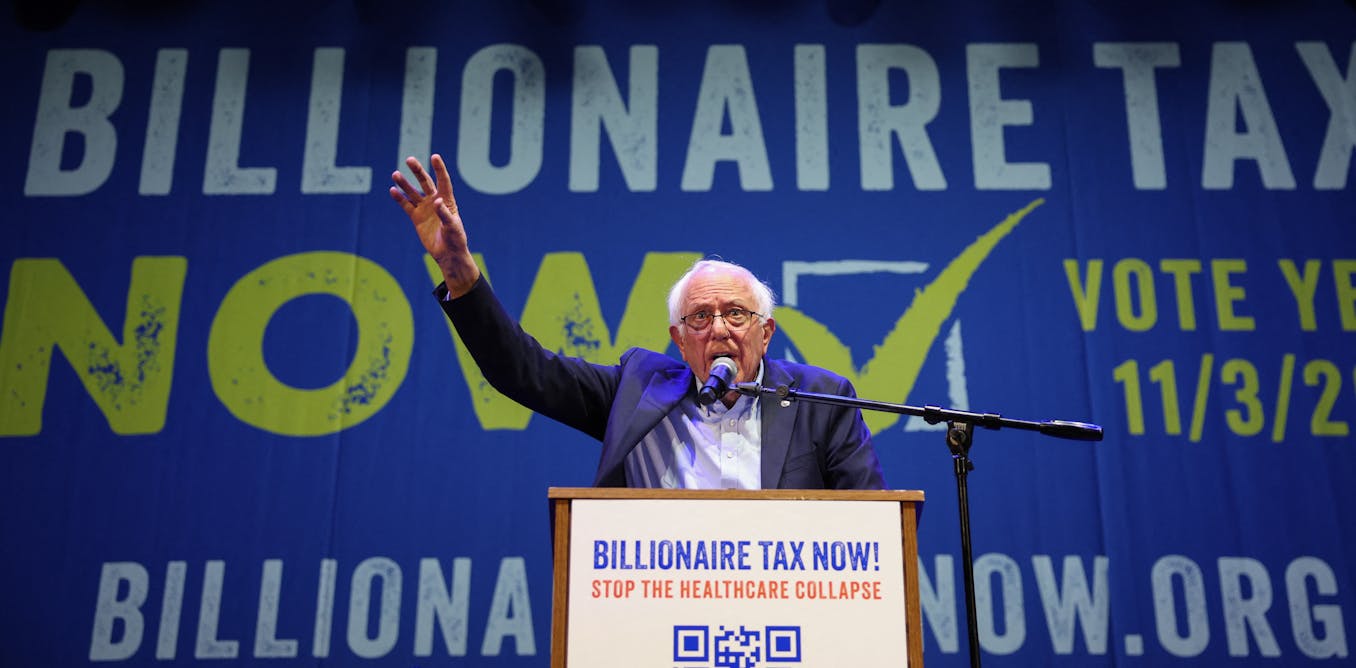
California voters will decide in November whether to impose a one-off 5% wealth tax on every billionaire in the state. The proposal has drawn international attention as a test case for similar measures in New York, the United Kingdom, and several other U.S. states.
Google co-founder Sergey Brin has already spent $100 million on a campaign to defeat the measure. If the tax passes, Brin's estimated tax bill would reach $13 billion, a roughly 130-to-1 return on his political investment if the opposition succeeds.
Supporters of the union-backed proposal say it would raise $100 billion in revenue for state-funded healthcare, food assistance, and public education. They point to data showing most billionaires pay lower marginal tax rates than the average worker, and argue the money is needed to fill gaps left by President Donald Trump's cuts to Medicaid. California's Democratic Governor Gavin Newsom opposes the measure, arguing it will drive billionaires and their tax revenue out of the state.
Similar measures are under consideration elsewhere. New York Mayor Zohran Mamdani has proposed a 2% income tax increase on earnings above $1 million and passed a property surcharge on second homes. Washington state, Maine, and Minnesota have passed or are considering similar wealth or income tax measures. In the U.K., a group of 120 millionaires launched a 'Proud to Pay' campaign asking the government to levy an additional 2% tax on wealth over £10 million.
The push for wealth taxes comes amid a sharp divergence in income shares. The share of U.S. economic output flowing to workers fell to a record low of 52.9% in 2026, according to data from the Bureau of Economic Analysis. For every $100 the economy produces, workers take home $52.90 in pay, the smallest slice since records began in 1947. Similar trends are visible globally. Meanwhile, billionaire wealth has accelerated. Forbes reports a global record 3,428 billionaires as of 2026. In June, Elon Musk briefly became the world's first trillionaire after the public launch of SpaceX; his wealth now sits at around $800 billion.
Two structural factors have driven the divergence. Union membership and bargaining power have declined worldwide, weakening workers' ability to negotiate higher wages. At the same time, corporate consolidation into a small number of large 'superstar firms' – including Alphabet, Amazon, and Uber – has reduced competition and allowed these companies to hold down wages, economists have said. The rise of artificial intelligence and automation will accelerate these trends, enabling the largest firms to shed workers even as output and profitability climb.
For the last two decades, stagnating wages were propped up by cheap credit. Central banks kept interest rates low through unconventional policies, and household spending held steady on the back of rising household debt. Inflation pushed central banks to raise rates from emergency pandemic lows, cutting off cheap credit. With inflation rising faster than wages, real living standards have declined.
Voters have turned away from incumbents and established parties across the developed world. After Mamdani's headline-grabbing victory in New York, Democratic Socialists have won a series of primary races. Left-independent Catherine Connolly was elected Irish president. The Greens have risen in the U.K., and Germany's Die Linke has staged a resurgence. These parties and leaders share a focus on combating growing global wealth inequality. Billionaires, as the most visible symbol of that inequality, have become an obvious target.
The California proposal shows that attempts to rein in billionaire wealth draw furious opposition. Beyond Brin's $100 million, donors including Peter Thiel, Eric Schmidt, and Chris Larsen have spent heavily to oppose the tax. Brin's campaign committee has also organised competing ballot propositions that, if passed, would nullify the tax. An early poll showed the billionaire tax supported by a majority of voters. More than 1.6 million Californians signed the petition to put the tax on the November ballot.
Even if the tax passes, some supporters of broader wealth redistribution argue it treats a symptom rather than the underlying causes of inequality. They say a fuller agenda would include improving workers' bargaining power, breaking up monopolies, and public ownership of AI technology. Without those structural fixes, they argue, voter anger and political instability will continue to escalate.