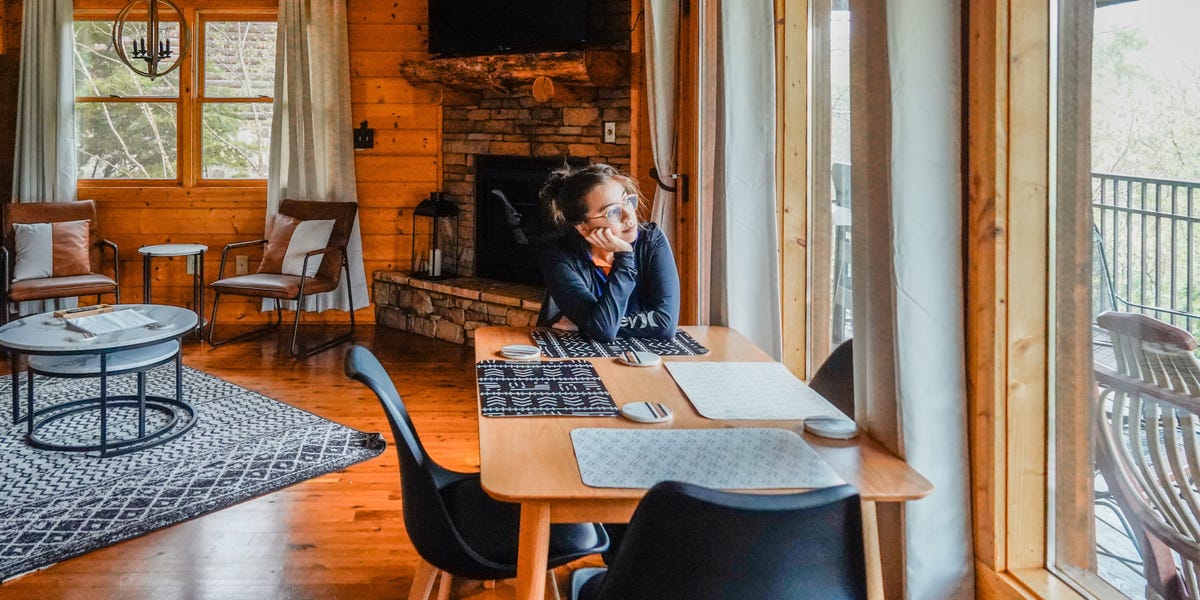
As a travel reporter, I've slept in a treehouse in Ontario's wine country and a converted wine barrel in Switzerland. A repurposed lifeguard tower in Miami rounds out the list of unusual places I've called home for a night. Nearly all of them came through Airbnb, which I book over hotels because the spaces are more interesting.
Most of my travel is solo. I've spent roughly 200 hours on overnight trains across the US and Europe, sailed the Caribbean for seven nights on one of the world's largest cruise ships, and taken rail trips to Vancouver, Niagara Falls, Montreal, and Quebec City. Every one of those journeys involved exploring a new city and falling asleep in a stranger's property, alone.
Over time I developed a handful of habits that make solo stays feel safer, especially in countries I don't know well. The central one is a small deception at booking. When I reserve an Airbnb for myself, I change the guest count from one to two. In my opening message to the host, I mention that a friend may join me for part of the trip.
The host never knows I'm traveling by myself. That illusion of company is what lets me relax enough to sleep in an unfamiliar place. The perception carries weight beyond the booking itself. A host who believes a guest has company tends to be more attentive to check-in instructions, and neighbors or building staff who see two names on a reservation are less likely to wonder about a lone visitor.
The trick costs money. Airbnb charges per guest at many listings, so selecting two people raises the nightly rate. I pay it without complaint. The Rome example shows why. I booked two nights in a livable art-sculpture Airbnb there. The price came to $102 per night for one person and $145 per night for two, a $43 difference per night. A companion did end up joining me for that stay. Had I been on my own, I would still have paid the higher rate. The extra $86 across two nights bought a feeling of security that a hotel booking would have given me for free, and I considered it money well spent.
Solo travel carries enough uncertainty on its own. Renting from an individual rather than through a hotel chain adds another layer: you're placing your safety in the hands of one person you've never met, someone whose reputation you know only through reviews. Anything that reduces that unease is worth the price.
The per-guest fee is not the only consideration. Some hosts raise cleaning fees or apply occupancy surcharges for a second guest, so the real cost of booking for two varies by listing. My rule is simple: if the markup is reasonable, I take it. The alternative, lying awake in a strange bed wondering whether anyone would notice if something went wrong, costs more than any booking fee.
I still book Airbnbs when I travel alone. The unique spaces are the point, and a converted wine barrel in Switzerland is not something a hotel chain offers. Booking for two just makes the experience feel a little safer.