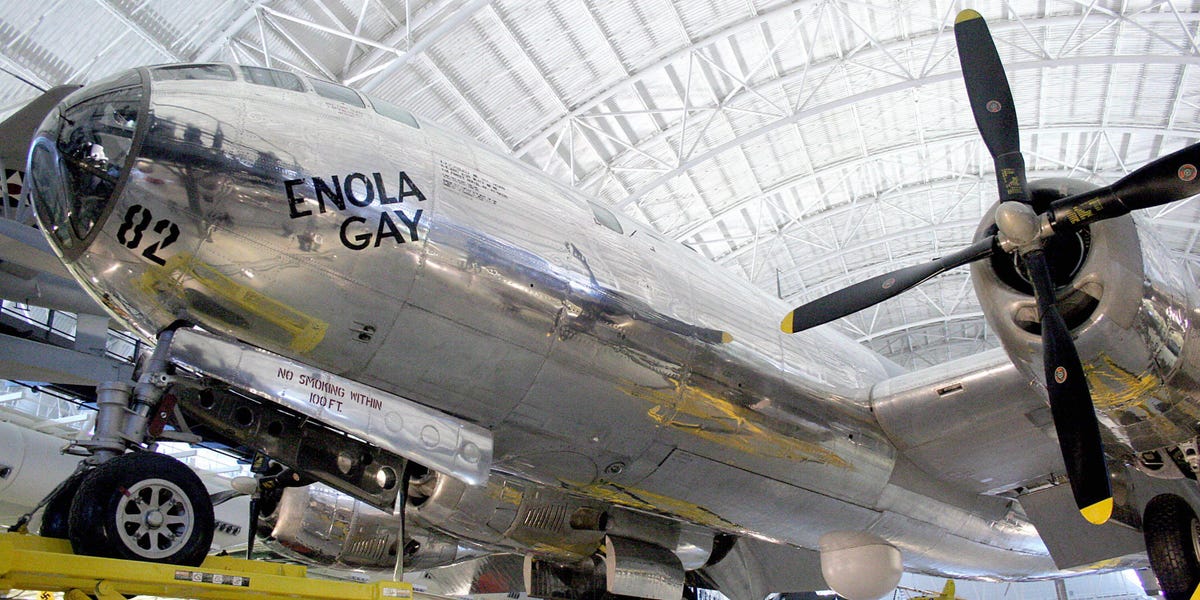
The Boeing B-29 Superfortress that dropped the first atomic bomb on Hiroshima sits 30 miles from the Smithsonian's flagship National Mall museum. The aircraft, named Enola Gay, has been on permanent display at the Steven F. Udvar-Hazy Center in Chantilly, Virginia, since 2003. The plane is too large for the main museum's 161,145 square feet of exhibit space. The Udvar-Hazy Center offers 340,000 square feet.
Museum staff spent 300,000 hours reassembling and restoring the aircraft, moving parts in 12 truckloads. The restoration effort highlights the complexity of maintaining vintage military aircraft, a niche that supports parts suppliers and specialized restoration firms. For defense contractors with long government relationships, the skills needed to restore a B-29 mirror those used in sustaining current fleets.
Boeing (BA) built the B-29. The company's Alpha Score of 46 out of 100, rated Mixed, reflects the tension between its commercial and defense businesses. The defense side has steady contract flows, with programs like the KC-46 tanker and F-15EX fighter continuing Boeing's long history of military aircraft production. The Enola Gay's design for a one-off mission stripped weight: no paint, saving 850 pounds, and only 50-caliber tail guns for defense. Those engineering trade-offs persist in modern military aviation, where payload and range are balanced against survivability.
Northrop Grumman appears in the same Udvar-Hazy collection. The museum holds a Northrop P-61C Black Widow, the first US aircraft designed for night combat. That overlap in historical significance points to the broader defense sector's reliance on long development cycles and government contracts. Lockheed Martin, another major defense prime, does not exhibit at Udvar-Hazy but has its own legacy aircraft in other Smithsonian facilities.
The Enola Gay's public display was not without controversy. The Smithsonian first assembled the fuselage for a 1995 exhibit marking the 50th anniversary of the bombing. The script was rewritten several times as veterans' groups pushed for emphasis on Japanese aggression and the argument that the bomb saved lives. Anti-war activists staged alternative exhibits on the sidewalk outside the museum. The permanent exhibition at Udvar-Hazy now takes a minimalist approach, leaving interpretation to visitors. That restraint reduces reputational risk for the Smithsonian and, by extension, for Boeing as the aircraft's manufacturer.
Roughly 70,000 people died from the initial blast, heat, and radiation, according to the U.S. Department of Energy's Office of History and Heritage Resources. A higher estimate from Japan and anti-nuclear scientists counted 140,000 deaths at Hiroshima. The death toll over five years may have exceeded 200,000 due to aftereffects. A second B-29, named Bockscar, dropped a "Fat Man" bomb on Nagasaki on August 9, 1945. Japan's emperor announced surrender in a radio address on August 15.
The Enola Gay's pilot, Col. Paul Tibbets, commanded the Army Air Forces' 509th Composite Group. The hand-picked unit trained at an airfield in Wendover, Utah. The plane was 11.5 miles from the blast when the bomb detonated, yet the shockwave rattled the aircraft.
Eighty-one years after the bombing, the Enola Gay remains both a historical artifact and a symbol of the nuclear age. For investors, the aircraft stands as a reminder of the long product cycles and government dependency that define the defense sector. The 300,000-hour restoration is a concrete measure of what it takes to keep these machines in the public eye. Boeing's defense business, valued through contracts for new and upgraded platforms, follows a similar rhythm of sustained commitment and specialized labor.
The Udvar-Hazy Center's location near Dulles Airport puts the exhibit within reach of the Washington, D.C., defense community. That proximity may draw contractor employees and analysts who track the sector's health. The permanent display, with its quiet presentation, allows that audience to draw its own conclusions about the B-29's legacy and the industry that built it.