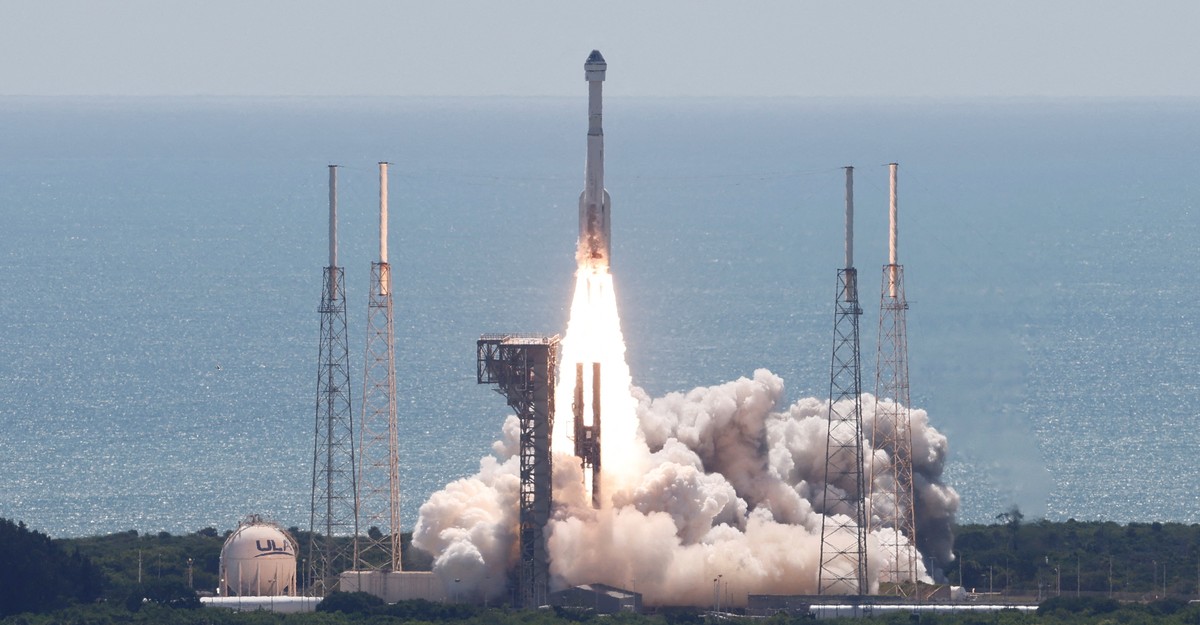
A Boeing spacecraft carrying two NASA astronauts lifted off from Cape Canaveral this morning, marking the company's first crewed launch and the first time a woman has piloted a new orbital vehicle on its maiden voyage. Barry Wilmore and Sunita Williams are now en route to the International Space Station aboard the Starliner capsule, a vehicle whose path to the pad was littered with software bugs, corroded valves, flammable tape, parachute issues, and a last-minute computer glitch that scrubbed an attempt just last week.
NASA has relied on SpaceX for crew transport since 2020, when the space agency retired its shuttle fleet and handed the job to private contractors. Boeing received a billion-dollar contract alongside SpaceX to build its own system, but Starliner's development lagged years behind. The company's 2019 uncrewed test flight was cut short by a software malfunction that engineers said would have led to a total mission failure with astronauts aboard. A 2021 attempt was shelved after finding 13 corroded valves. An uncrewed flight to the station and back succeeded in 2022, but Boeing then discovered problems with the parachute system and flammable tape inside the capsule.
Early last month, a crewed attempt was scrapped hours before liftoff because of a faulty valve on the United Launch Alliance rocket. Over the following weeks engineers found more issues with Starliner itself. A second attempt last weekend was halted less than four minutes before launch when a ground computer malfunctioned. "All is going well," Mark Nappi, Boeing's commercial-spaceflight program manager, said at a prelaunch press conference last week. The computer glitch proved otherwise.
NASA Administrator Bill Nelson has told reporters that Boeing CEO Dave Calhoun assured him the space division's leadership was sound. Calhoun will step down at year's end, the second Boeing chief to leave in five years amid the company's airline safety crisis. The troubles at Boeing's airplane division have drawn questions about whether they extend to its space work. Nelson said they do not.
Wilmore and Williams are scheduled to dock with the space station tomorrow. Along the way they will briefly take manual control of Starliner to test its handling. The capsule then faces a fiery reentry and a touchdown in the New Mexico desert. Only after that return does NASA certify the vehicle for regular flights carrying up to four astronauts at a time.
SpaceX went through the same process in 2020 with its Dragon capsule. Those first crewed flights were tense; now Dragon launches barely register. Boeing faces the same gauntlet. The writer Jerry Useem recently observed in The Atlantic that the company that created the Jet Age has become "a glorified gluer-together of precast model-airplane kits." A truncated space mission would add to that reputation. A major failure could turn a company that helped define the Space Age into an emblem of constant calamity.
BA stock page