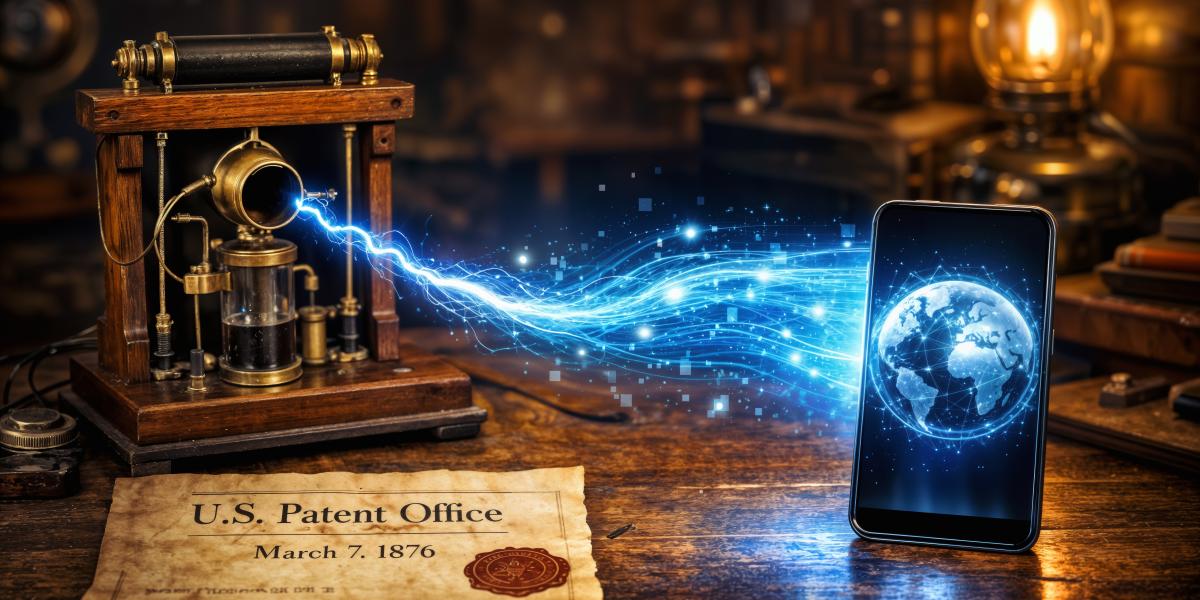
On March 7, 1876, Alexander Graham Bell received US Patent No. 174,565 for the speaking telegraph. Three weeks earlier, both Bell and Elisha Gray filed their ideas with the Patent Office on the same day. Bell's application arrived first. On March 10, Bell used a liquid transmitter to call his assistant, Thomas Watson, with the words "Mr. Watson–Come here–I want to see you." That transmission is widely considered the first intelligible voice message over an electrical wire.
This year marks 150 years since that invention, and it offers a chance to trace how the telephone industry was shaped by patents, regulation, and monopoly–not just by innovation. The historical definition of monopoly matters: monopoly had always meant "grants of exclusive privilege" by government, wrote Murray Rothbard. Without state power, there is no sensible, non-arbitrary definition of the term.
Rothbard described how monopoly could be imposed "in the name of opposition to monopoly." The American state, progressive elites, and big businesses worked together to create monopolies that could not stand in a free market. Tom DiLorenzo wrote about the myth of "natural monopoly": "When monopoly did appear, it was solely because of government intervention."
Burton Fulsom's "The Myth of the Robber Barons" distinguished "political entrepreneurs" who succeeded through federal aid, pools, and vote buying from "market entrepreneurs" who built superior products at low cost. Patrick Newman defined cronyism as "government intervention that benefits special interests at the expense of the public interest."
Gabriel Kolko's "The Triumph of Conservatism" argued that big business explicitly sought government protection. American industry at the turn of the century was becoming more competitive, not less. Many businessmen saw federal regulation as the only way to control competition. "Ironically, contrary to the consensus of historians, it was not the existence of monopoly that caused the federal government to intervene in the economy, but the lack of it," Kolko wrote.
The question of who first invented the telephone is legally settled but historically contested. A review of Bell's correspondence and engineering notes from a Bell associate concluded that Bell's idea came first and that neither he nor the Patent Office borrowed from Gray's work. Bell acknowledged his predecessors. But patent law is not egalitarian, wrote Benjamin Brown: "emphasizing the many, sometimes parallel, contributions is of great importance, but patent law assigns individual or organizational ownership."
Christopher Beauchamp's "Invented by Law: Alexander Graham Bell and the Patent That Changed America" argued that the "invention" of the telephone was as much a legal creation as a technical one. Lawyers and companies shaped the patents during litigation, emphasizing features the inventors themselves had not thought central. "The patents underpinned the companies' commercial success, with predictable consequences for the historical reputations of the patentees," Beauchamp wrote. "In 1936, when the organizers of the Patent Office centenary chose Alexander Graham Bell as the first great inventor on their roll of honor, the Bell System was the largest business organization in the world."
The Bell Telephone Association formed on July 9, 1877 to commercialize the invention. A year later, on July 20, 1878, the enterprise became the Bell Telephone Company with more capital and corporate structure. From 1878 to 1888, Bell filed over 600 lawsuits when the Supreme Court heard five appealed cases. The Court affirmed Bell's patent in every one.
Theodore N. Vail became general manager of the Bell Telephone Company in 1878. He became the first president of AT&T in 1885 and was the architect of the modern Bell System, built on the vision of "one policy, one system, universal service." Vail told associates: "We have the only original telephone patents. We have organized and introduced the business and we do not propose to have it taken away from us by any corporation."
Western Union had created the American Speaking Telephone Company–WU-AST–using its Gold and Stock Telegraph subsidiary, bringing in Thomas Edison, Elisha Gray, and A. E. Dolbear to compete with Bell. The rivalry ended in 1879 with a settlement. Western Union acknowledged Bell's priority and agreed to leave the telephone business. Bell obtained Western Union's telephone patents and agreed to buy WU-AST's exchanges. Western Union received 20 percent of royalties from telephone instruments for the remaining life of the Bell patents.
Bell held a virtual monopoly from 1877 until 1894, based on control of all crucial patents. When key patents expired, independent companies jumped in. Bell, wrote Kolko, "immediately adopted a policy of harassing the host of aspiring competitors that sprang up by starting suits against them–twenty-seven in 1894-1895 alone."
James J. Storrow, a close adviser to the American Bell Telephone Company management, wrote to the president in 1891: "The Bell Company has had a monopoly more profitable and more controlling–and more generally hated–than any ever given by any patent."
The era of freer competition arrived after the Bell patents officially expired in 1893 and 1894. "Dozens of competitors sprung up," DiLorenzo wrote. The Bell company was prepared. Noobar Danielian's "AT&T: The Story of Industrial Conquest" explained: "The new era found the American Bell Telephone Company prepared to stifle and harass competitors because it had a firm grip on the lesser patents which related to the practical exploitation of Bell's newly discovered art."
The patents and monopolies shaped market-legal conditions for decades. Beauchamp wrote that the legal monopoly "obviously operated to set the terms of telephone provision and had a powerful restraining effect on the growth of the industry." The success of arguments for centralization, he argued, "depended heavily on the preexisting monopolies created under the patents."