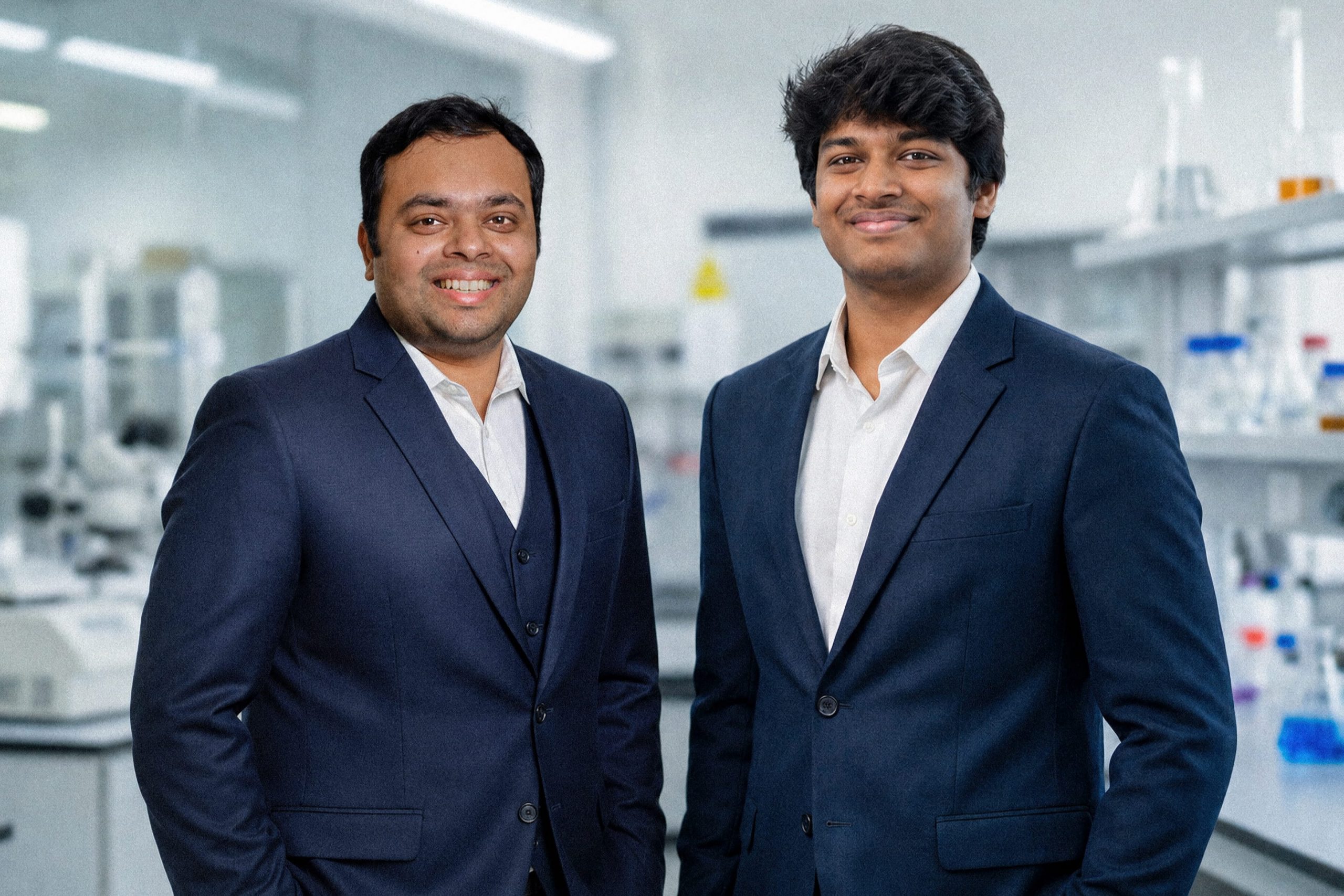
ARDHANN, a deep-tech startup building sensor-embedded composite materials for the hydrogen economy, won the Underrepresented Founders pitch competition at the SCALE Expo & Summit 2026. The win signals that the company's proposition – a laminate with an embedded graphene sensor mesh that detects internal damage before failure – is beginning to land outside materials science circles. That is the first of two reasons co-founder and CEO Dr Sangeeth Sivan Kumar said the recognition mattered. The second is personal.
"I grew up in South India, in a family that has run cotton textile mills for three generations," Kumar told AlphaScala. "From there to Manchester is not a path investors typically pattern-match to. Being recognised at SCALE was a reminder that the route into deep tech can start anywhere, and that the network is starting to back founders who don't fit the standard template."
The company is now working toward a seed round, funded by a £500,000 pre-seed round that Kumar said takes ARDHANN to a seed-ready position in 18 months. The capital funds the Gen 2 prototype of the sensor-embedded composite, two paid field pilots with anchor customers, and the first commercial-grade build of the Material Intelligence software platform. About 55 percent of the funds go into R&D and prototyping, 27 percent into two commercial FTE hires, and the balance into legal, compliance, IP filings, and facilities.
Why Composites Need a Nervous System
The problem ARDHANN addresses is a material science failure that costs the global economy $2.5 trillion from corrosion alone. In hydrogen environments, steel fails up to 10 times faster and costs 50 percent more to operate than in fossil-fuel settings, Kumar said. Composites are the only structural replacement at scale. They are "blind to internal damage." Conventional inspection is external, periodic, and reactive – operators learn a vessel is failing only when it fails.
The company's answer is a material that does not just replace metal. It senses its own condition. ARDHANN manufactures a new generation of composite using an automated, all-directional reinforcement process. During that manufacture, it embeds a graphene-based sensor mesh at the fiber level. The sensing is not bolted on or glued to the surface. It is in the structure.
The Two-Layer Stack
The software layer is Material Intelligence, a physics-informed machine learning platform. The sensors stream live data on strain, pressure, temperature, and chemical activity from inside the part. The model combines that live data with the underlying physics of the material to monitor what is happening in real time. It flags failure modes before they propagate and feeds performance data back into the design of the next generation of parts.
"Most hardware-software companies in this space do one or the other," Kumar said. "Sensor companies sit on top of someone else's material. Composite companies sell parts that are blind. We are building both layers as one integrated stack, which is what unlocks the value, because the data only means something if the sensor is physically inside the right place."
Two Anchor Pilots at Scoping Stage
ARDHANN is conducting technical scoping with two tier-one customers. The first is Indian Oil Corporation, India's largest oil and gas company by revenue, for Type V hydrogen cylinders. The second is Airbus, through its Innovation group, for aerospace fuel-system sensing. Kumar was explicit that neither pilot is yet a paid contract. The £500,000 pre-seed funds the work that converts those conversations into signed paid pilots.
"The number is sized to break the chicken-and-egg of deep-tech B2B sales," Kumar said. "Once we have the IOCL Type V cylinder pilot operational and the Airbus engagement on a formal paid scope, the next tier of buyers can underwrite their decisions on those references, and we are in a position to raise a meaningful seed round on hard evidence rather than projections."
Alongside the customer pilots, the company has £40,000 committed from the Conception X Angel Syndicate through an Advance Subscription Agreement. It was selected into the Royce Hydrogen Accelerator at the Henry Royce Institute, Hildrogen NEXT, and the UK Space Agency Accelerator. Its research base is the Graphene Engineering Innovation Centre at the University of Manchester, with support from DITF on the textile-composite manufacturing side.
Kumar pointed to the Tech Nation Breakout 50 selection as the signal he values most. "That one came from external due diligence by Haatch and Symvan Capital, two well-known UK early-stage VCs," he said. "For a pre-revenue deep-tech company, that kind of third-party validation matters more than any in-house metric we could quote."
Market Timing, TAM, and Five-Year Plan
The global addressable opportunity for advanced composites with embedded sensing and a machine learning platform in ARDHANN's target sectors sits at about £4.5 billion to £6 billion. The realistically serviceable portion, given geography and existing OEM lock-ins, is about £1 billion. By year five, the company models a base-case ARR of £12 million to £18 million from a manageable footprint of cylinder OEMs and aerospace pilots.
What makes the timing right, Kumar said, is that buyers are no longer choosing whether to switch. Policy is forcing the timeline.
- The UK has committed about £2.5 billion in revenue support across HAR1 and HAR2.
- The EU's IPCEI Hy2Infra approved €6.9 billion of public funding and €5.4 billion of private investment in February 2024.
- The US Section 45V hydrogen tax credit was finalized in January 2025.
- India's National Green Hydrogen Mission is funded at ₹19,744 crore and disbursing.
"Hydrogen cylinder, pipeline, and aerospace fuel-system buyers are moving inside specific certification windows, mostly 12 to 36 months, not multi-decade timelines," Kumar said. "We are not betting on whether the market arrives. We are betting on whether ARDHANN gets to the qualified-buyer stage before the next entrant does."
Raising as a First-Time, Underrepresented Founder
Kumar described the fundraising process as harder than the press releases suggest. It was also better in ways he did not expect. The hard part is the asymmetry of information. Every investor conversation runs on a different mental model of what a deep-tech company at pre-seed should look like. Some compare it to a software pre-seed where the team is the asset. Others compare it to a hard-tech Series A where the test data is the asset. "We are neither, and learning how to translate between those frames in real time has been the biggest skill curve of the last year," he said.
The better-than-expected part was the people. "The advisors who have given the most useful time have not been the loudest ones," Kumar said. "They have been the ones who took twenty minutes to explain why a particular cap table choice would hurt us at Series A, or why we should hold a particular IP claim back from a pitch deck."
He also credited his co-founder relationship. Sanjay, his brother, handles the manufacturing problem while Kumar fights the investor pipeline. "The absence of friction is the actual asset," he said.
What Moved the Needle
Three things have moved the needle for ARDHANN, Kumar said.
First, do not compress yourself into a template. "We did not pretend to be a Cambridge spinout or an ex-VC second-time founder. We are two brothers from a south Indian textile family who built a composite sensor at the University of Manchester. The specificity of that story has done more for us than any attempt at polish."
Second, build the advisory bench before you need it. Bringing on Venkat Sethuraman, a 30-year oil and gas veteran, as Commercial Advisor and embedding at the Graphene Engineering Innovation Centre gave the company credibility it could not have generated on its own before it had revenue, a deck, or visible traction.
Third, find external validation that is identity-blind. Pitch competitions, Tech Nation programmes, government grants, and accelerators with published selection criteria carry the same weight whatever you look like or where you come from. "An externally validated logo on slide one buys you the second meeting that your network would otherwise have to buy for you," Kumar said.
"Do not internalise the rejections," he added. "We have been turned down for being too early, too late, too composite, too software, too UK, and too global. None of that means we are wrong. It means the matchmaking process is messy. Keep walking."
Key insight: Deep-tech pre-seed rounds live or die on third-party validation from accelerators, competitions, and government grants. For underrepresented founders without an inherited network, these signals substitute for the pattern-matching that investors use to filter the other fifty decks.
The £500K pre-seed is a bridge, not a finish line. ARDHANN's next test is converting the Indian Oil and Airbus scoping conversations into paid contracts. That milestone, if met, will define the seed round narrative. For now, the Tech Nation Breakout 50 nod and the SCALE win provide the external credibility that early-stage deep tech needs to survive the gap between prototype and pilot.