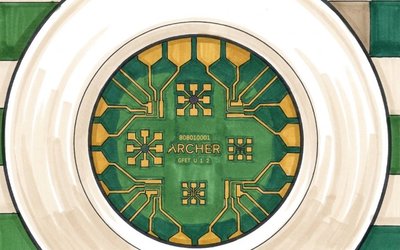
Archer Materials (ASX: AXE) is shifting its quantum device development from laboratory-scale prototypes to wafer-scale production using semiconductor industry-standard processes, with a working qubit demonstration targeted for this year. The move marks a transition from early-stage validation to a manufacturable technology pathway, directly addressing the scalability bottleneck that has kept most quantum computing plays in the research domain.
Archer has completed multiple design, fabrication, and testing cycles of graphene-based quantum devices, building a repeatable fabrication method that can be transferred to commercial foundries. Graphene’s electronic properties make it a candidate for qubit architectures. Inconsistent device performance across fabrication runs has been a barrier, however. Archer’s wafer-scale approach aims to solve that by standardising processes, improving device consistency and reproducibility.
From Lab Benches to Foundry Floors
The simple read is that Archer is progressing toward a qubit. The better market read is that Archer is systematically de-risking the manufacturing side of quantum hardware. Most quantum startups remain stuck at the single-device, hero-experiment stage. Archer’s emphasis on wafer-scale processing–using tools and workflows already familiar to semiconductor fabs–positions it to plug into existing supply chains rather than requiring a bespoke manufacturing ecosystem. That lowers the barrier to commercial adoption and makes the technology more investable for institutional capital that has been waiting for a manufacturable quantum play.
The fabrication cycles have generated characterisation data on graphene materials and devices, feeding back into design improvements. This iterative loop is essential for moving from a physics experiment to an engineered product. Archer’s ability to run multiple cycles on a wafer scale, rather than one device at a time, accelerates learning and reduces the cost per data point. Archer expects the transition to support higher throughput, greater manufacturing efficiency, and enhanced compatibility with industrial foundry environments.
Chief executive officer Dr Simon Ruffell framed the progress as a demonstration of consistent delivery:
What Confirms the Wafer-Scale Thesis
The immediate catalyst is the qubit demonstration. A successful demo that shows coherent quantum behaviour in a device fabricated via the wafer-scale process would validate the entire approach. It would signal that Archer can produce working qubits not just in a physics lab. The demo would show that the methods can scale. Confirmation would likely come from subsequent announcements of foundry partnerships or technology transfer agreements.
A delay in the qubit demo or a demonstration that fails to meet performance benchmarks would weaken the setup. The risk is that graphene-based qubits face fundamental coherence challenges that only become apparent at scale. The market will also watch for data on device yield and variability across a wafer, not just a single working device. If Archer can show consistent qubit performance across multiple sites on a wafer, the manufacturing thesis gains significant credibility.
The stock’s reaction to the demo will depend on the quality of the data presented. A clean Rabi oscillation or a clear coherence time measurement would be a strong positive. A noisy result with caveats would leave the market sceptical. Traders should look for independent verification or peer review to gauge the robustness of the claim.
Next Marker: Qubit Demo and Foundry Transfer
Archer has stated it is on track to demonstrate a working qubit this year. Following that, Archer plans to focus on transferring fabrication processes into foundry-compatible manufacturing environments, with a continuous improvement program to enhance qubit performance. The timeline for foundry integration is not specified. The preparatory work–characterising graphene materials and generating data for wafer-scale processing–is already underway.
The transition to foundry-compatible manufacturing is not trivial. It requires that the fabrication process be documented, repeatable, and tolerant of the variations inherent in a production environment. Archer’s early engagement with industry-standard processes suggests it is building toward that goal. A foundry partnership announcement would be a major re-rating event. It would validate the commercial readiness of the technology.
Beyond Qubits: Optionality in Adjacent Markets
The same graphene fabrication capabilities that underpin the qubit program open doors to adjacent markets. Archer has flagged potential applications in terahertz sensing, photonic devices, AI infrastructure, and cloud technologies. While these are secondary to the quantum computing narrative, they provide optionality. If the qubit timeline slips, progress in these areas could sustain investor interest. Archer’s ability to monetise its fabrication IP through licensing or partnerships in these fields would add a revenue dimension to what is otherwise a pre-revenue quantum story.
These adjacent markets are not speculative science projects. Terahertz sensing has applications in security screening and industrial inspection. Photonic devices are critical for data centres. Archer’s graphene devices could serve as building blocks for high-speed detectors or modulators. Archer has not disclosed specific commercial engagements in these areas. The technology overlap means that any progress here could be funded by the same R&D effort.
Risk Check: Execution and Binary Event Exposure
The primary risk is execution. Wafer-scale fabrication of quantum devices is unproven at commercial scale. Even if a single qubit works, scaling to multi-qubit systems with error correction is a multi-year challenge. Archer’s market capitalisation reflects a speculative premium; any stumble in the demo could trigger a sharp re-rating. The stock is also sensitive to broader quantum sector sentiment, which can swing on news from larger players like IBM or Google.
For traders, the setup is a catalyst-driven play with a clear binary event: the qubit demo. The wafer-scale narrative provides a longer-term re-rating potential if Archer can demonstrate a path to foundry integration. The stock will likely trade on milestones rather than fundamentals, making it a high-beta name within the quantum theme. Position sizing should account for the binary risk.