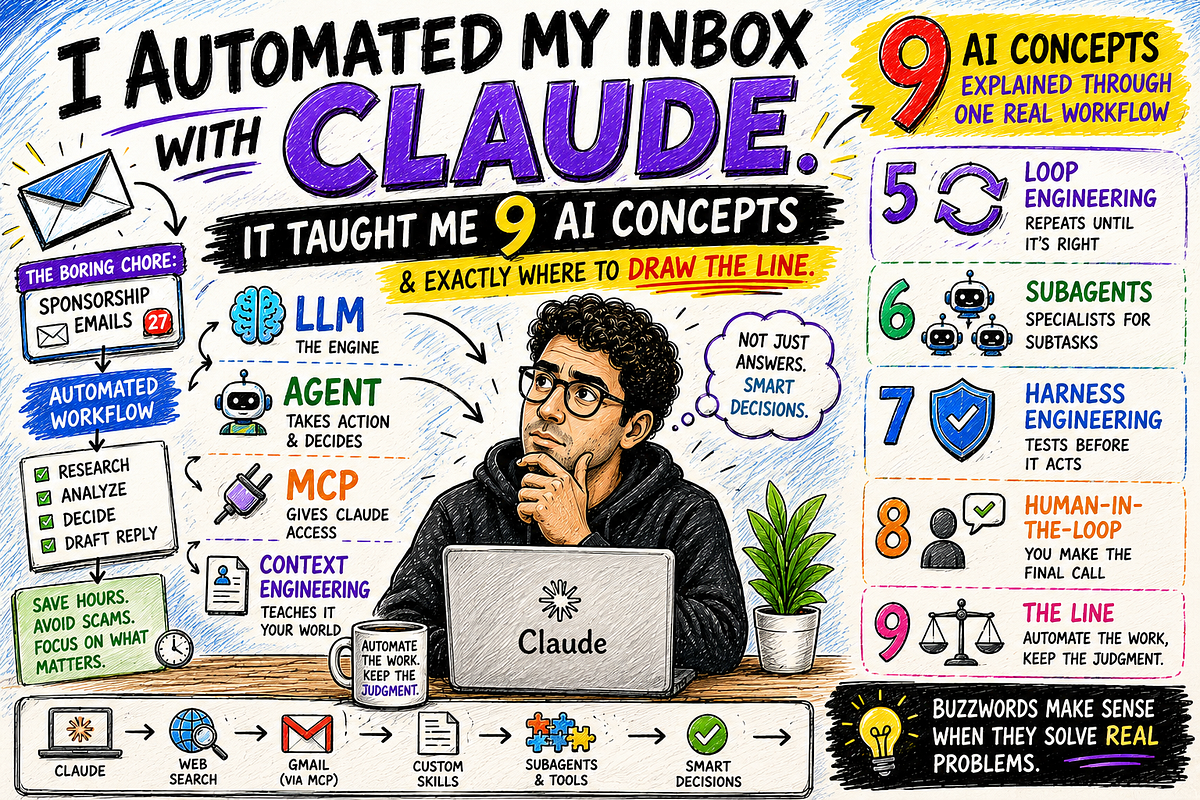
A writer described this week how they turned Claude into a sponsorship-email screener. The bot checks sender domains against the writer's known brand list, flags mismatches, drafts a polite decline, and passes legitimate offers to a human folder. The result: one hour saved every morning, and no more near-misses on phishing disguised as partnerships.
The process relied on three pieces that sound like marketing bullet points until you watch them work – prompt engineering, confidence thresholds, and delegation rules. Prompt engineering told the model what to look for: the email domain, the language asking for a reply, the tone. Confidence thresholds set the bar: only offers scoring above 85% got forwarded for a human read. Delegation rules handed the low-stakes responses to the bot outright.
That same stack – a local model, a set of rules, a decision tree – is exactly what Apple is building into its on-device inference layer. The neural engine in the A18 and M4 chips runs a smaller version of the large-language model without shipping data to the cloud. App Intents lets that model reach into Mail, Messages, Calendar, and third-party apps. The writer needed a separate Claude client. Apple's own ecosystem won't require one.
The advantage is integration. A cloud model like ChatGPT or Claude has to be granted permissions, opened in a separate window, given a fresh prompt every session. An on-device Apple model sees a new email land, reads the thread context, and acts on the user's standing instructions – all before the user opens the app. That friction difference is the difference between a tool you configure once and a tool you configure daily.
Apple has not yet shipped a consumer-facing AI product that demonstrates this seamlessness. The writer's inbox setup is a working example of what the product needs to deliver. Siri has been the weakest link for years. The underlying technology – the Neural Engine, App Intents, on-device retrieval – has been in place since iOS 17. The missing piece is the user-facing decision logic that makes the model feel like a proactive assistant instead of a query box.
The WWDC keynote in June will be the moment Apple shows whether it can close that gap. A demo where Siri scans an email, recognizes an event, adds it to the calendar, and sends a confirmation reply – all without a server trip – would demonstrate the same principle the writer's Claude setup uses. Faster decisions. Fewer mistakes. No data leaving the phone.
For investors, the stock catalyst path is straightforward. Apple's on-device AI differentiates its ecosystem from Android alternatives that rely on cloud partners. It gives users a reason to upgrade to devices with the latest Neural Engine. It opens the door to monetization through services – more iCloud storage for AI summaries, tighter integration with Apple Pay for transaction reminders, a smarter HomeKit. Apple’s stock market analysis team has flagged on-device inference as the next differentiator. The writer's inbox automation is a proof of concept. Now Apple needs to ship.