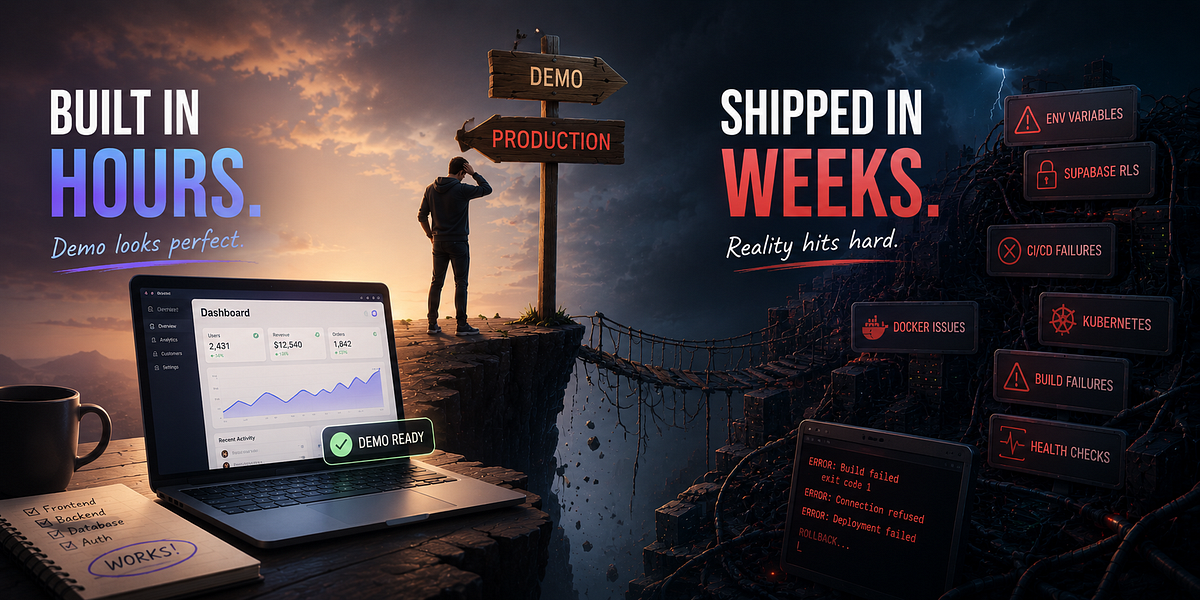
The demo works. Friends say they'd pay. The app compiles in the AI builder's preview. Then you try to ship it.
Six days later you're debugging environment variables and watching CI builds fail for reasons that feel disconnected from the code you reviewed. The AI that wrote the code cannot help with any of that.
That gap has a name now. Developers call it the deployment wall. It is the moment infrastructure abstraction breaks down and you need either a different tool or a human DevOps engineer.
The Deployment Wall
By 2026, 41% of all code globally will be AI-generated, according to data cited in a recent product-development account. The building part is fast. The part after the build is where time and money live.
What does a real production setup cost when you hire it out? Freelance DevOps consultants charge $75 to $200 an hour. A proper containerisation and CI/CD pipeline, with environment management and Kubernetes config, takes a competent engineer three to five days. That is a $2,000 bill for a bootstrapped founder.
The AI builder that generated the application code was not designed to handle deployment. That is a separate problem.
A startup called 8080.ai is trying to close the gap. It runs a multi-agent system with a dedicated DevOps agent that generates Dockerfiles and Kubernetes config alongside the application code. The pitch is production architecture from day one.
For Apple investors, the question is which platforms solve this. Apple's coming AI tools for Xcode will face the same question. If the build output stops at working local code and leaves deployment to manual work, the same gap reappears. Developers in the Apple ecosystem will measure each update by how much of that pipeline it automates.
The numbers make the point. A 2025 survey showed that getting from 0% to 90% of an app is easy with AI coding tools. The final 10% – authentication and deployment – takes most of the time and cost. Vibes do not scale to production by themselves.
The connection between developer tool quality and App Store revenue is well documented. The next WWDC will show whether Apple has a deployment answer or leaves developers to find their own.