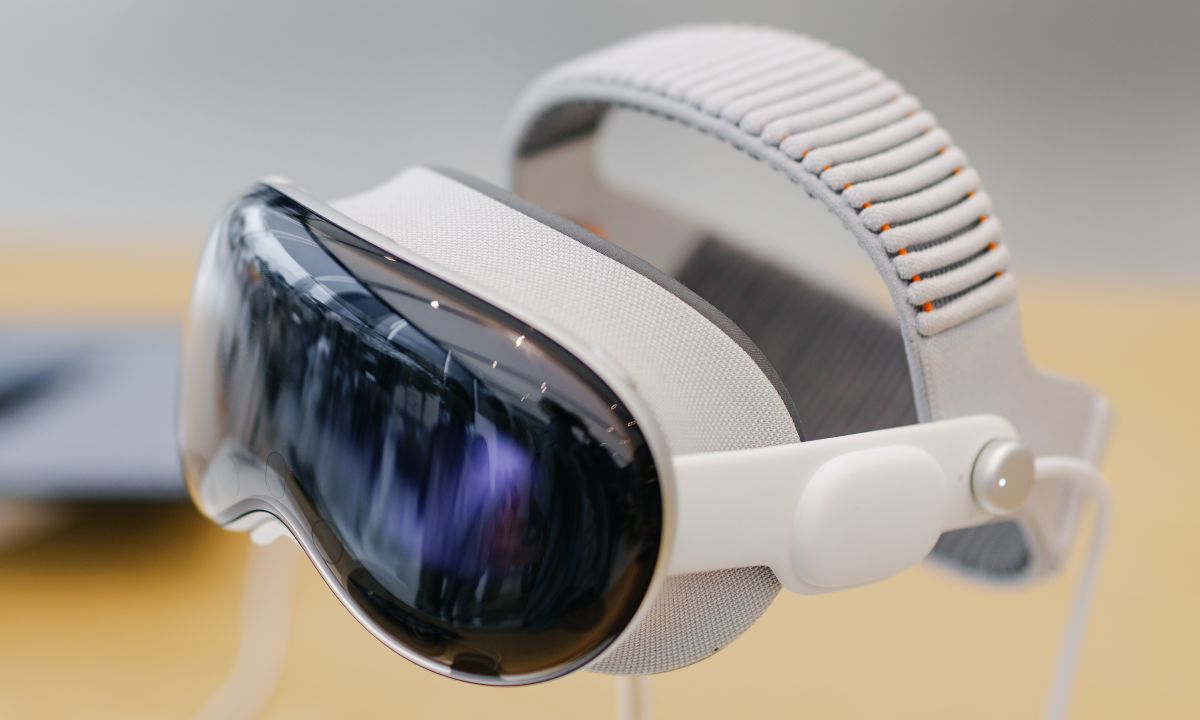
Paul Meade, the Apple executive who led engineering on the Vision Pro headset and oversaw the company’s push into display-free smart glasses, is leaving for OpenAI, Bloomberg reported Friday. His departure is the latest in a string of high-level exits from Apple’s hardware teams to AI and big-tech competitors.
Meade had been at Apple for seven years, working on the Vision Pro and more recently on the smart glasses project meant to move Apple into the AI wearables space. At OpenAI, he will join former Apple colleagues Jony Ive, Tang Tan and Evans Hankey – all of whom left Apple to launch an AI hardware startup that OpenAI acquired in 2025. The report characterizes the move as a blow to Apple, which has lost several other executives to Meta and OpenAI over the past year.
The smart glasses project is central to Apple’s post-Vision Pro strategy. Weeks before this departure, a report by Seeking Alpha, citing TF International Securities analyst Ming-Chi Kuo, said Apple had abandoned plans for a Vision Pro successor and will instead focus on two smart glasses products. A display-less version is slated for 2027. A more advanced pair with augmented reality and mixed reality would follow in 2029.
Losing Meade does not kill the project. It does signal a talent drain that could slow development, especially as rivals move faster. Meta, together with EssilorLuxottica, last week launched a new collection of AI glasses called Meta Glasses, starting at $299. The companies said the collection is designed to reach a broader audience than their earlier models.
“While our iconic brands continue to be a leading driver of adoption in the market, we see an opportunity to drive access to broader audiences through this company-branded collection,” EssilorLuxottica Chairman and CEO Francesco Milleri said in a news release. “More price-sensitive consumers will have an opportunity to experience the power that wearables bring into their everyday lives.”
OpenAI has been building out its hardware unit with former Apple designers. Meade’s arrival gives it deeper engineering talent. For Apple, the challenge is not just filling a role. It is holding onto the institutional knowledge that goes with years of work on optics, miniaturization and battery life. The company’s stock is up about 1.4% on the day at $550.25, with an Alpha Score of 65. The broader market has paid little attention to the personnel shift.
One of the sharper takes on the smart glasses space came from PYMNTS earlier this year. It argued that AI in these devices “does not eliminate the need for a clear use case,” and that the question of “why a user should wear AR glasses for hours each day, rather than pull out a smartphone when needed, remains open.” That framing is useful. The technology is advancing, yet the product-market fit is still unproven for most consumers.
Apple’s advantage has always been its ecosystem integration – the way a device talks to an iPhone, a Mac, or an AirPod without friction. That advantage persists even without Meade. The competition is now led by executives who know exactly how Apple built that ecosystem, and they are working for the other side.
Apple’s 2027 timeline for the display-less glasses is the next concrete marker. If that slips, the talent loss will have had real impact.