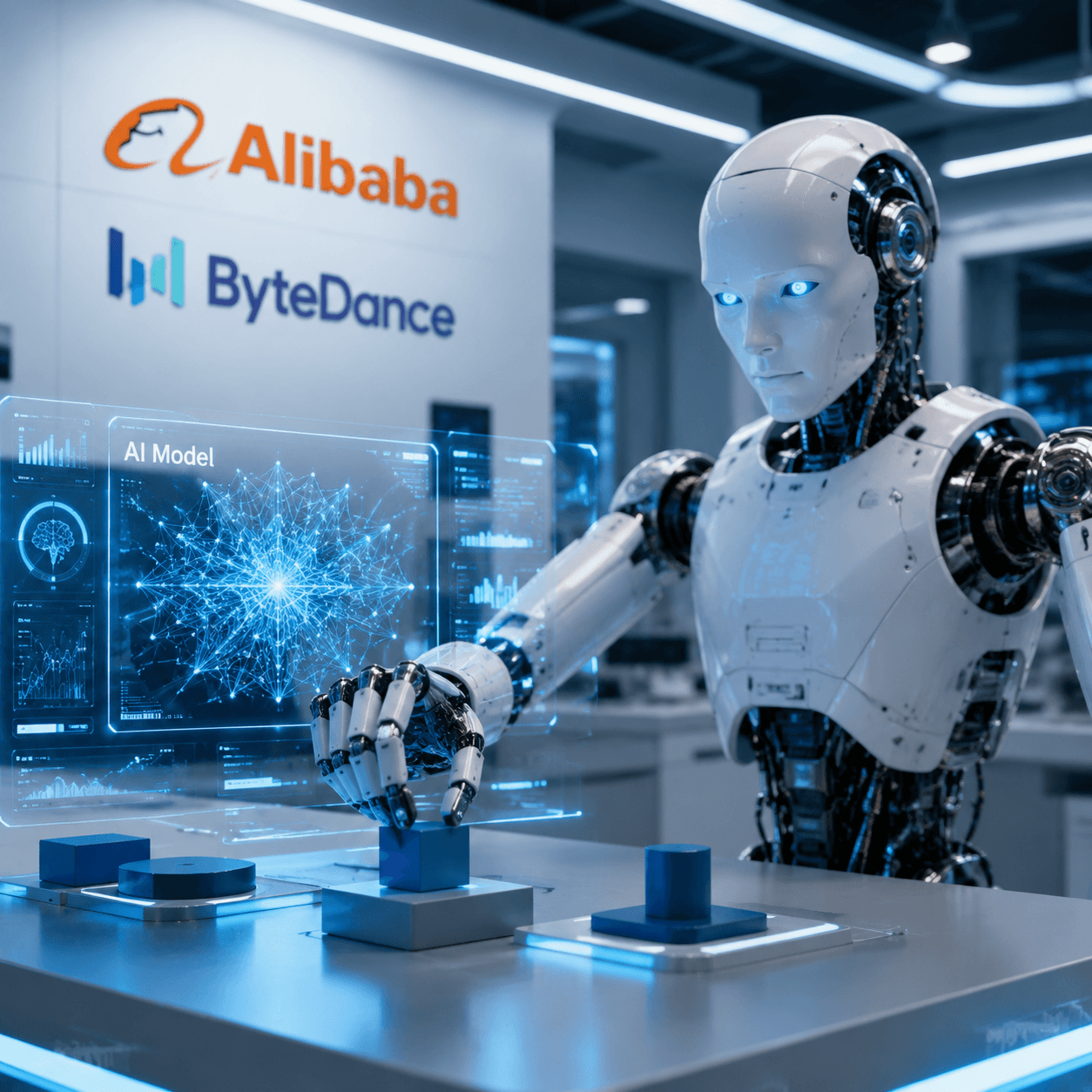
Alibaba released the Qwen-Robot series this week, a set of AI models built for embodied intelligence. ByteDance followed with an internal announcement that elevates robotics to a core business unit. The two moves show China's largest internet companies are putting real resources behind hardware that can perceive and act.
The Qwen-Robot models extend Alibaba's Qwen large-language family. They are meant to give robots a reasoning brain – the ability to interpret commands, plan movements, and adapt to changing environments. Alibaba said the models are open-source. ByteDance's shift is organizational: robotics had lived inside its AI lab; now it reports directly to the CEO. The company has been quietly hiring engineers with experience in manipulation, navigation, and teleoperation.
What the internet giants bring is not mechanical skill. They do not make actuators or joints. They own the two inputs that matter most for the next generation of robots: data and closed-loop use cases. Alibaba processes billions of logistics transactions a year inside Cainiao, its delivery arm. Those operations are full of repetitive pick-and-place tasks that can be automated. ByteDance runs Douyin, where short-video content is created at a scale that makes almost any physical interaction – from warehouse sorting to AI-powered toy assembly – a candidate for robot deployment.
The captive-scenario advantage is real. A startup must beg factories for pilot projects. Alibaba can deploy robots into its own sorting centers tomorrow. ByteDance can test consumer robotics inside its own campus cafes and retail pop-ups. The feedback loop is faster. The cost of failure is lower.
The read-through for the robotics sector is mixed. Traditional hardware builders such as UBTech and Fourier Intelligence have a lead in mechanical design and sensor integration. The software layer – perception, planning, natural-language control – is where value is shifting. A robot is only as good as its ability to understand context. That is precisely the skill Alibaba and ByteDance have been training for years.
Investors who track China's industrial automation story should watch how quickly Alibaba's cloud unit starts offering robot-model inference as a service. They should also watch whether ByteDance licenses its embodied AI to third-party hardware makers. The companies themselves are not robot assemblers. They are selling the brain. That business model carries higher margins and faster scale than hardware.
Alibaba's stock has an AlphaScala Alpha Score of 46/100, rated Mixed. The robotics push is a long-term narrative driver, not a near-term earnings catalyst. For the sector as a whole, the entry of two cash-rich, data-rich players raises the bar for any startup that wants to compete at the reasoning layer.