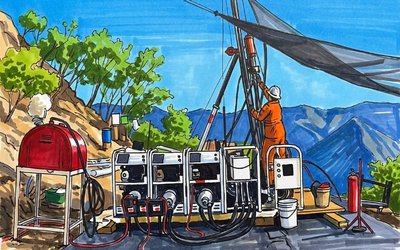
Advance Metals (ASX: AVM) has officially commenced its maiden 4,500-metre diamond drilling campaign at the Gavilanes silver project in Mexico. This operational milestone follows the company's January 2025 acquisition of the asset from Sailfish Royalty Corp, a move designed to expand its footprint in the silver sector. The project spans 135 square kilometres and currently holds a foreign estimate of 22.4 million ounces of silver equivalent (AgEq), derived from 2.83 million tonnes at 246 grams per tonne AgEq.
Drilling Strategy and Target Identification
The current campaign is structured to test both down-dip and along-strike extensions of known high-grade mineralisation. Previous exploration at the site was limited, with historical drill coverage spanning less than 900 metres along strike. The company has identified priority targets at the peripheral El Nopal prospect to the southeast, as well as the La Cruz and La Tuna prospects to the west. By focusing on these zones, Advance Metals aims to identify additional mineralised material that could support a resource upgrade later this year.
Site preparation has been a primary focus over the last month, with the team establishing necessary access and constructing drill pads across the target areas. This work is intended to facilitate a systematic exploration process, mirroring the approach the company previously applied to its Yoquivo project. Managing director Dr. Adam McKinnon noted that the program is designed to generate the specific data required to transition the current foreign estimate into a more formalised resource classification.
Historical Context and Resource Potential
The Gavilanes project has demonstrated significant potential in historical drilling, which included 48 diamond holes totaling 9,667.9 metres. Past results have highlighted the presence of high-grade silver at relatively shallow depths. Notable historical intersections include:
| Intersection | Grade (g/t Silver) | Depth (m) |
|---|
| 6.3m | 2,016 | 77.2 |
| 3.3m | 2,540 | 109.8 |
| 3.8m | 988 | 57.7 |
These figures underscore the high-grade nature of the system, which the current 4,500-metre campaign seeks to validate and expand. The project is characterised by extensive untested veins and breccia zones that extend over two kilometres. For investors evaluating the risk-reward profile of small-cap miners, the primary mechanism here is the conversion of historical, non-JORC compliant estimates into verified resources. Success in this maiden campaign would effectively derisk the asset, whereas failure to intercept similar grades would likely lead to a re-evaluation of the project's economic viability.
Operational Execution and Market Read
For those monitoring the stock market analysis of junior miners, the transition from acquisition to active drilling is the most critical phase for capital allocation. Advance Metals is operating in a jurisdiction with established mining infrastructure, but the execution risk remains tied to the geological continuity of the veins identified in the historical data. The company's ability to replicate the success seen at Yoquivo will be the primary benchmark for institutional interest in this project.
While the market often reacts to the initial commencement of drilling with speculative volume, the real value inflection point will occur when assay results are released. Investors should look for confirmation that the mineralisation at El Nopal, La Cruz, and La Tuna aligns with the grades observed in the historical 9,667.9-metre program. If the drill bits confirm the continuity of the high-grade zones, the company will be well-positioned to move toward a resource upgrade. Conversely, if the drilling reveals structural complexity or lower-than-anticipated grades, the valuation of the Gavilanes asset may face downward pressure as the market discounts the potential for a large-scale, high-grade deposit. For broader sector context, companies like Janus Living, Inc. (JAN stock page) continue to navigate their own sector-specific headwinds, highlighting the importance of asset-level execution in the current environment.