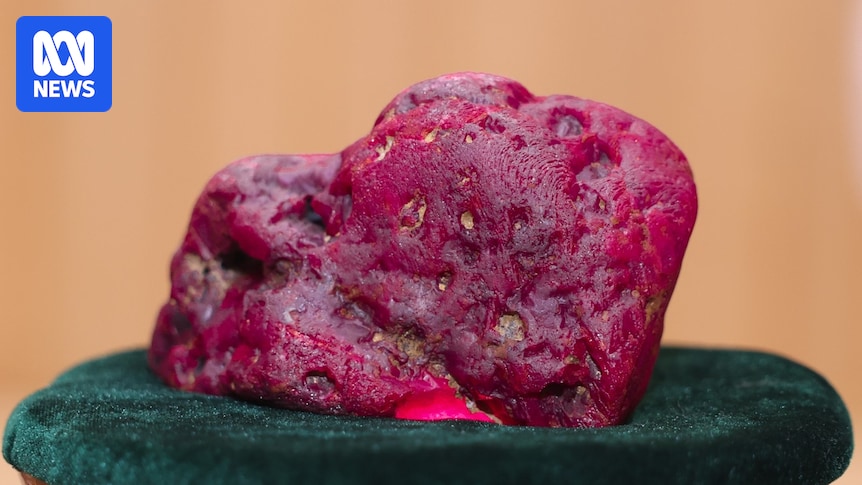
The 11,000-carat ruby, with purplish-red hue, was examined by junta leader Min Aung Hlaing, renewing scrutiny on gem revenues funding Myanmar's military amid civil war.
A 11,000-carat rough ruby, weighing 2.2 kilograms, was discovered in mid-April near Mogok, Myanmar, and immediately examined by junta leader Min Aung Hlaing at his office in Naypyitaw. The simple market read is that a massive new supply of high-quality rough could depress ruby prices. The better read is that the find spotlights the conflict-gem supply chain that funds a military accused of genocide, raising the probability of renewed sanctions, ethical sourcing crackdowns, and a bifurcated market where legitimately sourced stones command a growing premium.
The stone was unearthed just after the traditional New Year festival, according to the state-run Global New Light of Myanmar. At 11,000 carats, it is roughly half the weight of the 21,450-carat (4.29 kg) ruby found in 1996, but the new find is considered more valuable because of its superior color and quality. The gem is described as having a purplish-red hue with yellowish undertones, a high-quality color grade, moderate transparency, and a highly reflective surface. Those characteristics place it in a tier above the earlier giant, which was more notable for sheer mass than for gemological fineness.
For the ruby market, a stone of this size and quality does not simply add incremental supply. It is a one-off discovery that can be cut into multiple high-value faceted stones, potentially disrupting the top end of the auction and luxury jewelry segment. The immediate signal is that Mogok, the source of up to 90% of the world’s rubies, continues to yield exceptional material. That geological reality keeps a floor under long-term supply expectations, but the political reality of who controls that supply is now the dominant variable.
Mogok was captured in July 2024 by the Ta’ang National Liberation Army (TNLA), a guerrilla force representing the Palaung ethnic minority. The TNLA took over and operated the mines, but control was eventually transferred back to Myanmar’s army as part of a China-mediated ceasefire agreement concluded late last year. That sequence means the ruby supply chain has passed through the hands of an ethnic armed group and then back to the Tatmadaw, the military that has been the target of international sanctions and a genocide case at the International Court of Justice.
The practical consequence for traders is that any ruby coming out of Mogok today carries an almost untraceable chain of custody. The same mining area can produce stones that are taxed by the junta, smuggled by local militias, or mixed into legitimate channels through Thailand or China. The discovery of a headline-grabbing stone inside a conflict zone does not just raise ethical questions; it raises the risk that downstream buyers, from luxury houses to exchange-traded funds with ethical mandates, will face pressure to verify provenance or exit the market entirely.
Myanmar’s military has long relied on gemstone revenues. A 2019 UN Human Rights Council report linked two enterprises, Myanmar Economic Holdings Limited and Myanmar Economic Corporation, to senior military leaders including Min Aung Hlaing and Deputy Commander-in-Chief Vice Senior General Soe Win. Both companies, along with at least 26 of their subsidiaries, hold licences for jade and ruby mining in Kachin and Shan states. The report found that the Tatmadaw had committed forced labour and sexual violence in northern Myanmar in connection with their business activities.
The UN Independent International Fact-Finding Mission on Myanmar recommended that Min Aung Hlaing and Soe Win be investigated and prosecuted for genocide, crimes against humanity, and war crimes. The Gambia brought a genocide case to the ICJ, which opened in January. Against that backdrop, the junta leader’s public examination of the giant ruby is not a ceremonial gesture; it is a signal that the military government views gem wealth as a strategic asset and a symbol of state control, even as it faces international isolation.
For the market, the mechanism is straightforward. Gem sales, both licit and smuggled, provide hard currency that helps the junta bypass financial sanctions. Every high-value stone that reaches the global market without rigorous due diligence effectively monetizes the military’s control over mining regions. That is why human rights groups like Global Witness have urged jewellers to stop purchasing Myanmar-sourced gems. The discovery of an 11,000-carat ruby makes that call harder to ignore.
A stone of this size and quality does not have a public auction price yet, but its characteristics suggest it could yield multiple exceptional faceted rubies. The purplish-red hue with yellowish undertones is a classic Mogok colour profile that commands top premiums. Moderate transparency and high reflectivity further enhance its cutting potential. Compared to the 1996 giant, which was more opaque, this stone is likely to produce a higher per-carat value after cutting.
The immediate supply impact is negligible for commercial-grade ruby prices, because a single large rough does not change the output of smaller stones. However, at the top end, the arrival of several large, high-clarity rubies could temporarily saturate the ultra-high-net-worth auction market, potentially softening prices for comparable stones. More importantly, the discovery reinforces the perception that Mogok’s resource is far from depleted, which could cap long-term price appreciation for rare rubies if buyers begin to expect more such finds.
But the better valuation read is that the conflict-gem overhang will compress the multiple that buyers are willing to pay for stones without impeccable provenance. Already, auction houses and luxury brands have tightened sourcing standards. A ruby that cannot be traced to a mine with a clean human rights record may trade at a discount, or be excluded from certain markets entirely. That creates a two-tier market: ethically certified rubies, primarily from Mozambique or Greenland, could see a premium, while Myanmar stones face a widening stigma discount.
The immediate catalyst is whether the international community responds to the ruby discovery with new measures. The UN Special Rapporteur on human rights in Myanmar, Tom Andrews, released his final report in April, calling for accountability and noting that decades of impunity had led to a human rights catastrophe. The report explicitly linked the military’s business interests to human rights violations. The US, EU, and UK have already imposed sanctions on Myanmar’s military conglomerates, but gem imports have often been exempt or poorly enforced.
A renewed push to close loopholes could come from the ICJ genocide proceedings or from a coordinated G7 action. If major jewellery markets ban Myanmar rubies outright, the supply of legitimately traded stones would shrink, potentially driving up prices for non-Myanmar rubies. Conversely, if enforcement remains lax, the flow of conflict stones will continue, keeping a lid on ethical premiums. Traders should monitor statements from the Responsible Jewellery Council, the World Jewellery Confederation, and national customs agencies for any tightening of import rules.
The security situation around Mogok remains volatile. The TNLA’s brief control of the mines showed that ethnic armed groups can disrupt supply at will. The China-mediated ceasefire is fragile; any breakdown could halt mining operations or shift control back to non-state actors. That introduces a supply disruption risk that is independent of sanctions. If fighting intensifies, the flow of all Mogok rubies, conflict or not, could be interrupted, creating a short-term supply squeeze.
On the other hand, a stable ceasefire that leaves the military in control would entrench the current conflict-gem model. The TNLA and other groups also use gem revenues to fund their operations, so the ethical problem is not limited to the junta. A comprehensive peace deal that includes transparent revenue-sharing and third-party monitoring of mines would be the only durable solution, but that remains a distant prospect.
For traders, the key risk is that the ruby discovery becomes a lightning rod for activist campaigns. A high-profile stone examined by a sanctioned junta leader is the kind of visual that can trigger consumer boycotts, much as blood diamonds did in the early 2000s. Even if no new sanctions are imposed, reputational risk alone could cause luxury brands to preemptively exit Myanmar ruby sourcing, reducing demand for those stones.
The 11,000-carat ruby is not a tradeable asset in itself, but it changes the information set for anyone exposed to the coloured gemstone market, luxury goods equities, or ethical commodity funds. The simple narrative of a big supply addition is misleading. The real shift is in the probability of a regulatory and reputational crackdown on Myanmar gems. That crackdown would bifurcate the market, rewarding companies with verifiable, conflict-free supply chains and penalizing those reliant on opaque Mogok sourcing.
Traders should watch for the next concrete marker: any statement from a major jewellery house or industry body on Myanmar ruby sourcing, or any customs enforcement action in a key importing country. A single seizure of a high-value Myanmar ruby at a border could signal a shift in enforcement posture. Until then, the discovery serves as a reminder that the ruby market’s most valuable asset, Mogok’s geology, is also its greatest liability.
Drafted by the AlphaScala research model and grounded in primary market data – live prices, fundamentals, SEC filings, hedge-fund holdings, and insider activity. Each story is checked against AlphaScala publishing rules before release. Educational coverage, not personalized advice.