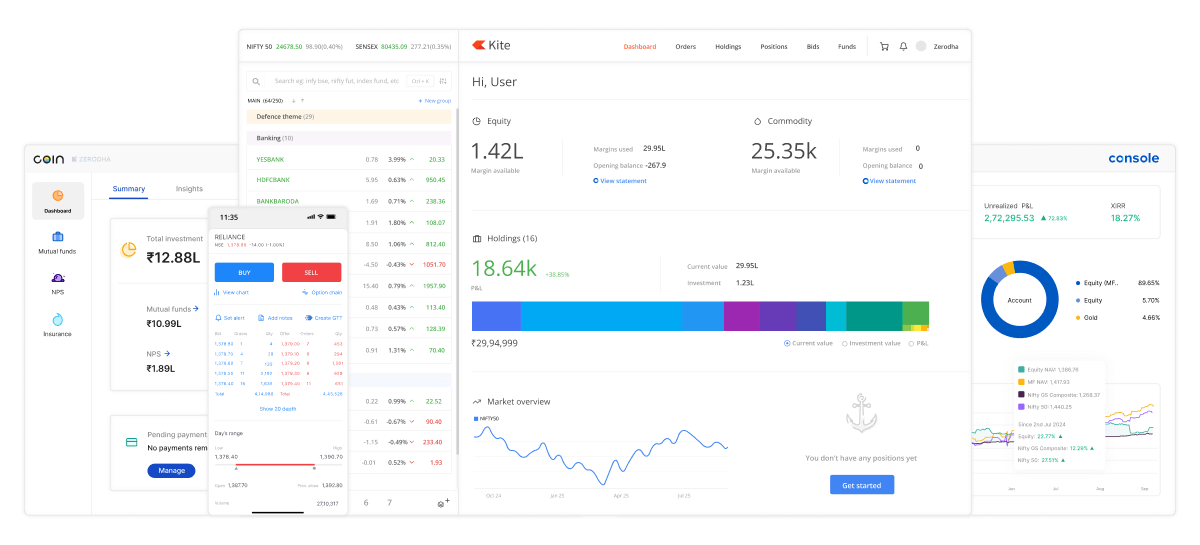
Zerodha adds 15% exposure margin on MWPL stocks from May 29. The change blocks extra capital on positions in banned derivative names, hitting leverage and intraday strategies.
Zerodha, India's largest stock broker, has introduced an additional exposure margin of 15% on securities that fall under the Market Wide Position Limit (MWPL) framework. The change took effect on May 29, 2026, and applies to all equity derivative positions in stocks where open interest has crossed the MWPL threshold.
The margin is calculated on the total position value, not just the incremental exposure. For a trader holding a ₹10 lakh position in an MWPL stock, the new rule adds ₹1.5 lakh in blocked capital on top of existing margin requirements. Zerodha stated the measure is intended to align with exchange risk management guidelines, though the broker is applying it at its own discretion.
The MWPL mechanism is triggered when aggregate open interest in a stock's futures and options contracts exceeds 95% of the market-wide position limit set by exchanges. Stocks under this restriction face mandatory position reductions and no new position creation until open interest falls back below the threshold. The additional margin effectively pre-prices the liquidity and execution risk that builds up in these names.
Traders holding positions in MWPL stocks already contend with compulsory square-off of 50% of their positions if the stock remains in the ban period. The new Zerodha margin compounds the capital efficiency problem. A position that previously required ₹3 lakh in margin may now need ₹4.5 lakh, forcing either a reduction in size or a shift to non-MWPL names.
The MWPL list is dynamic and published daily by exchanges. Stocks that frequently appear include high-volatility small-caps and mid-caps where derivative volumes have spiked relative to available floating stock. Recent examples have included RBL Bank, IDFC First Bank, and PNB Housing Finance, though the list rotates based on open interest data.
For intraday traders and option sellers, the margin change is most acute. Option sellers in MWPL stocks now face a higher capital hurdle for the same premium collection, reducing the risk-reward ratio. Futures traders see their leverage compress: a 4x leveraged position effectively becomes 3x under the new margin load.
The immediate question for anyone with open positions in MWPL stocks is whether to reduce size before the margin hits or accept the higher capital charge and wait for the stock to exit the ban period. The latter strategy works only if the trader has spare margin capacity and expects the ban to lift within days. Stocks can remain under MWPL for weeks if open interest stays elevated.
Traders should also watch for broker-level margin changes from competitors. If Zerodha's move is followed by other large brokers like Angel One or ICICI Direct, the cost of holding MWPL stocks could become prohibitive across the board, accelerating position unwinding and potentially pushing stock prices lower.
The next concrete marker is the daily MWPL list update from the exchanges. A stock that exits the ban period sees the additional margin removed immediately, restoring normal leverage. Until then, capital allocation in these names requires a tighter risk budget.
For related analysis on derivative market mechanics, see the commodities analysis section and the crude oil profile for margin comparisons across asset classes.
Prepared with AlphaScala research tooling and grounded in primary market data: live prices, fundamentals, SEC filings, hedge-fund holdings, and insider activity. Each story is checked against AlphaScala publishing rules before release. Educational coverage, not personalized advice.