Xi's Pyongyang Visit Tests China's Sway Over Nuclear-Armed North Korea
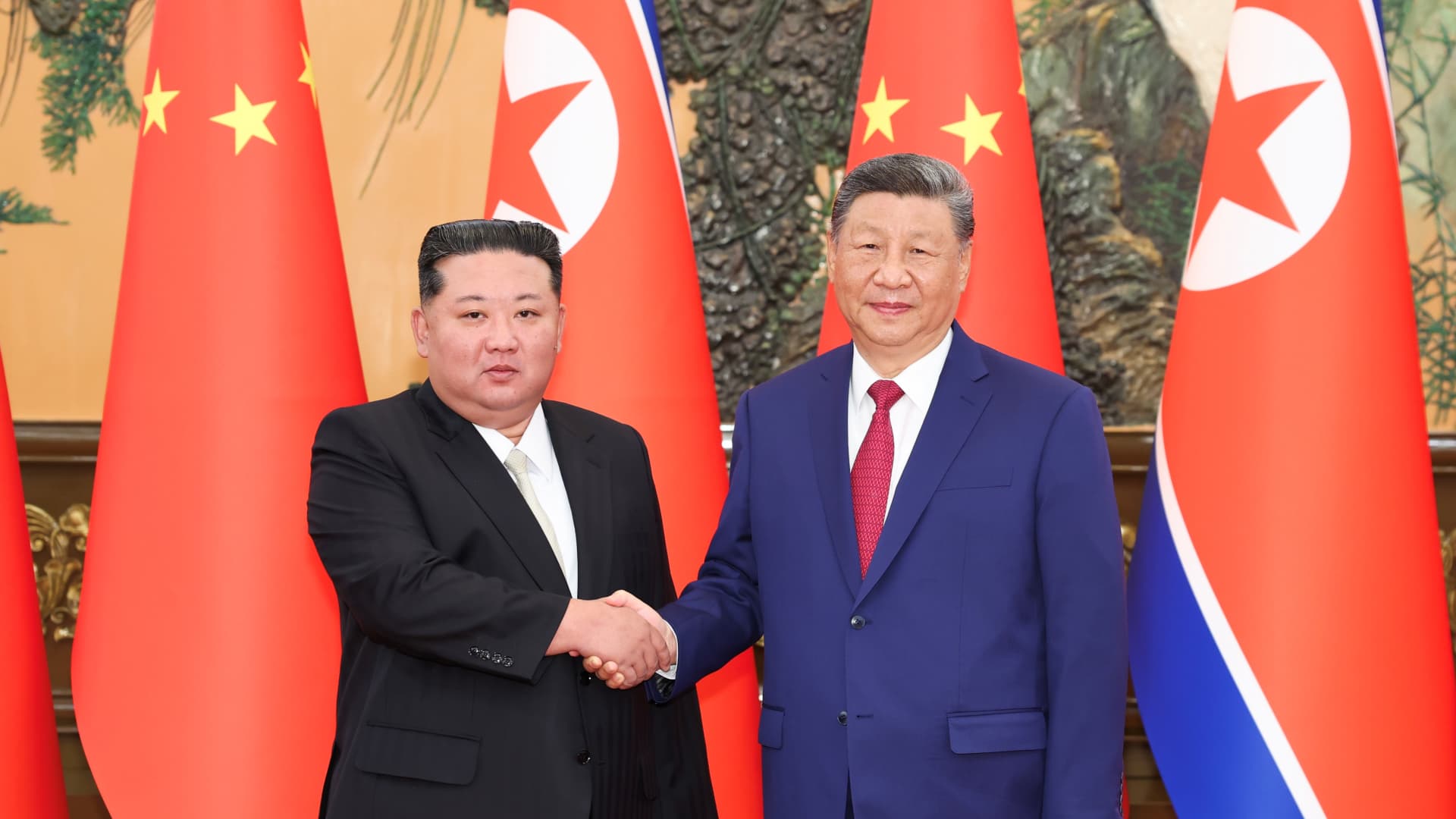
Xi Jinping visits Pyongyang for first time in seven years as Beijing tries to counter Russia's influence over Kim Jong Un. The joint statement on nuclear status and Taiwan will set the geopolitical risk premium on Korean assets.
Chinese President Xi Jinping arrives in Pyongyang on Monday for his first visit to North Korea in nearly seven years. The two-day trip is Xi's first overseas visit of 2026, a signal that Beijing views the relationship as urgent enough to break his post-pandemic pattern of hosting foreign leaders in China rather than traveling.
The core question for markets is whether Xi can pull Kim Jong Un back toward Beijing's orbit after years of deepening military and trade ties with Moscow. If the summit produces concrete economic concessions or a public alignment on Taiwan, the geopolitical risk premium on Korean peninsula assets could compress. If Kim extracts tacit recognition of his nuclear status without giving ground, the risk of sanctions erosion and regional arms-race acceleration increases.
Why the Russia Factor Changes the Leverage Equation
The Military Cooperation That Shifted the Balance
Since Xi's last visit in June 2019, North Korea has dispatched troops to fight in the Ukraine war alongside Russian forces. That deployment, combined with continued nuclear and missile tests in defiance of UN sanctions, has given Pyongyang a new bargaining chip. "North Korea has more leverage vis-a-vis China compared to June 2019," said Rachel Minyoung Lee, senior fellow at the Stimson Center's Korea Program. She cited deepened military ties with Moscow, advances in the nuclear program, and an improved domestic economy.
Victor Cha, president of the geopolitics and foreign policy department at the Center for Strategic and International Studies, framed the dynamic directly: "Xi wants to counterbalance all of the Russian influence over North Korea as a result of their military cooperation in the war in Europe. China does not like anyone else having more influence on Pyongyang than they do."
What Pyongyang Wants From This Summit
North Korea is expected to press for economic concessions and potentially for Beijing's tacit recognition of its nuclear status. Lee noted that Russia is believed to have privately conceded that recognition already. China has publicly opposed Pyongyang's nuclear tests in the past, its current stance is ambiguous. "The North Koreans seem set on clarifying that during Xi's visit," she said.
Practical rule: A joint statement that omits the standard denuclearization language would be the clearest signal that Beijing has shifted its red line. Markets should watch the communiqué's wording on nuclear status more than any photo-op handshake.
The Nuclear Enrichment Facility as a Pre-Summit Signal
What North Korea Unveiled and Why the Timing Matters
Days before Xi's arrival, North Korea unveiled a new uranium enrichment facility. Kim announced plans to bolster the country's nuclear forces "at an exponential rate," signaling Pyongyang's ambition to cement its status as a nuclear weapons state before any negotiations begin.
The timing is not accidental. By displaying enrichment capacity ahead of the summit, Kim sets a floor for discussions: any Chinese request for denuclearization restraint now comes after a public demonstration of expanded capability. The move also strengthens Pyongyang's hand if Xi is carrying a message from U.S. President Donald Trump, who has signaled willingness to resume diplomacy.
How This Affects the Denuclearization Precondition
North Korea has insisted that Washington drop its denuclearization precondition before any talks begin. South Korea's minister of unification Chung Dong-young said last month that a possible Pyongyang-Washington summit could be on the agenda of this week's Xi-Kim meeting. If Xi facilitates a U.S.-North Korea channel without securing a freeze on enrichment activity, the diplomatic framework shifts from rollback to containment.
What Beijing Wants: Taiwan Alignment and Peninsula Stability
The Taiwan Linkage
For Beijing, the summit is partly about securing Pyongyang's alignment on Taiwan. Lee said China is likely to seek North Korean support against what it views as Japan's increasingly assertive defense posture. A public statement from Kim backing Beijing's position on Taiwan would give Xi a diplomatic win to bring home, even if the nuclear question remains unresolved.
Managing Escalation Risk
Lee added that managing escalation risk on the Korean peninsula is also a core objective for Beijing. The combination of North Korea's nuclear advances, Russia's military cooperation, and Trump's unpredictable diplomacy creates a scenario where miscalculation becomes more likely. Xi's visit is a bid to establish a direct channel that reduces the odds of a crisis Beijing cannot control.
William Yang, Crisis Group's senior analyst for Northeast Asia, said: "The fact that Xi has decided to make his first overseas trip of 2026 to North Korea reflects the level of significance that Beijing attaches to the attempt to shore up ties."
Affected Assets and Sector Read-Through
Korean Peninsula Exposure
Broader Asia Geopolitical Risk
The summit also affects the risk premium on Japan and Taiwan assets. If Xi secures North Korean alignment on Taiwan, it reinforces Beijing's narrative of regional consensus. If Kim refuses to endorse that position, it signals limits on Chinese influence that other regional players may exploit.
What Would Confirm the Thesis
Signals That Beijing Regained Influence
- A joint statement that includes North Korean support for China's position on Taiwan
- Concrete economic cooperation agreements (infrastructure, trade, or energy)
- A commitment from Kim to resume denuclearization talks with the U.S., even without preconditions
- Reduction in visible military cooperation between North Korea and Russia (troop rotations, arms shipments)
Signals That Pyongyang Holds the Upper Hand
- A joint statement that omits any reference to denuclearization or includes language that could be read as recognition of North Korea's nuclear status
- No public alignment on Taiwan
- Continued or accelerated enrichment activity after the summit
- Xi departs without a follow-up meeting scheduled, suggesting the gap remains wide
The Next Decision Point for Traders
The summit runs Monday and Tuesday. The key deliverable is the joint statement, likely released after Xi departs Pyongyang. Traders should compare the language on three specific points: denuclearization (present or absent, and how qualified), Taiwan (explicit endorsement or silence), and economic cooperation (specific projects or general pledges).
A statement that mirrors past language on denuclearization while adding Taiwan alignment would be a modest positive for Korean peninsula risk assets. A statement that drops denuclearization language entirely would be a negative signal that sanctions enforcement is weakening and that North Korea's nuclear status is becoming normalized. A statement that fails on both fronts – no denuclearization commitment and no Taiwan alignment – would confirm that Beijing's influence has eroded further than markets currently price.
For traders holding exposure to South Korean equities or the won, the asymmetry favors reducing position size before the statement and waiting for the text. The upside from a positive outcome is limited by the structural deterioration in China-North Korea relations. The downside from a negative outcome includes both the direct geopolitical risk and the second-order effect of a stronger Russia-North Korea axis that complicates U.S. strategic positioning in Asia.
Bottom line for traders: Xi's Pyongyang trip is a test of whether China can reverse North Korea's drift toward Russia. The joint statement's language on nuclear status and Taiwan will determine whether the geopolitical risk premium on Korean assets compresses or expands. Until the text is published, the prudent trade is to reduce exposure and wait for clarity.
Drafted by a large language model from the source reporting linked above, then screened by automated publishing checks. It is not read by a journalist before publication. Some articles cite our Alpha Score. Verify prices and figures against the original source. Educational coverage, not personalized advice.