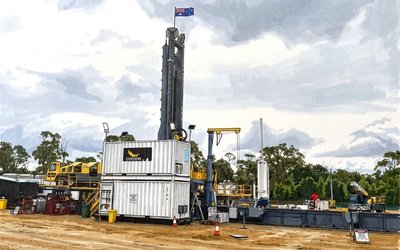
Lakes Blue Energy (ASX: LKO) reports that pressure at the Wombat-5 well has built to 1,764 psi (12.2 MPa) as at 26 May 2026, with a minimum 237 metres of gas-bearing sands identified behind casing across three zones. The well is in the pressure build-up phase after initial clean-up and flowback work. The update strengthens the evidence that the horizontal well in the Gippsland Basin’s Strzelecki Formation has intersected gas-charged reservoir rock. It does not settle the question of deliverability. The next meaningful marker is the regulator-approved perforation and flow-test phase, targeted for late August 2026.
This article explains the technical steps the company is taking, why the pressure build-up matters yet remains incomplete evidence, and what specific triggers would confirm or weaken the thesis that Wombat-5 can become a commercial gas producer.
The Pressure Build-Up Phase: What It Proves and What It Does Not
A pressure build-up test is a reservoir characterisation tool. After initial flowback unloads the wellbore of fluids, the well is shut in and the rate of pressure recovery is measured. The shape of the pressure curve reveals near-wellbore damage, formation permeability, and boundary effects from faults or reservoir limits. Lakes Blue Energy has shifted from the clean-up phase – which mainly clears drilling fluids and fines from the near-wellbore region – into this longer-duration data-collection phase.
The 1,764 psi Target and Reservoir Connectivity
The company targets a pressure of 1,800 psi for the build-up phase. Reaching 1,764 psi suggests the reservoir is capable of recharging pressure after being drawn down. A build-up to near-original reservoir pressure indicates that the zones behind casing are connected to a sufficiently large gas volume. The data cannot quantify flow rate or the permeability-thickness product until it is analysed through a Horner plot or derivative diagnostic. Wells with strong pressure recovery can still fail to produce commercial volumes if the reservoir quality is poor or if the completion has not optimally connected the wellbore to the rock.
Gross Gas-Bearing Sands vs. Net Pay
The company reports a minimum of 237 metres of high-quality gas-bearing sands behind casing. Gross gas-bearing interval is not the same as net pay. Not every metre of sand will produce gas at economic rates. The planned minimum 156-metre perforation interval across the highest-quality sands is the company’s best estimate of where to target flow. The ratio of net perforated interval to gross sand (156/237, or about 66%) is aggressive but common in horizontal wells. The market will need to see perforation and flow-test results before assessing whether that selectivity is adequate.
Gas Shows Through C5: A Sign of Condensate Potential
Lakes reported strong gas shows throughout the horizontal section from methane (C1) through pentane (C5). The presence of heavier hydrocarbons (C3-C5) indicates that the gas is not dry – it contains condensate-range components. For a gas producer, that can improve the per-barrel revenue . It also introduces the risk of liquid loading if the flow rate is insufficient to lift condensate out of the wellbore. The propellant enhanced perforating and later possible propellant stimulation are designed partly to mitigate liquid loading by creating cleaner, deeper perforation tunnels and improving near-wellbore connectivity.
The Next Intervention Phase: Mechanism, Timing, and Execution Risk
Lakes is finalising a draft variation to the Wombat-5 Operating Plan with the regulator. The next phase involves three sequential steps: placement of reservoir-compatible completion brine, propellant enhanced perforating of the selected 156-metre interval, and baseline flow testing at controlled rates followed by shut-in pressure build-up monitoring. The entire phase is targeted for late August 2026, subject to approvals, completion-fluid testing, and equipment availability.
Completion Brine Compatibility
Completion brine is a dense, solids-free fluid used to control wellbore pressure during perforation. If the brine is incompatible with the formation – wrong salinity, wrong pH, or containing solids – it can cause formation damage that reduces permeability near the wellbore. The company is conducting fluid testing to ensure compatibility. Any delay in that testing or a mismatch requiring reformulation could push the timeline past the late-August window.
Propellant Enhanced Perforating vs. Conventional
Conventional perforating uses shaped explosive charges to punch holes through casing and cement into the formation. The downside is that the explosive shock can compact the rock immediately around the perforation tunnel, reducing permeability. Propellant enhanced perforating (PEP) uses a slower-burning propellant that generates a high-pressure pulse that extends fractures beyond the compacted zone, creating deeper, cleaner tunnels. For a tight gas reservoir like the Strzelecki Formation, PEP can be the difference between a well that flows at marginal rates and one that reaches economic thresholds. The company also said propellant stimulation guns are being evaluated as a later follow-up, contingent on flow-test results. That implies two potential stages of stimulation: first PEP during initial completion, and later larger-volume propellant treatments if flow remains sub-commercial.
Baseline Flow Testing: The Definitive Deliverability Data Point
After perforation, Lakes plans to flow the well at controlled rates while monitoring pressure, gas composition, water cut, and sand production. The baseline test is designed to establish the well’s inherent productivity without major stimulation. The shut-in pressure build-up after flow will provide a second pressure transient test – this time after the reservoir has been produced – which can reveal formation permeability, skin factor, and reservoir boundaries. The combination of pre- and post-flow build-up data is the definitive method for calculating reserves and designing the full field development plan for the Wombat field.
Regulatory and Operational Dependency Chain
The company explicitly states the late-August target is subject to regulator approval of the plan variation. Australia’s offshore petroleum regulator (NOPSEMA or its state equivalent) requires detailed well operations management plans, particularly for activities that involve perforating and stimulation. Approval timelines can vary. Add to that the dependencies on completion-fluid testing and equipment availability – both of which can slip – and the late-August window is best understood as a best-case target, not a firm deadline.
The Seismic Overlay: What Geomage PoSTM Results Change
Alongside the well test, Lakes is reprocessing the legacy 2008 Wombat 3D seismic dataset with Geomage. Preliminary PoSTM (Post-Stack Time Migration) results show improved structural uplift and better vertical and lateral resolution within the Strzelecki Formation. Final time and depth datasets are expected in mid-August 2026.
Why Reprocessing Matters for the Well Test
Seismic reprocessing can identify subtle faults, fractures, and sand fairways that were not visible in the original 1998-era processing. If the reprocessed data reveals that Wombat-5 is positioned in a compartmentalised part of the field – isolated by faults – that would explain weak connectivity and would argue for a more aggressive stimulation program. Conversely, if the data shows the well is in a continuous sand body, the PEP perforation alone may be sufficient. The timing overlap is tight: final seismic outputs in mid-August, only weeks before the planned intervention. If the reprocessing identifies a better perforation target, the company could adjust the interval selection. If it reveals a problem, the intervention could be delayed to incorporate new learnings.
The Full Field Development Plan Link
The seismic reprocessing feeds directly into inversion studies and design inputs for a planned new 3D seismic acquisition program. That new acquisition would then underpin the Full Field Development Plan (FFDP) . For investors, the FFDP is the document that will contain the capital expenditure budget, production profile, and reserves estimate. The Wombat-5 flow test is the single most important input into that plan. Without a successful flow test, the FFDP has no anchor point for flow rate assumptions.
What Confirms the Bullish Thesis
For the trade to work – LKO shares appreciating on the basis of Wombat-5 success – the market needs to see specific numeric evidence, not qualitative improvement.
- Sustained gas flow above a minimum rate. No precise threshold has been disclosed. An early-stage gas well in the Gippsland Basin would need to produce at least 1-3 million standard cubic feet per day (MMscf/d) to be considered commercially viable for tie-back to existing infrastructure. A flow test result in that range, sustained over a 24-hour period, would be the strongest confirmation.
- Low water cut. Associated water production reduces the gas rate and increases lifting costs. The company reported no water details in this update. A clean gas flow with negligible water would indicate that the perforation interval is above any aquifer.
- Pressure build-up consistent with a connected reservoir. After the flow test, a shut-in pressure build-up that returns to near-reservoir pressure within days would indicate good permeability and a large drainage volume. A slow or incomplete recovery would suggest near-wellbore damage or compartmentalisation.
- Seismic reprocessing supporting a continuous sand body. If Geomage PoSTM data shows the Strzelecki Formation is laterally continuous across the Wombat structure, it reduces the risk that the horizontal wellbore has encountered a series of disconnected lenses.
What Breaks the Thesis
The bear case is straightforward: Wombat-5 has shown gas shows and pressure build-up before, yet has not flowed commercial volumes. The risks are well documented.
- Delays beyond September 2026. Regulatory approval, fluid testing, or equipment availability could push the intervention into Q4 or 2027. For a small-cap explorer with limited cash runway, time is money. No cost or budget data has been disclosed – a red flag for investors assessing financial risk.
- Weak flow test results. If the perforated interval produces gas at less than 0.5 MMscf/d with significant water or sand, the next step would be the propellant stimulation guns. That would add another phase and more capital burn without a guarantee of success.
- Negative seismic reprocessing. If the reprocessed seismic reveals structural complexity that isolates the well from the main reservoir, the whole field development plan could be re-evaluated. That could impair Wombat-5's role as a development well and reduce it to a data-gathering well.
- Regulatory denial or conditions. If the regulator requires additional environmental assessment, public consultation, or revised well design, the late-August timeline collapses.
Next Decision Point for Traders
The immediate catalyst is the finalisation of the operating plan variation and the subsequent start of the perforation-flow test phase – currently targeted for late August 2026. In the weeks leading up to that, the release of the Geomage seismic reprocessing results (mid-August) will be the second most important event. A positive seismic outcome could give the stock a lift before the well test results, while a negative outcome would add to the bear case.
For investors tracking the stock, the key checklist is:
- Regulator approval of the plan variation – announced via ASX.
- Completion-fluid testing completed successfully – may be disclosed in a concise update.
- Mobilisation of perforating and flow-test equipment to the Wombat-5 site.
- Initial flow test results – the headline number (gas rate, water cut, casing pressure) will be the most watched metric.
Until a commercial flow rate is announced, Wombat-5 remains a resource-in-place story rather than a cash-flow story. The pressure build-up to 1,764 psi is encouraging. It is insufficient to justify a re-rating. The market will stay range-bound around current levels until the late-August intervention provides data that can be plugged into a discounted cash flow model. Any investor taking a position before that point is betting on the outcome of a binary technical event with multiple execution risks.
Lakes Blue Energy is at a classic early-stage exploration inflection point – the technical indicators are positive, yet the real-world test of flow has not been passed. The next four to five weeks will determine whether Wombat-5 graduates from a geological success to a commercial one. For broader context on the commodity cycle that influences gas valuations, see our commodities analysis.