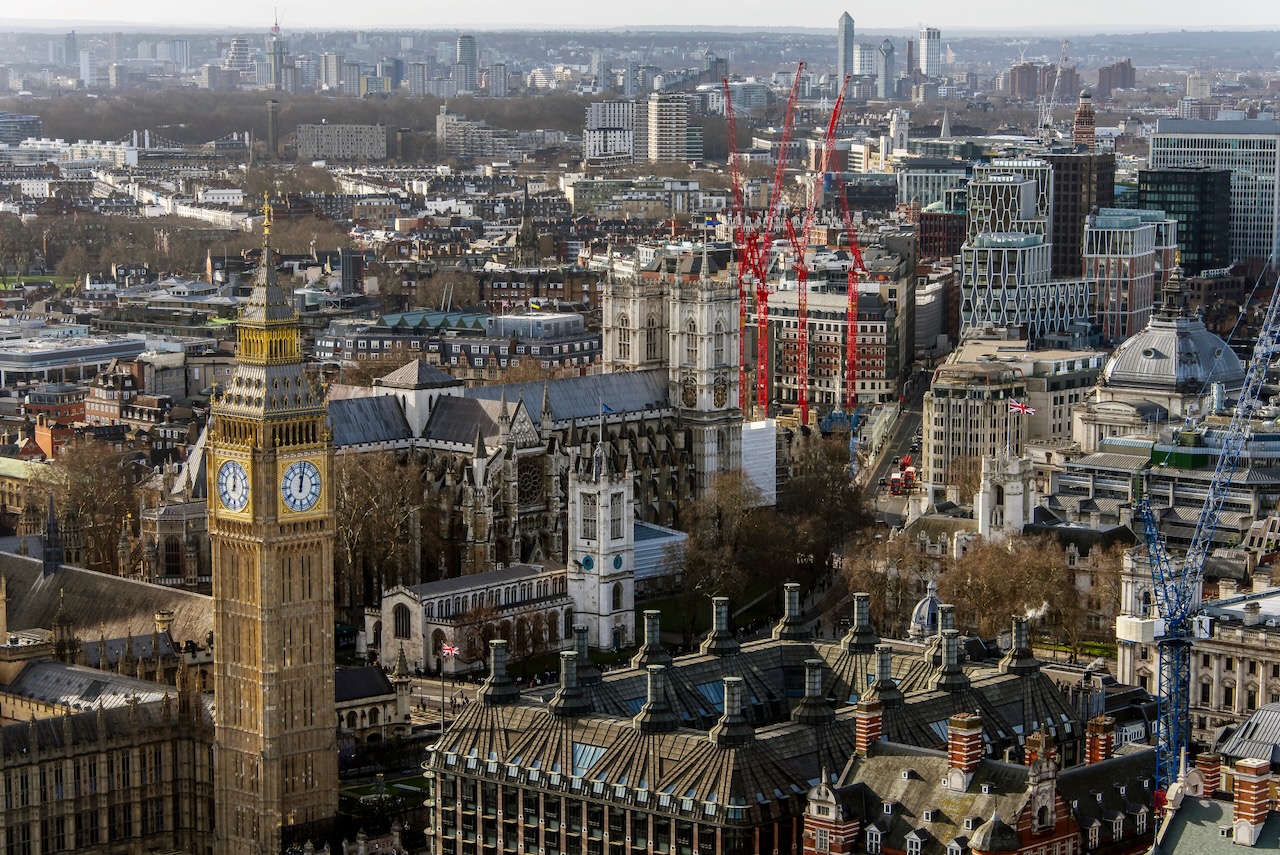
Large parts of the 1960s office block at 1 Victoria Street are being retained. That cut the carbon cost of new piling. It forced the cranes to sit on foundations more than 60 years old.
Nine Wolff cranes serve the redevelopment in phases. Demolition contractor Keltbray used a Wolff 355 B luffing jib crane for the heavy lifts: excavators, tracked loaders, dumpers, structural steel. The compact luffing jib handled the tight site while handling awkward loads.
When construction began, Mace took over. Four more Wolff cranes went in at B2 level – one 166 B and three 355 Bs. They supported the slipforming process for the concrete core. In slipforming the formwork moves continuously upward as concrete is poured almost without interruption. Timing, material flow and crane availability become critical.
The installation sequence in the basement tested coordination. The demolition crane stayed longer than planned. One of the 355 Bs was erected at a reduced height until the demolition crane was removed. Then it climbed to its full working height of 50 metres.
The biggest engineering challenge was reusing the original foundations without re-piling. Each crane had to sit directly over the existing foundation support points. The building's structural layout dictated where each crane and its support points could go. Free positioning was impossible. Conventional anchoring into purpose-built concrete foundations – standard on new builds – was off the table.
Wolffkran solved it with a cross-frame system. Each of the four support legs can be individually adjusted, with lengths ranging from six to ten metres. The whole crane tower was rotated to align with the support points in the original foundation. For TC2, the constraints were extreme: four different leg lengths were required within a single cross-frame base to hit the correct alignment.
One of the most demanding phases is still ahead: dismantling the cranes inside the basement. The basement slabs will be cast extremely close to the towers. The cross-frame and ballast will eventually become almost fully enclosed by the building. Headroom and working space below ground will be very limited.
Conventional mobile cranes won't work in those conditions. Wolffkran will use ceiling hoists, low-level forklifts and skating systems to remove the central ballast blocks and cross-frame in a controlled sequence. All components will be transported out of the building from below.
The next major phase arrives in late 2026. The crane configuration moves to the roof. Two 355 Bs and two 630 B luffing jib cranes will handle lifts for the upper floors, the façade installation and building services.
Wolffkran says the project ranks among the most technically demanding crane operations in central London. The constrained urban environment and the unusual crane installation on existing foundations drove the complexity. Completion is scheduled for early 2028.